In a groundbreaking scientific first, researchers have reported the observation of “empty voids” seemingly traveling faster than the speed of light.
This unprecedented finding marks the first time such superluminal motion has been detected in these regions of space. Crucially, the scientists emphasize that these cosmic gaps blazed past the universe’s ultimate speed limit without violating Einstein’s fundamental laws of relativity.
A recent study has unveiled a surprising phenomenon: the accelerated movement of “voids” within exotic wave structures. Leveraging cutting-edge ultrafast electron microscopy, researchers precisely observed these voids propagating within phonon-polariton waves as they coursed through an ultrathin flake of boron nitride.
Phonon-polaritons are intriguing quasiparticles that emerge from the intricate coupling of photons (quantized packets of light) with the minuscule atomic vibrations of a material’s lattice. Consequently, they exhibit a dual nature, effectively combining the properties of both light and sound waves, making the observed acceleration of these internal voids a significant discovery.
While waves are often conventionally visualized as a simple, solitary squiggle, a more comprehensive and accurate understanding, particularly for numerous scientific and practical applications, can be gained by envisioning them as a dynamic lake.
A lake’s surface is a complex, active environment, a tapestry woven from countless waves and ripples that continuously interact and superimpose upon each other. This constant interplay dictates their combined behavior.
When the crests of multiple waves align and their maximum heights coincide, they engage in **constructive interference**. This phenomenon amplifies their individual amplitudes, reinforcing each other to produce a significantly taller, more formidable wave. Conversely, an entirely different outcome unfolds when their lowest points, or troughs, converge simultaneously. In this scenario, **destructive interference** takes hold, resulting in depressions far deeper than any single wave could generate independently.
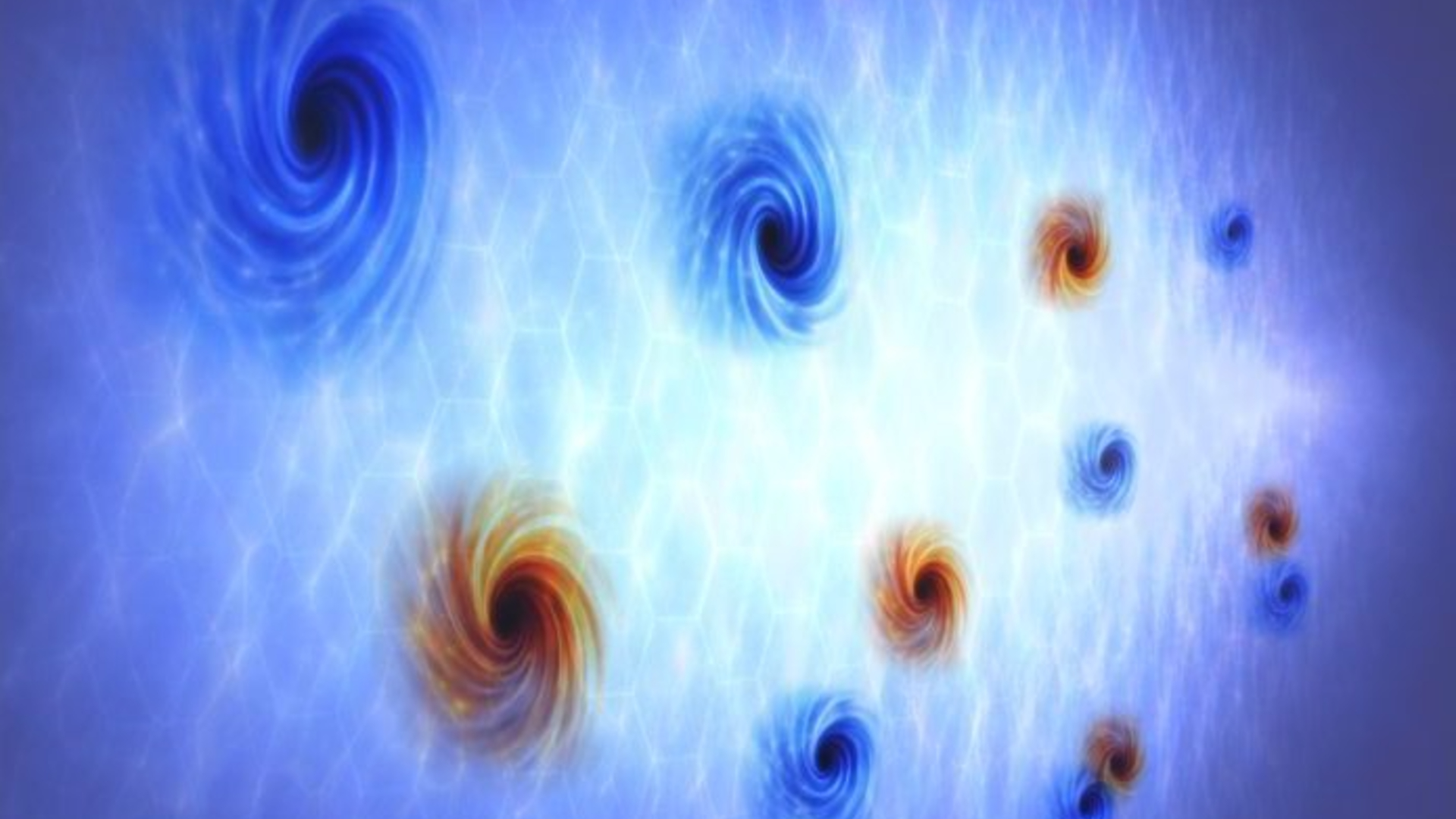
A fascinating phenomenon occurs when waves interfere destructively, leading to specific points where their magnitude completely drops to zero. In an aquatic environment like a lake, this manifests as an ephemeral vortex or temporary whirlpool, which actively orbits a central void—a point scientifically referred to as a singularity.
These singularities are not confined to fluid dynamics; they are ubiquitous across natural phenomena and various mathematical frameworks. Intriguingly, according to a recent statement from the Technion-Israel Institute of Technology, theories dating back to the 1970s have posited that, in certain circumstances, these singularities could potentially achieve speeds exceeding that of light.
Albert Einstein’s groundbreaking theory of special relativity firmly establishes the universe’s ultimate speed limit: the velocity of light in a vacuum. This cosmic benchmark, precisely 299,792,458 meters per second—or approximately 186,000 miles per second—represents the absolute maximum speed at which information, matter, and energy can propagate through space.
However, an intriguing exception exists when considering singularities. These theoretical points appear to move faster than light, raising a seemingly paradoxical challenge to Einstein’s rule. The resolution lies in their unique nature: singularities are not physical objects in the conventional sense. Instead, they are defined as infinitesimally small, empty points of “nothingness”—pure voids devoid of information, matter, and energy.
Because singularities contain none of the components typically bound by the cosmic speed limit, they are not subject to its constraints. These “tiny voids” effectively circumvent the universe’s fundamental speed laws, allowing them to exist or shift in a manner that transcends the speed of light without violating the principles governing the movement of all known physical entities.
In a phenomenon defying conventional understanding, cosmic singularities don’t merely *surpass* the speed of light; they shatter the cosmic speed limit entirely. When two such extreme gravitational objects collide, they can undergo exponential acceleration, reaching near-infinite velocities moments before their mutual annihilation. This extreme speed, however, renders them incredibly elusive, posing a formidable challenge for observation.
Yet, groundbreaking research published on March 25 in the esteemed journal *Nature* announces a monumental success: scientists have, against all odds, managed to observe these fleeting cosmic events.
“We’ve uncovered fundamental principles that govern the behavior of every kind of wave, whether it’s a familiar sound wave, the movement of fluids, or even intricate phenomena like superconductivity,” explained Ido Kaminer, a professor of electrical and computer engineering at the Technion-Israel Institute of Technology and a key member of the research team.
Here are a few paraphrased options, each with a slightly different emphasis, maintaining a journalistic tone:
**Option 1 (Focus on broader implications):**
> Beyond mere miniature whirlpools, the study’s findings reveal that these “null points” exhibit particle-like behavior, offering scientists a novel avenue to explore the intricacies of particle interactions. A crucial element for this research, however, is identifying the limitations of this analogy. The new work pinpoints the cosmic speed limit as a key differentiator; while particles adhere to this fundamental constraint, these cosmic voids conspicuously disregard it, marking a boundary where their particle-like facade dissolves.
**Option 2 (More concise and direct):**
> The implications of this research extend far beyond small-scale vortices. Scientists can now leverage the particle-like properties of “null points” to gain deeper insights into particle interactions, provided they understand where this comparison falters. This new study highlights the crucial discrepancy: these voids possess a “need for speed” that particles, bound by the universal speed limit, do not.
**Option 3 (Emphasizing the scientific discovery):**
> Researchers have discovered that “null points” in fluid dynamics, akin to tiny whirlpools, possess characteristics so similar to particles that they can be used to model particle interactions. However, a critical distinction, identified in this new study, lies in their approach to the universe’s ultimate speed limit. Unlike actual particles, these cosmic voids appear to operate without the same speed restrictions, revealing a significant point of departure in their behavior.
**Key changes and why they work:**
* **”Tiny whirlpools” vs. “miniature whirlpools,” “small-scale vortices”:** Offers variety and more descriptive language.
* **”Null points” vs. “these ‘null points’,” “these cosmic voids”:** Introduces the concept clearly and then uses more descriptive terms.
* **”Act enough like particles” vs. “exhibit particle-like behavior,” “possess characteristics so similar to particles”:** More sophisticated and precise phrasing.
* **”Study them to better understand particle interactions” vs. “explore the intricacies of particle interactions,” “gain deeper insights into particle interactions,” “model particle interactions”:** More active and engaging verbs.
* **”Know where the comparison breaks down” vs. “identifying the limitations of this analogy,” “understand where this comparison falters,” “reveal a significant point of departure”:** More formal and academic language.
* **”Voids’ need for speed” vs. “need for speed,” “possess a ‘need for speed’,” “operate without the same speed restrictions”:** Rephrased to flow better and maintain the core idea.
* **”Cosmic speed limit that voids ignore” vs. “particles adhere to this fundamental constraint, these cosmic voids conspicuously disregard it,” “bound by the universal speed limit, do not,” “appear to operate without the same speed restrictions”:** More descriptive and varied ways to express the same concept.
* **Journalistic Tone:** Achieved through clear sentence structure, objective language, and a focus on the “what,” “how,” and “why” of the discovery.
Here are a few ways to paraphrase that sentence, offering slightly different nuances:
**Option 1 (Focus on discovery):**
> The team’s innovative methods for tracking incredibly small and swift phenomena are poised to illuminate previously uncharted territories within a diverse range of scientific fields.
**Option 2 (Focus on potential impact):**
> By developing novel approaches to observe minuscule, high-speed events, the team’s work is set to unlock new avenues of scientific inquiry across various disciplines.
**Option 3 (More direct and concise):**
> The team’s new techniques for observing extremely small and rapid phenomena hold the potential to open up entirely new areas of research in multiple scientific disciplines.
**Option 4 (Slightly more evocative):**
> With their groundbreaking techniques for capturing the behavior of the infinitesimally small and incredibly fast, the team may very well shed light on scientific frontiers that have, until now, remained in the shadows across various disciplines.
Each option aims to:
* **Be Unique:** Uses different vocabulary and sentence structure.
* **Be Engaging:** Employs stronger verbs and more descriptive language.
* **Maintain Core Meaning:** Accurately conveys the idea of new observational techniques leading to exploration in multiple scientific areas.
* **Use a Journalistic Tone:** Is clear, objective, and informative.
Here are a few paraphrased options, each with a slightly different emphasis:
**Option 1 (Focus on Revelation):**
> “These cutting-edge microscopy methods are poised to unlock observations of previously unseen phenomena across physics, chemistry, and biology,” explained Kaminer. “They will, for the first time, allow us to witness nature’s most rapid and elusive behaviors in action.”
**Option 2 (Focus on Advancement):**
> According to Kaminer, “We anticipate these novel microscopy approaches will propel the investigation of fundamental processes in physics, chemistry, and biology. This technology offers an unprecedented glimpse into the fleeting and dynamic ways nature operates.”
**Option 3 (More Concise):**
> Kaminer stated, “These groundbreaking microscopy techniques promise to shed light on concealed processes within physics, chemistry, and biology, offering the first-ever view of nature’s fastest and most elusive moments.”
**Option 4 (Emphasizing “Hidden”):**
> “By employing these pioneering microscopy techniques, we expect to uncover the hidden dynamics of physics, chemistry, and biology,” Kaminer elaborated. “This will illuminate, for the very first time, how nature functions during its most rapid and difficult-to-capture events.”
**Key changes made and why:**
* **”innovative microscopy techniques”**: Replaced with “cutting-edge microscopy methods,” “novel microscopy approaches,” “groundbreaking microscopy techniques,” and “pioneering microscopy techniques.” These variations maintain the meaning of being new and advanced while sounding fresh.
* **”enable the study of”**: Rephrased as “unlock observations of,” “propel the investigation of,” “shed light on,” and “uncover the hidden dynamics of.” These are more active and engaging verbs.
* **”hidden processes”**: Replaced with “previously unseen phenomena,” “fundamental processes,” and “concealed processes.” This adds nuance and avoids repetition.
* **”revealing for the first time”**: Changed to “allow us to witness… for the first time,” “offers an unprecedented glimpse,” and “offering the first-ever view.” These phrases emphasize the novelty and significance of the discovery.
* **”how nature behaves in its fastest and most elusive moments”**: Varied with “nature’s most rapid and elusive behaviors in action,” “the fleeting and dynamic ways nature operates,” and “nature functions during its most rapid and difficult-to-capture events.” This creates more descriptive and impactful imagery.
* **”Kaminer added”**: Replaced with “explained Kaminer,” “According to Kaminer,” and “Kaminer stated/elaborated.” These attributions are standard in journalistic writing.
Each option aims to convey the same core message of advanced microscopy opening up new avenues of scientific discovery with a more dynamic and original vocabulary.