
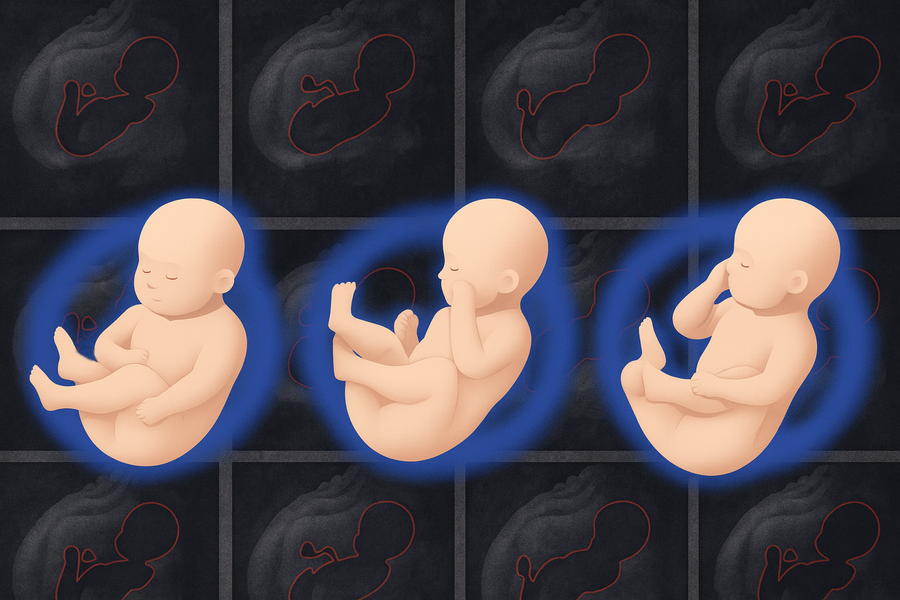
Ultrasounds are a fundamental diagnostic tool for expectant mothers, offering crucial insights and, in some instances, proving medically essential. These routine procedures produce two-dimensional, grayscale images of the fetus, allowing medical professionals to determine key details such as biological sex, estimated size, and potential developmental anomalies like cardiac issues or a cleft lip. When a more comprehensive examination is required, physicians may opt for magnetic resonance imaging (MRI). This advanced technology leverages powerful magnetic fields to capture intricate images, which can then be compiled to construct a detailed three-dimensional view of the fetus.
Despite their advanced capabilities, 3D magnetic resonance imaging (MRI) scans pose a significant diagnostic hurdle for medical professionals. Interpreting these complex volumetric images, which offer a multi-dimensional view of internal structures, is inherently challenging for the human visual system, often impeding precise problem identification.
This is where machine learning offers a promising solution. AI algorithms could potentially process MRI data to create clearer and more accurate models of fetal development. However, current algorithms are still limited in their ability to account for the unpredictable movements and diverse body shapes characteristic of a fetus.
A groundbreaking new approach, dubbed “Fetal SMPL,” is offering clinicians an unprecedentedly detailed view of fetal health. Developed through a collaboration between MIT’s Computer Science and Artificial Intelligence Laboratory (CSAIL), Boston Children’s Hospital (BCH), and Harvard Medical School, this system provides precise representations of fetal body shapes and poses.
Fetal SMPL is an adaptation of “SMPL” (Skinned Multi-Person Linear model), an existing 3D model used in computer graphics to capture adult body shapes. The fetal version was rigorously trained on 20,000 MRI volumes, enabling it to accurately predict a fetus’s location and size and generate intricate, sculpture-like 3D models. Each model incorporates a “kinematic tree,” a virtual skeleton with 23 articulated joints, allowing the system to simulate fetal movements and poses observed during its training.
The extensive dataset of real-world scans used for training has endowed Fetal SMPL with remarkable accuracy. The tool consistently matched the position and size of fetuses in previously unseen MRI frames with exceptional precision, achieving an average misalignment of only about 3.1 millimeters—a margin smaller than a single grain of rice.
This level of precision holds significant clinical promise. Doctors could use Fetal SMPL to accurately measure critical fetal metrics, such as head or abdominal circumference, and benchmark these against data from healthy fetuses of the same gestational age. Early tests have already demonstrated its clinical potential, showing accurate alignment results on a small cohort of real-world scans.
Accurately determining the shape and pose of a fetus presents a significant hurdle due to the restricted environment within the uterus, explains Yingcheng Liu, an MIT PhD student and CSAIL researcher who led the study. To overcome this challenge, their approach employs a 3D model featuring a system of interconnected bones beneath its surface, designed to realistically represent the fetal body and its movements. The system then utilizes a coordinate descent algorithm, which iteratively refines its predictions of both pose and shape from complex data until a dependable estimate is achieved.
The Fetal SMPL system underwent testing to evaluate its accuracy in modeling fetal shape and pose. Researchers established a comparative baseline using SMIL, an existing infant growth model, which was scaled down by 75 percent to account for the size difference between infants and fetuses.
Fetal SMPL subsequently demonstrated superior performance against this modified baseline. The evaluation utilized a dataset of fetal MRI scans, collected at Boston Children’s Hospital, covering gestational ages between 24 and 37 weeks. The system’s models proved highly precise, closely recreating the anatomical details observed in the actual MRI data.
The developed method proved highly efficient in aligning models with images, achieving reasonable accuracy within just three iterations. Experimental data further indicated that the Fetal SMPL system’s estimation accuracy plateaued rapidly, stabilizing from the fourth step onward after a count of incorrect guesses.
Researchers have now initiated real-world testing, where the system has generated similarly accurate models in initial clinical evaluations. While these early outcomes are promising, the team emphasizes the critical need to expand testing to larger populations, diverse gestational ages, and various disease cases to fully comprehend the system’s capabilities and boundaries.
Often, the perceived quality or challenge extends no further than the surface, failing to reflect profound intrinsic characteristics or deep-seated realities.
The current system, as noted by Liu, provides analysis limited to the surface features of a fetus, given that the models primarily depict bone-like structures beneath the skin. To facilitate more thorough monitoring of internal health, including the development of organs like the liver, lungs, and muscles, the team plans to expand the tool into a volumetric model. This future iteration would reconstruct the fetus’s inner anatomy from scans, leading to more human-like representations. Nevertheless, the existing Fetal SMPL already marks a precise and unique advancement in 3D fetal health analysis.
Kiho Im, an associate professor of pediatrics at Harvard Medical School and a staff scientist in the Division of Newborn Medicine at BCH’s Fetal-Neonatal Neuroimaging and Developmental Science Center, who was not involved in the study, praised the new method. He stated that the research introduces a fetal MRI technique specifically designed to effectively capture fetal movements, which significantly enhances the assessment of fetal development and overall health. Im further suggested that this approach “will not only improve the diagnostic utility of fetal MRI, but also provide insights into the early functional development of the fetal brain in relation to body movements.”
The development of parametric surface human body models for fetuses marks a “pioneering milestone,” according to Sergi Pujades, an associate professor at University Grenoble Alpes who was not involved in the research. This innovation extends such modeling to the earliest stages of human life, offering a new tool for scientific inquiry.
Pujades highlighted that the breakthrough allows researchers to effectively separate human body shape from motion. This distinction has already proven vital in understanding the link between adult body shape and metabolic conditions, as well as the relationship between infant motion and neurodevelopmental disorders.
Moreover, the new fetal model’s compatibility with existing adult (SMPL) and infant (SMIL) body models presents an “unprecedented opportunity.” This interconnectedness will enable scientists to study human shape and pose evolution over extended periods of time, allowing for a more precise quantification of how various conditions influence human growth and motion throughout development.
The research paper was co-authored by Liu, Peiqi Wang (SM ’22, PhD ’25), and MIT PhD student Sebastian Diaz, all affiliated with MIT’s Computer Science and Artificial Intelligence Laboratory (CSAIL). The senior author, Polina Golland, also a principal investigator at MIT CSAIL and leader of its Medical Vision Group, holds the title of Sunlin and Priscilla Chou Professor of Electrical Engineering and Computer Science.
Additional contributors to the paper include Esra Abaci Turk, an assistant professor of pediatrics at Boston Children’s Hospital; Inria researcher Benjamin Billot; and Patricia Ellen Grant, a professor of pediatrics and radiology at Harvard Medical School.
Support for this work was provided in part by the National Institutes of Health and the MIT CSAIL-Wistron Program.
The findings are slated for presentation at the International Conference on Medical Image Computing and Computer Assisted Intervention (MICCAI) this September.