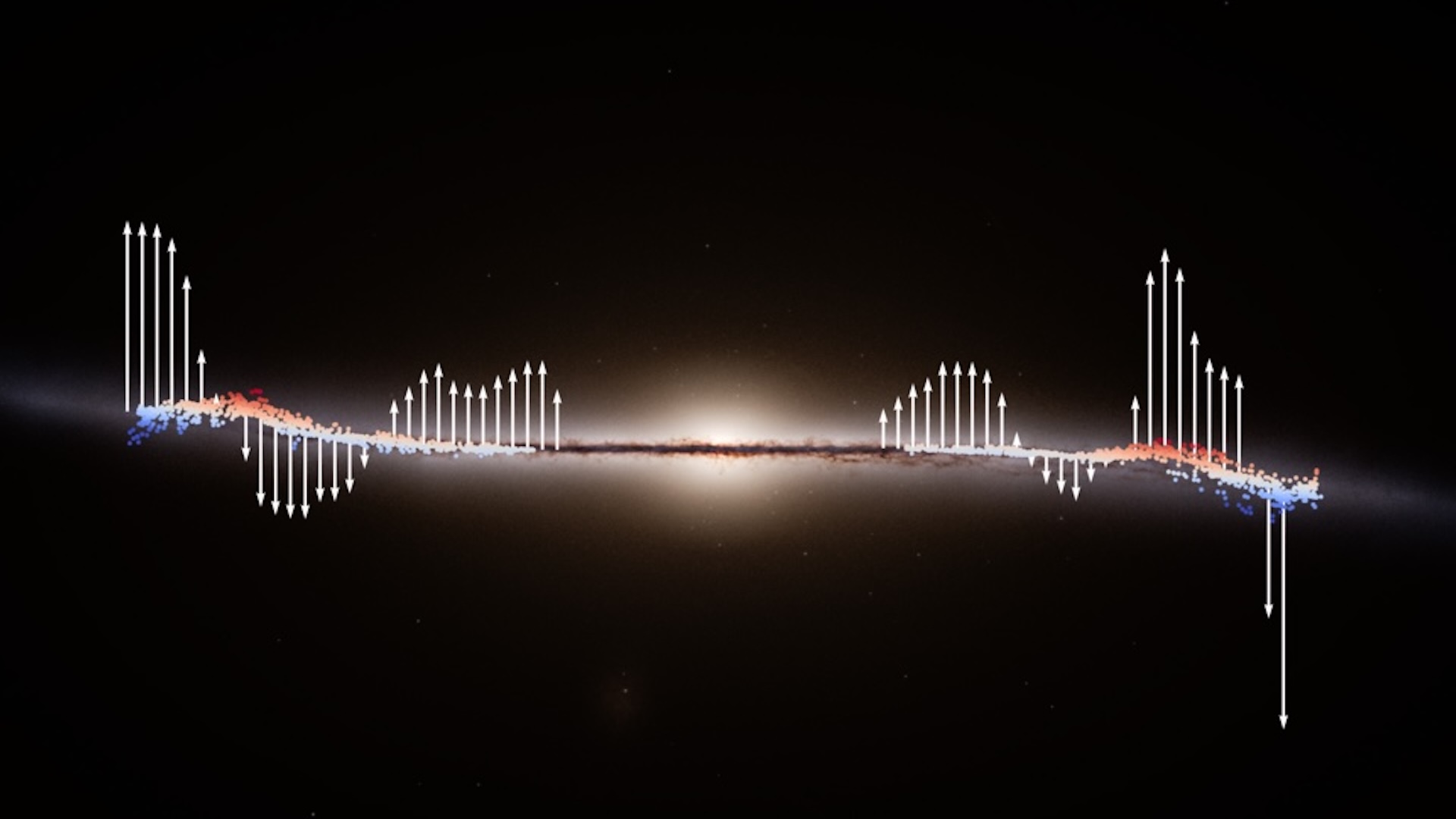
A groundbreaking new study has revealed that a colossal “wave” is currently propagating across our galaxy, influencing the motion of billions of stars in its path.
Scientists have pinpointed a significant galactic wave rippling through the Milky Way, a finding derived from the comprehensive mapping data gathered by the European Space Agency’s (ESA) Gaia space telescope. Before its retirement earlier this year, Gaia meticulously recorded the precise positions and intricate movement patterns of millions of stars, providing an unparalleled dataset for such astronomical discoveries.
A monumental wave is significantly shaping a vast region of the Milky Way, according to statements from ESA officials. Its profound impact extends to stars located between 30,000 and 65,000 light-years from the galaxy’s central hub. This affected zone represents a considerable segment of our home galaxy, which spans an estimated 100,000 light-years in diameter.
The precise origins of the observed celestial motion remain a subject of ongoing inquiry for astronomers. Officials from the European Space Agency (ESA) have put forth a leading hypothesis: a past collision with a smaller dwarf galaxy may have instigated the substantial disturbance. Nevertheless, further extensive investigation is deemed necessary to conclusively answer this fundamental question.
The journal Astronomy & Astrophysics unveiled the findings on July 14.
Throughout its nearly twelve-year mission, the Gaia spacecraft meticulously charted the velocities and paths of countless stars. In 2020, the observatory revealed a surprising discovery: the Milky Way’s disk actually wobbles, much like a spinning top. Researchers precisely mapped this newfound galactic wave by tracking the positions and movements of both young, giant stars and a class of pulsating stars known as Cepheids, which are characterized by their predictable yet variable brightness.
The synchronized movement of young giant stars and Cepheids with a galactic wave has led ESA officials to propose that gas within the disc might also be influenced by this large-scale ripple. Scientists hypothesize that nascent stars could retain an imprint of this wave’s information, inherited directly from the gas clouds where they originated.
European Space Agency (ESA) officials have drawn a vivid parallel, likening the observed galactic wave to the familiar stadium spectacle known as “the Wave.” They explained that just as spectators sequentially rise from their seats, extend their arms, and then sit back down as this collective movement sweeps section by section across a stadium, the galactic wave operates on a similar principle of sequential, coordinated motion.
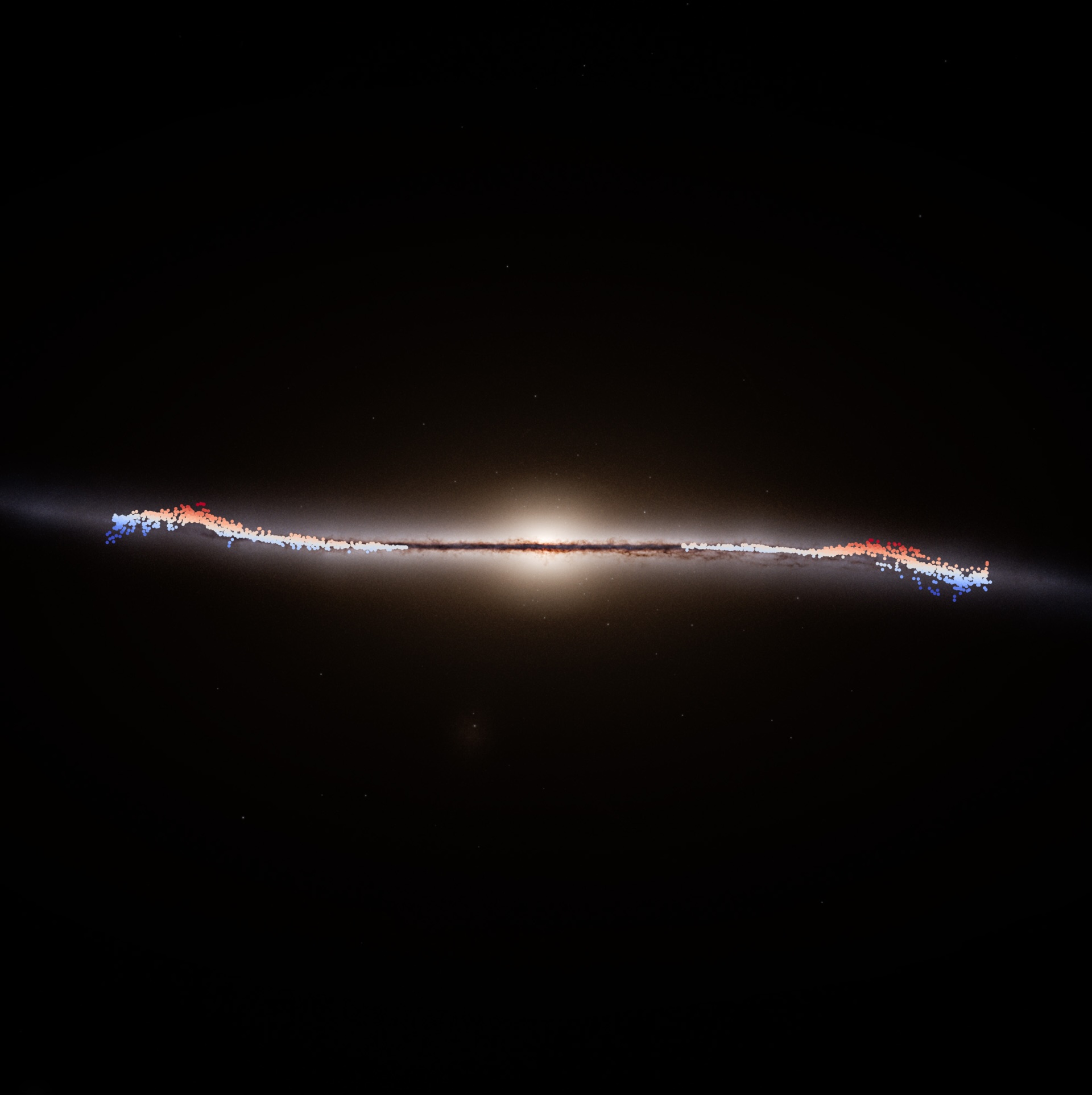
When viewed from an edge-on perspective, our Milky Way galaxy displays a distinctive wave-like motion. These vertical dynamics manifest as ripples, extending broadly across the vast expanse of the galactic disk.
The observed phenomenon aligns precisely with the expected characteristics of a wave, according to Eloisa Poggio, an astronomer and lead author at Italy’s National Institute of Astrophysics.
A newly identified cosmic wave may be linked to the Radcliffe Wave, a significantly smaller ripple already documented within the Milky Way. This known structure, the Radcliffe Wave, is located approximately 500 light-years from the sun and spans an impressive 9,000 light-years across space.
The Radcliffe Wave, a considerably smaller filament, is situated in a distinct sector of the galaxy’s disc, separating it from the wave studied by his team, Poggio explained. He added that the potential connection between the two waves remains uncertain, prompting a desire for further research to clarify any relationship.