
Earlier this month, Donald Trump and Sir Keir Starmer unveiled an agreement they termed a “new tech prosperity deal,” asserting it would generate £150 billion in investment for the nation.
A significant portion of the capital is designated for investment in the Artificial Intelligence (AI), computing, and data centre sectors, leveraging the Thames Valley’s established specialization in these key technological fields.
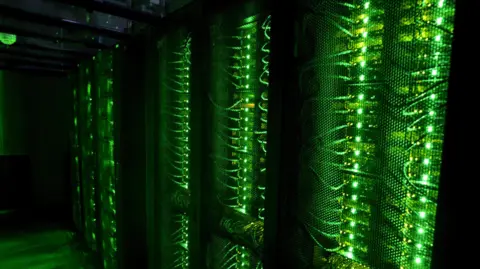
More than thirty data centers operate within Slough, solidifying its status as a key digital hub.
Industry experts are championing the Thames Valley as a prime candidate for a significant share of a new £150 billion tech deal funding package. While the precise allocation for the region is yet to be determined, there is a strong consensus that it should be prioritized for these substantial investments.

Data centers are the critical infrastructure underpinning modern existence.
Data centers constitute an “absolutely critical” backbone of the digital economy, according to Andrew Pilsworth, Managing Director for Data Centres and Strategic Partnerships at SEGRO. Pilsworth, representing the company that operates Slough Trading Estate—one of Europe’s most significant sites—explained that every online action in our digital lives ultimately transits through such a facility. This fundamental reliance, he noted, makes data centers pivotal to the digital growth agenda pursued by the government.
The expanding data center industry offers significant advantages to the entire Slough community, primarily by generating employment. This includes roles during the initial construction phases, followed by the creation of high-quality, high-value positions for professionals such as mechanical and software engineers once these facilities are operational.
The precise allocation of the £150 billion in US investment, a figure the UK government claims to have secured, is unlikely to be known for an extended period, possibly stretching from months into years.
Microsoft, whose UK headquarters are located in Reading, has unveiled a landmark £22 billion spending package. This represents the technology giant’s largest-ever investment outside the United States and stands as the single most substantial financial commitment announced.
Microsoft CEO Satya Nadella has expressed his anticipation that significant investment in artificial intelligence will act as a primary driver for economic growth and enhanced productivity within the United Kingdom. Nadella underscored the company’s long-standing commitment to the UK, noting Microsoft’s continuous presence since 1982—a period spanning over four decades—during which it has consistently invested to deliver advanced technologies to customers nationwide.
The Thames Valley has firmly established itself as a leading destination, consistently attracting businesses in the burgeoning fields of artificial intelligence and computing.
The Thames Valley boasts a disproportionate concentration of artificial intelligence firms, according to economic data company The Data City. While the region accounts for only 1.6% of all companies nationwide, a significant four per cent of UK businesses specializing in AI are based there.
Chief Economist Paul Swinney attributes the appeal for cutting-edge companies to two main factors: a plentiful supply of high-skilled workers and strategic location. Swinney noted that the area provides an abundance of the specialized talent innovative businesses require, a draw further enhanced by its advantageous proximity to major transport hubs like Heathrow Airport and the city of London.
The swift evolution of Artificial Intelligence and other emerging technologies presents considerable challenges, necessitating an exceptionally nimble approach from the region and its workforce. A spokesperson emphasized the rapid pace of technological shifts, noting that while smartphone app development was a primary focus a decade ago, AI now holds that leading position.
The industrial landscape of the next decade remains unpredictable. Consequently, the primary challenge for regions like Reading and the wider Thames Valley is to consistently cultivate an environment attractive to whatever new sectors emerge.