The latest atmospheric insights are not originating from terrestrial centers in Dublin, London, or New York, but rather from the depths of deep space. Scientists are reportedly observing a solitary, sunless world whose auroras glow with a breathtaking intensity, far eclipsing Earth’s famous northern lights.
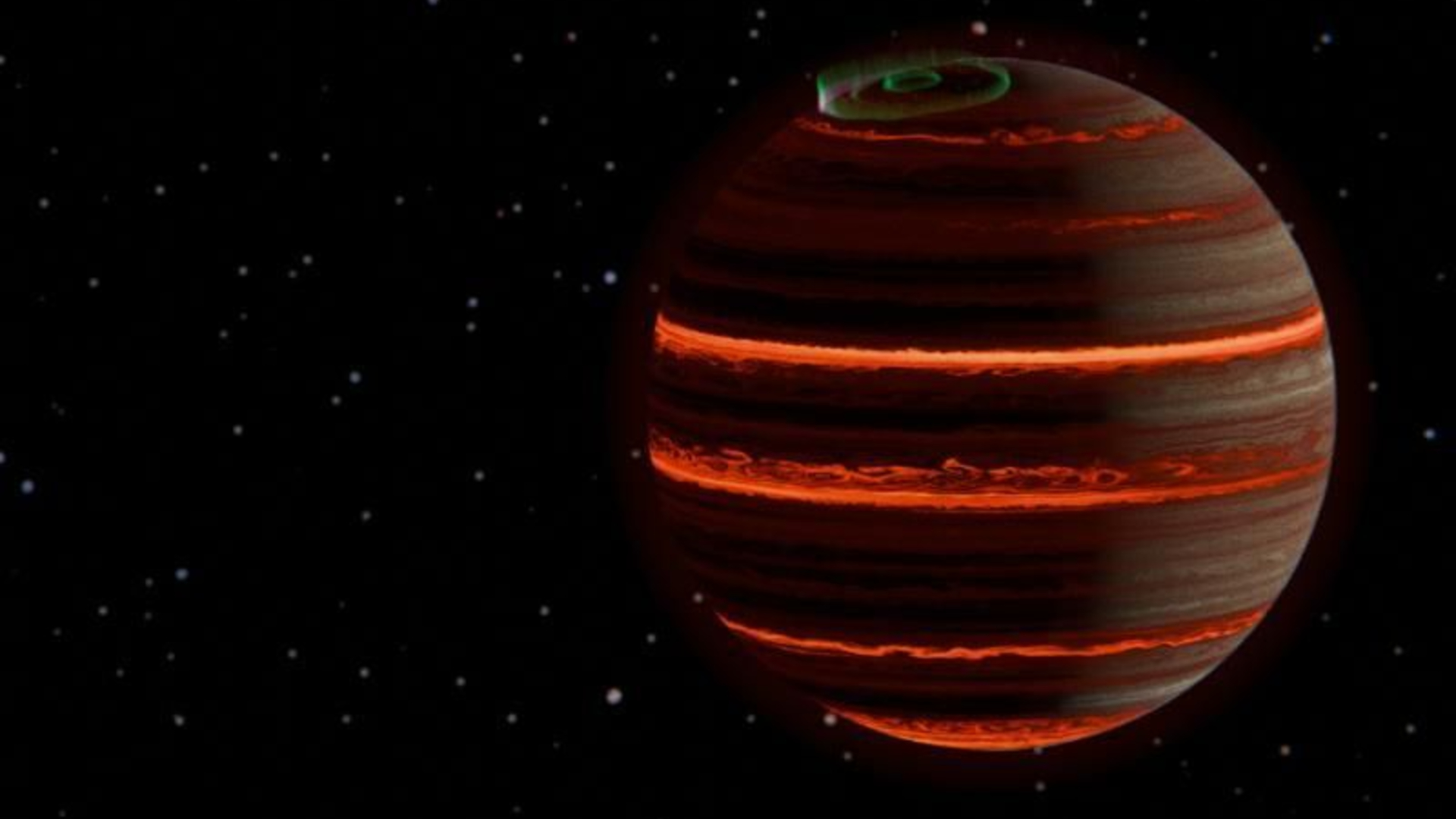
Designated SIMP-0136, this intriguing celestial body, approximately 200 million years old, resides about 20 light-years from Earth in the constellation Pisces. It defies easy categorization, being neither a fully-fledged planet nor a true star. Astronomers classify SIMP-0136 as a brown dwarf, a type of object often described as a “failed star.” Like conventional stars, it forms from collapsing clouds of gas. However, it never gathers sufficient mass to initiate and sustain hydrogen fusion within its core – the defining characteristic that powers luminous stars.
SIMP-0136 stands apart from Earth as a rogue world, navigating through space without the orbit of a sun. This peculiar celestial body spins on its axis once every two and a half hours. Leveraging the advanced capabilities of the James Webb Space Telescope (JWST), astronomers have now delivered the most comprehensive “weather report” yet for this drifting planet, meticulously charting the subtle atmospheric fluctuations observed across a full rotation.

A groundbreaking study, featured on September 26 in the journal *Astronomy & Astrophysics*, has achieved a first by tracking the atmospheric evolution of a brown dwarf as it spins. This pioneering research unveiled dynamic shifts in the celestial body’s temperature, chemical composition, and cloud formations. Scientists are heralding these findings as a significant step forward, providing unprecedented insights into the weather systems of worlds beyond our solar system.
The recent research has yielded some of the most precise atmospheric measurements recorded for an extra-solar object to date, critically marking the first direct observation of shifts in its atmospheric characteristics. This breakthrough was confirmed in a statement by Evert Nasedkin, the study’s lead author from Trinity College Dublin in Ireland.
Johanna Vos, a study co-author from Trinity College Dublin, emphasized that comprehending these weather processes will be pivotal for the ongoing discovery and characterization of exoworlds.
The James Webb Space Telescope’s precise instruments detected minute shifts in SIMP-0136’s brightness during its rotation, allowing scientists to meticulously map its atmospheric strata. Contrary to long-held astronomical suspicions that flickering light stemmed from fragmented clouds, the study unveiled a surprising stability in SIMP-0136’s clouds, which are composed of hot, sand-like silicate grains.
A significant atmospheric discovery unfolded at higher altitudes, where a research team identified a layer of air substantially warmer than scientific models had projected. This stratum registered temperatures approximately 570 degrees Fahrenheit (300 degrees Celsius) above predictions. The study attributes this unexpected heat primarily to the influence of auroras.
While Earth’s auroras captivate with their ethereal, shimmering lights, a phenomenon resulting from charged solar particles interacting with our planet’s magnetic field, the exoplanet SIMP-0136 exhibits a far more intense version. There, an exceptionally potent magnetic field dramatically amplifies this effect. Charged particles collide with the atmosphere so forcefully that they not only produce a brilliant glow but also inject significant energy into the air, consequently heating the world’s upper atmospheric layers.
The James Webb Space Telescope (JWST) observed subtle temperature fluctuations, registering less than 40 degrees Fahrenheit (5 degrees Celsius), within the planet’s deeper atmospheric layers. Scientists hypothesize that these minute thermal shifts may be caused by vast storm systems, potentially akin to Jupiter’s iconic Great Red Spot, traversing the surface as the world rotates.
Brown dwarfs, exemplified by objects like SIMP-0136, offer astronomers a unique research advantage. Unobscured by the glare of a parent star, these celestial bodies serve as ideal surrogates for the giant exoplanets found orbiting distant suns. By meticulously studying their intricate weather patterns, scientists are progressively piecing together a clearer understanding of how atmospheres behave on these faraway worlds.
Astronomers intend to deploy the James Webb Space Telescope and future observatories, including the Extremely Large Telescope and NASA’s proposed Habitable Worlds Observatory, to expand current investigative methods to exoplanets. This ambitious endeavor seeks to uncover and track how weather patterns and atmospheric conditions on worlds orbiting distant stars shift and evolve over time.
The full report on these findings was made public September 26, appearing in the journal *Astronomy and Astrophysics*.