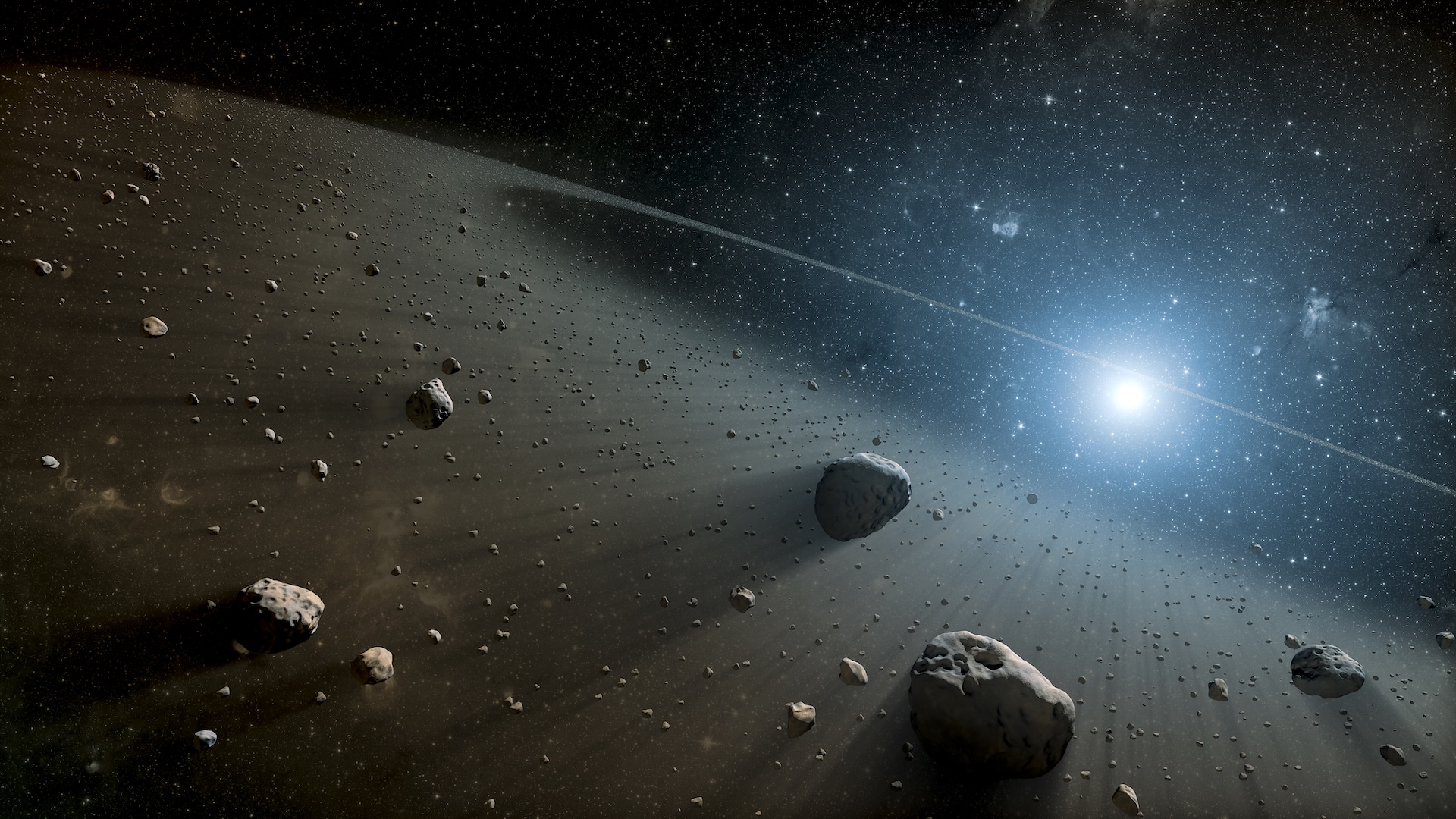
Orbiting between Mars and Jupiter, the asteroid belt is a vast accumulation of rocky material, widely hypothesized to be the undeveloped remnants of a planet. Roughly 4.6 billion years ago, during the formation of our Solar System, the raw matter in this region was expected to coalesce into a planetary body. However, the powerful gravitational forces exerted by Jupiter profoundly influenced the area, agitating it to such an extent that collisions among these nascent building blocks became destructive rather than constructive. What remains today is a widely dispersed collection of debris, collectively possessing only about 3% of the Moon’s total mass, scattered across millions of kilometers of space.
Jupiter’s immense gravitational pull, amplified by orbital interactions with Saturn and even Mars, plays a crucial role in shaping the asteroid belt. These gravitational resonances, specific regions where the orbital periods of asteroids align with those of the gas giants, significantly destabilize asteroid trajectories. As a result, countless asteroid fragments are either propelled inward towards the inner Solar System, including Earth’s vicinity, or flung outward towards Jupiter’s own orbital path. For those fragments that remain within the belt and evade escape, relentless mutual collisions gradually grind them down into fine meteoritic dust.
A team of astronomers, spearheaded by Julio Fernández of the Universidad de la República in Uruguay, has precisely determined the rate at which the asteroid belt’s material is depleting. Their research indicates that the asteroid belt is currently shedding approximately 0.0088% of the material actively engaged in collisions. Although this percentage may seem negligible, it represents a substantial loss of matter when considered across the immense timescales of the Solar System’s evolution.
The distribution of lost mass presents a compelling breakdown of its ultimate destinations. Approximately one-fifth of this material, about 20%, transforms into asteroids and meteoroids. These objects frequently intersect Earth’s orbital path, occasionally leading to spectacular atmospheric entries as meteors.
The predominant share, a significant 80%, is systematically pulverized through ongoing mutual collisions, resulting in fine meteoritic dust. This cosmic dust subsequently fuels the faint glow of the zodiacal light, observable in the night sky just after sunset or before sunrise.
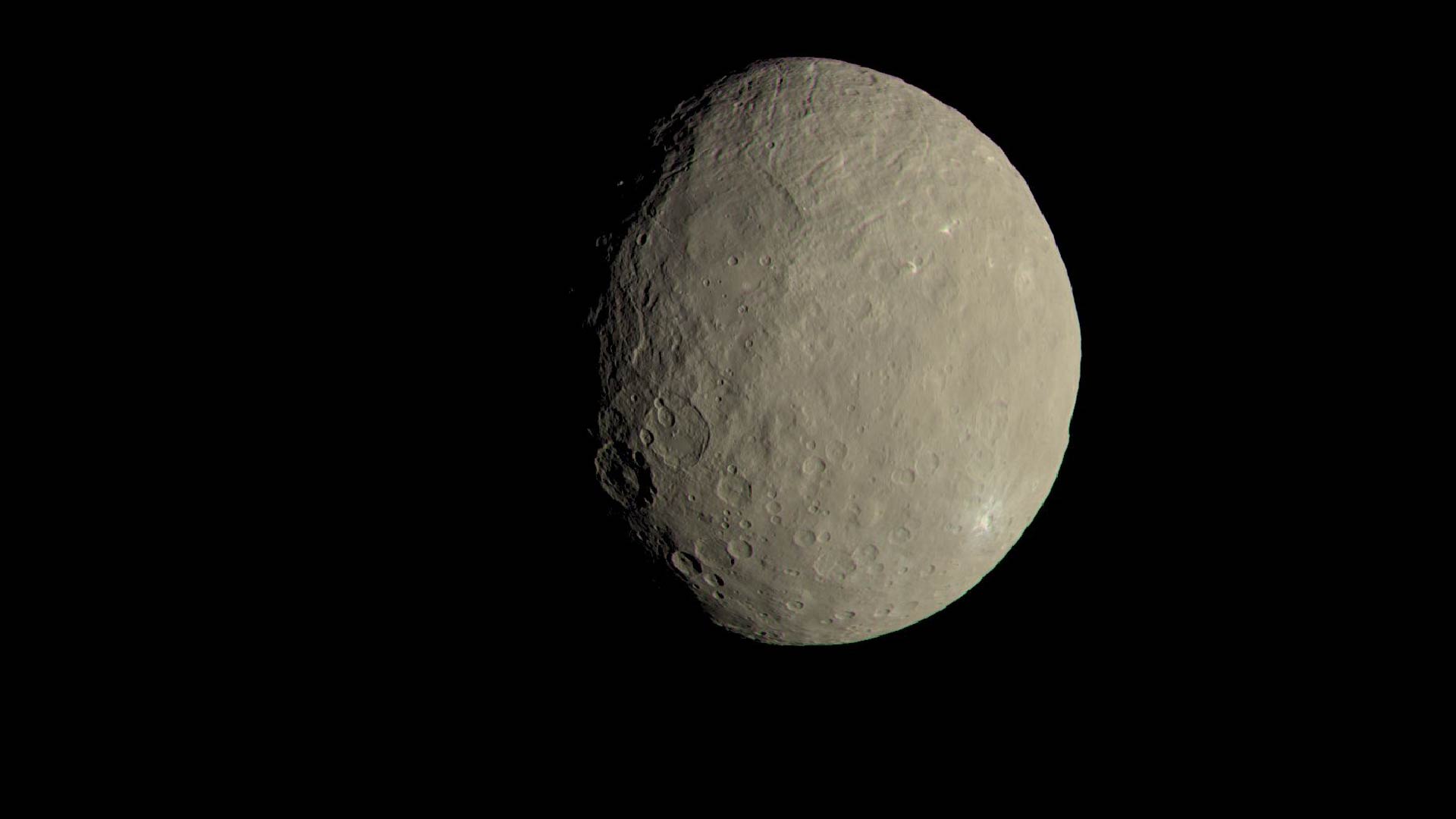
For accuracy, well-known major asteroids such as Ceres, Vesta, and Pallas were excluded from the investigation, as their enduring nature signifies they are no longer active participants in the process of material depletion under examination.
The ongoing depletion of the asteroid belt’s mass holds critical implications for Earth’s long-term evolution. Asteroids expelled from the belt do not merely dissipate; a significant number eventually migrate into the inner Solar System, where they become potential impact threats. Scientific research, by extrapolating current mass loss rates backward, suggests the asteroid belt could have been approximately 50% more massive around 3.5 billion years ago, experiencing a mass loss rate roughly twice as high. This theoretical model exhibits a strong correlation with geological evidence from both the Moon and Earth, which consistently demonstrates a declining rate of cosmic bombardment over the past several billion years.
New research challenges the traditional view of the asteroid belt as a static fixture in our Solar System. Instead, it reveals a dynamic structure that has progressively shed material over billions of years. Evidence from glass spherule layers embedded in Earth’s rock strata points to a more violent ancient past, when a substantially larger asteroid belt delivered a far greater number of rocky impacts to our planet.
Today, that intense bombardment has diminished to a steady trickle, mirroring the belt’s ongoing, slow depletion. Understanding this long-term process is critical. It not only aids in reconstructing the impact history that sculpted Earth’s surface but also provides vital data for modeling the future risk posed by Near-Earth Objects.
The original version of this article was published on Universe Today.