
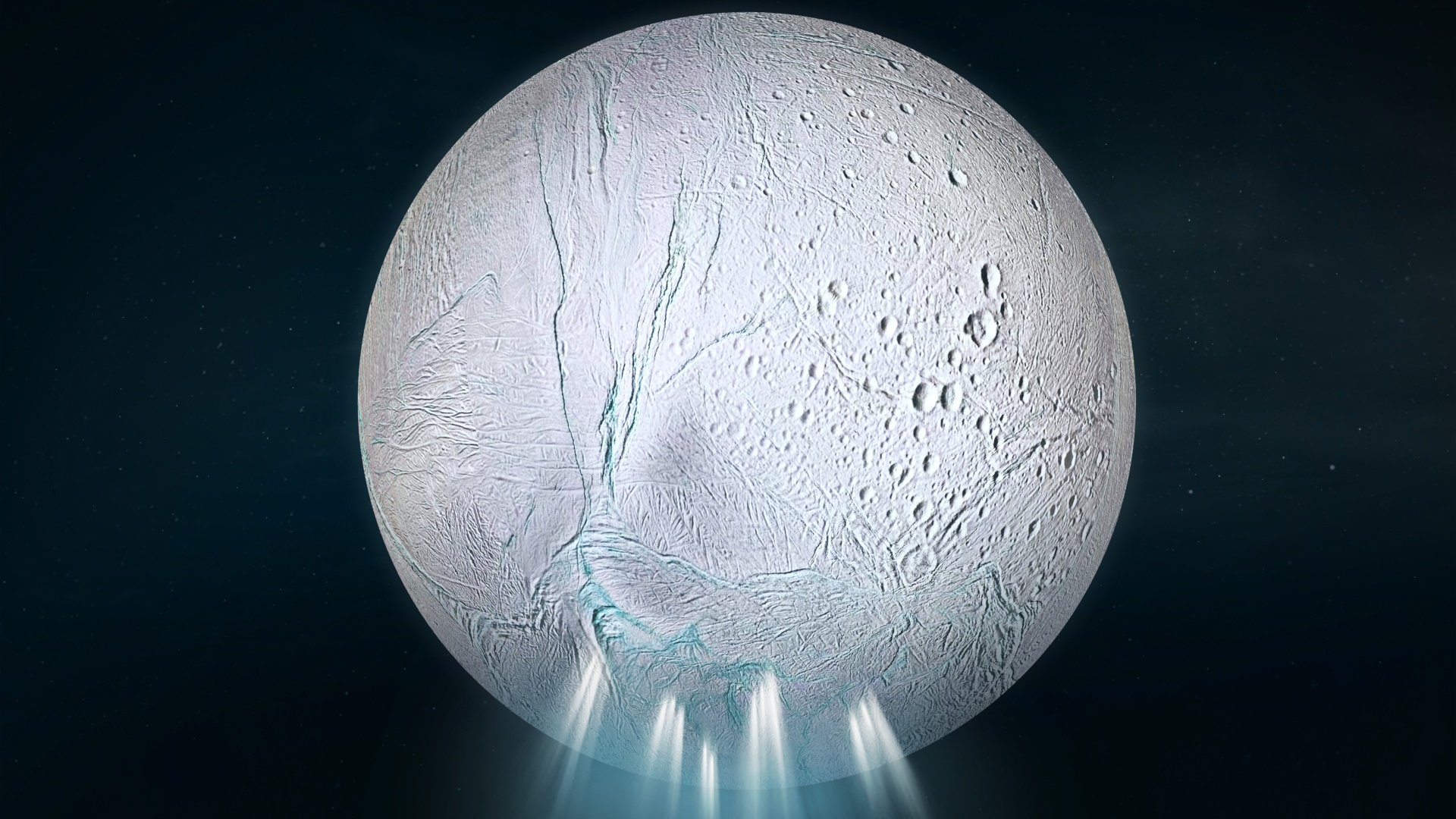
Complex organic molecules, considered vital precursors to the building blocks of life, have been identified within the watery geysers of Enceladus. This discovery comes nearly two decades after NASA’s Cassini spacecraft first collected samples from the Saturnian moon’s erupting plumes.
The Cassini spacecraft’s mission to Saturn concluded in 2017, yet scientists persistently uncover fresh insights from its extensive archive of data.
The identification of organic molecules, defined by their carbon content, significantly strengthens the argument for the icy moon Enceladus as a compelling subject for astrobiological research. This finding follows the 2005 revelation by the Cassini spacecraft, which detected plumes of water vapor erupting from massive fissures across Enceladus’ surface. These extensive cracks are thought to lead to a hidden subsurface ocean within the 310-mile-wide (500-kilometer-wide) Saturnian moon, providing the source for these dramatic geysers. While some of the material from these plumes descends back onto Enceladus as a fine snow, the majority dissipates into space, forming Saturn’s diffuse E-ring, which orbits the planet at a greater distance than most of its other ring structures.
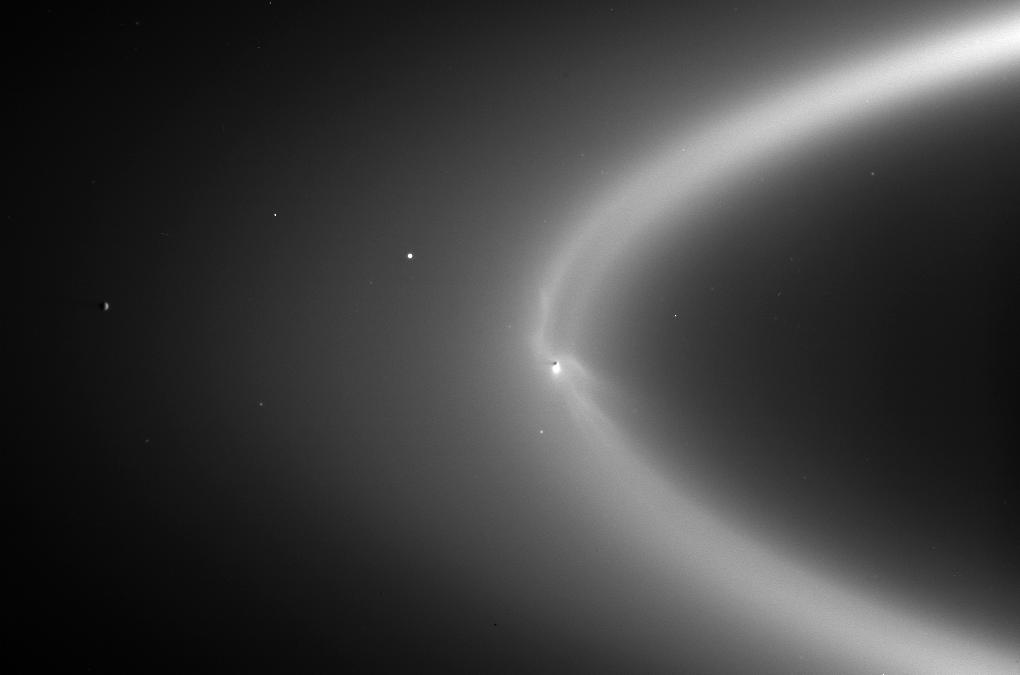
The Cassini spacecraft consistently gathered samples from Enceladus during its transit through Saturn’s E-ring, according to Nozair Khawaja, a scientist from Freie Universität Berlin and the University of Stuttgart. Researchers had previously identified a wealth of organic molecules within these ice grains, including crucial precursors for amino acids.
Scientific interpretations of data from Saturn’s E-ring have long been approached with caution. This ongoing skepticism arises from the relentless bombardment of the ring’s icy particles by charged particles trapped within Saturn’s magnetosphere, a process known to instigate significant chemical reactions. Consequently, a key ambiguity persisted: it was unclear whether the organic molecules observed in the E-ring originated from Enceladus’ subsurface ocean or were simply formed through these radiation-induced chemical transformations.
Cassini’s direct passes through several plumes prompted Khawaja to delve into 2008 archival data from the spacecraft’s Cosmic Dust Analyzer (CDA), an instrument spearheaded by scientists at the University of Stuttgart. Through a painstaking re-analysis of the CDA’s findings, Khawaja’s team uncovered evidence of organic molecules that had been missed in the initial examination.
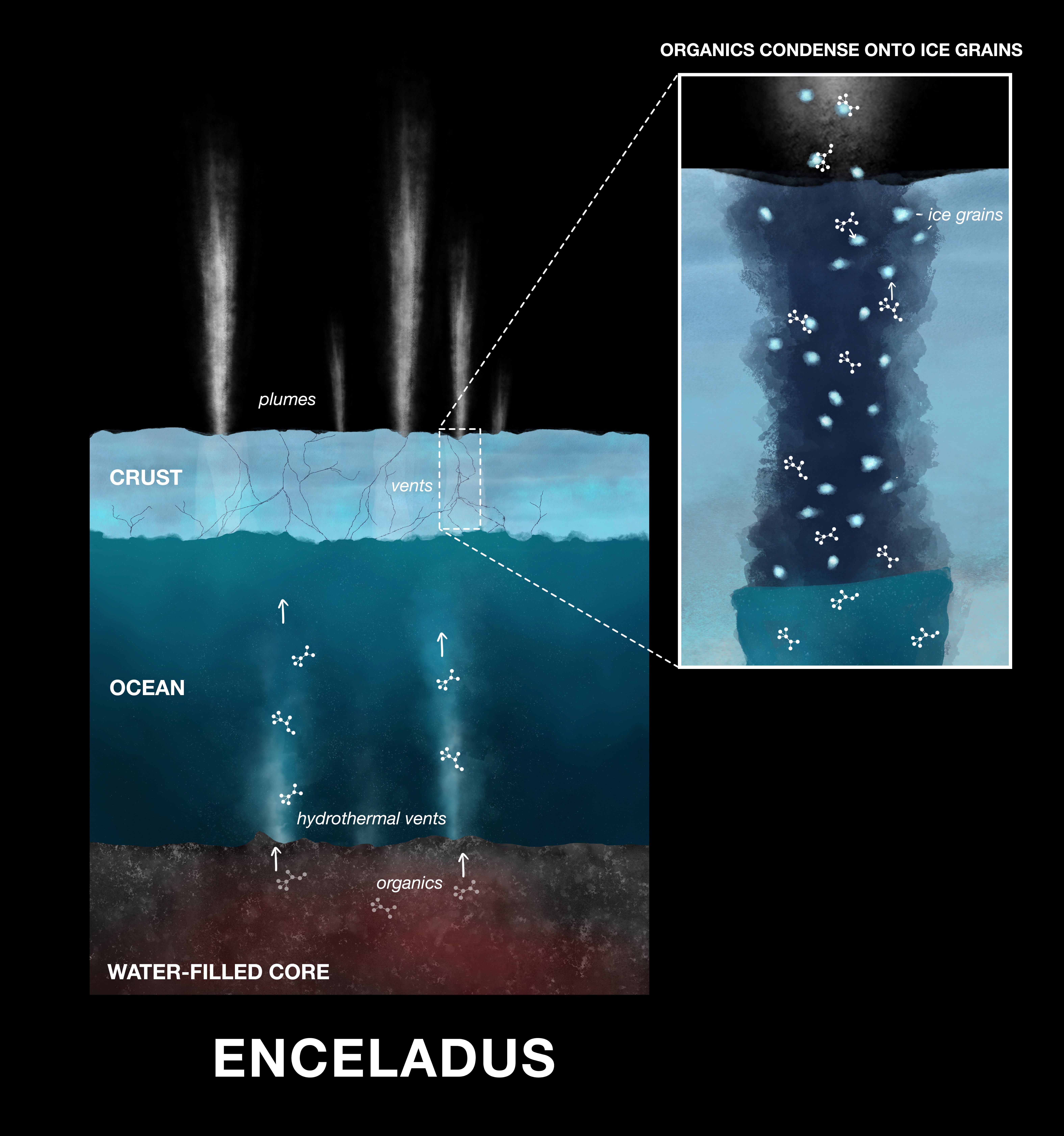
As the Cassini spacecraft navigated the plumes, its CDA’s detector recorded impacts from icy grains hurtling at an extraordinary 11 miles (18 kilometers) per second. This velocity considerably outpaced the 7.5 miles (12 kilometers) per second measured within the E-ring. Importantly, these grains, freshly ejected from the ocean, contained pristine material, unspoiled by any prior alteration from radiation.
Ice grains are not solely composed of frozen water but also contain other molecules, including organics, Khawaja explained. He noted that at lower impact speeds, shattered ice produces clusters of water molecules, which can obscure the signals from certain organic compounds. However, when these ice grains strike the Cosmic Dust Analyzer (CDA) at high velocities, water molecules do not cluster, providing a critical opportunity to detect these previously hidden signals.
Analysis has revealed that the organic molecules present in Enceladus’ E-ring are identical to those found in its plumes, definitively pointing to an origin within the moon’s subsurface ocean rather than space radiation. Beyond these findings, Khawaja’s research team identified a diverse array of organic molecules previously undetected in the plumes. These include aliphatic, (hetero)cyclic ester/alkalines, ethers/ethyl, and potentially compounds containing both nitrogen and oxygen. On Earth, such molecules are integral to the chemical pathways that form the fundamental building blocks of life.

Khawaja affirmed that the organic molecules uncovered by Cassini’s data point to numerous potential chemical pathways leading to compounds critical for sustaining life. This insight, he added, significantly bolsters the likelihood of the moon being habitable.
Nevertheless, an important reservation merits attention.
A recent study led by Grace Richards of the Istituto Nazionale di Astrofisica e Planetologia Spaziale (INAF) in Rome presents a new perspective on the origin of organic molecules on Saturn’s moon Enceladus. Contrary to previous concerns that radiation might primarily alter material within the E-ring, this research suggests the same radiation bombardment could actively create organic molecules directly on Enceladus’s surface.
This includes areas on the ground and around the “tiger stripe” fissures, the geologically active cracks from which the moon’s famous geysers erupt. If Richards’ hypothesis is correct, it introduces a significant challenge for astrobiologists. The presence of surface-generated organic molecules, potentially swept into space by the plumes, would make it difficult to distinguish whether organic compounds detected by the Cassini spacecraft originated from Enceladus’s subsurface ocean or were simply products of surface radiation.
One way to solve the issue would be to land on Enceladus and sample fresh ice directly. Indeed, this is the plan, with the European Space Agency considering a mission that would feature an orbiter/lander combo arriving at Enceladus in 2054. Only by getting ground truth can scientists know for sure whether Enceladus’ ocean really does feature the kind of complex chemistry that can potentially lead to life.
On October 1, the journal Nature Astronomy unveiled fresh data gathered by Cassini’s Cosmic Dust Analyzer.





