
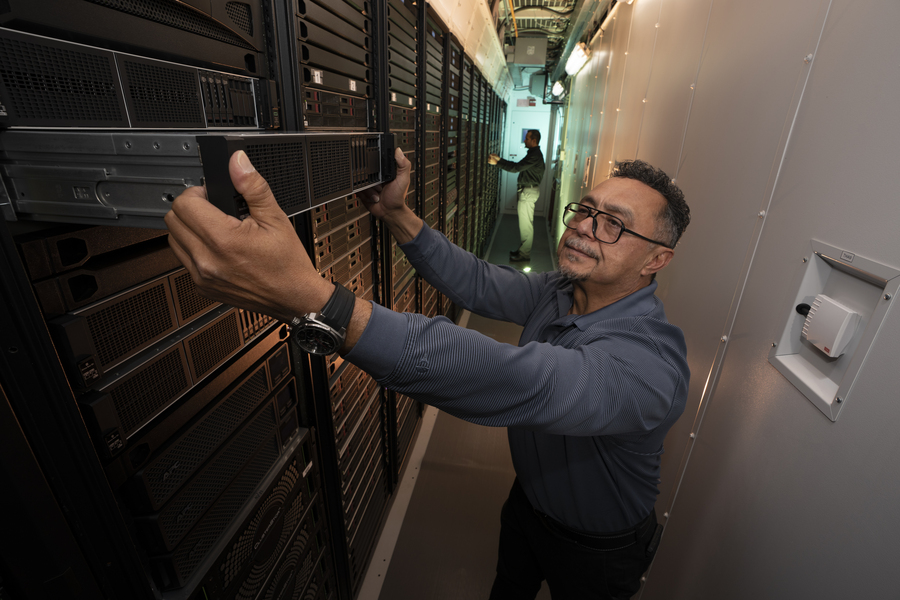
The Lincoln Laboratory Supercomputing Center (LLSC) has unveiled its new TX-Generative AI Next (TX-GAIN) computing system, now officially recognized as the most powerful AI supercomputer at any U.S. university. This designation follows its recent inclusion on the TOP500 list, which biannually ranks the world’s top supercomputers across various categories. TX-GAIN joins a suite of other high-performance systems at the LLSC, collectively bolstering research and development initiatives for both Lincoln Laboratory and the broader MIT campus.
The TX-GAIN system is poised to enable researchers to achieve significant scientific and engineering breakthroughs, states Jeremy Kepner, a Lincoln Laboratory Fellow and head of the LLSC. Kepner added that the system will be instrumental in supporting generative AI, physical simulation, and data analysis across the entirety of the institution’s research domains.
The Lincoln Laboratory Supercomputing Center (LLSC) stands as a crucial catalyst for innovation within the laboratory. Thousands of researchers routinely utilize the LLSC’s robust capabilities for data analysis, model training, and intricate simulations across a spectrum of federally funded research projects.
The supercomputers have been instrumental in high-impact initiatives, such as simulating billions of aircraft encounters to develop advanced collision-avoidance systems for the Federal Aviation Administration. They have also been vital in training sophisticated models for autonomous navigation tasks on behalf of the Department of Defense. Over the years, the LLSC’s computational power has been essential to the development of numerous award-winning technologies, leading to significant advancements in areas like airline safety, the prevention of new disease outbreaks, and enhanced hurricane response efforts.
TX-GAIN specializes in the development and deployment of generative artificial intelligence. This advanced form of AI distinguishes itself from traditional models, which typically focus on categorization tasks like identifying subjects in a photograph. Instead, generative AI is designed to produce entirely novel outputs. According to Kepner, the technology functions as a mathematical synthesis of interpolation, which fills in gaps within known data, and extrapolation, which extends data beyond established points. Today, generative AI is widely recognized for its application of large language models to generate remarkably human-like responses to user prompts.
Lincoln Laboratory is strategically deploying generative artificial intelligence across a diverse array of fields, significantly broadening its utility beyond large language models. The technology is notably employed to scrutinize radar signatures, augment incomplete weather data, pinpoint irregularities in network traffic, and delve into chemical interactions for the development of new pharmaceuticals and advanced materials.
TX-GAIN, a leading artificial intelligence system, leverages over 600 NVIDIA graphics processing unit accelerators, specifically engineered for AI computations, alongside conventional high-performance computing infrastructure. This powerful combination enables TX-GAIN to achieve a peak performance of two AI exaflops, equivalent to two quintillion floating-point operations per second. Its capabilities position TX-GAIN as the premier AI system at any university and within the entire Northeast region. Since its activation this summer, the system has garnered significant interest from researchers.
The advent of TX-GAIN has dramatically expanded the scope of protein modeling, allowing for the analysis of both a significantly greater volume of protein interactions and the intricate structures of much larger proteins with more atoms. Rafael Jaimes, a researcher from Lincoln Laboratory’s Counter–Weapons of Mass Destruction Systems Group, hailed this new computational prowess as a “game-changer” for protein characterization efforts in biological defense.
The LLSC’s focus on interactive supercomputing offers considerable utility for researchers. For years, the center has innovated software solutions, simplifying access to its formidable systems by eliminating the need for users to be experts in configuring parallel processing algorithms.
The LLSC’s enduring mission has been to simplify the supercomputing experience, making it as user-friendly as operating a personal laptop, according to Kepner. While the immense data volumes and sophisticated analytical methods required for today’s competitive landscape far surpass a laptop’s capacity, the LLSC’s accessible approach empowers users to swiftly run complex models and retrieve critical insights directly from their workspace.
TX-GAIN’s strategic focus now extends beyond its direct support for programs at Lincoln Laboratory, actively fostering research collaborations across MIT’s campus. These vital partnerships include contributions from the Haystack Observatory, the Center for Quantum Engineering, Beaver Works, and the Department of Air Force–MIT AI Accelerator. A key component, the AI Accelerator, is tasked with the rapid development, scaling, and deployment of artificial intelligence technologies specifically for the U.S. Air Force and Space Force. A tangible achievement of this work is the successful implementation of AI-driven optimization for flight scheduling in global operations.
Operating from an energy-efficient data center and facility in Holyoke, Massachusetts, the LLSC also dedicates significant research efforts to tackling the substantial energy demands of artificial intelligence. Its research staff are at the forefront of developing various power-reduction methods. A notable achievement is the creation of a software tool that can reduce the energy required for training an AI model by up to 80 percent.
Kepner stated that the LLSC is uniquely equipped to facilitate pioneering research, operating in a manner that is both cost-effective and energy-efficient.
The supercomputers at the Lincoln Laboratory Supercomputing Center (LLSC) are named with the “TX” designation, a direct homage to the laboratory’s groundbreaking 1956 Transistorized Experimental Computer Zero (TX-0). The TX-0 holds historical significance as one of the world’s inaugural transistor-based machines. Its 1958 successor, the TX-2, further cemented this legacy by playing a pivotal role in the early development of human-computer interaction and artificial intelligence. Through systems like TX-GAIN, the LLSC continues to build upon this innovative tradition.