Scientists have unveiled stunning new imagery offering an unprecedentedly detailed look at how antibiotics neutralize disease-causing bacteria. The visuals dramatically illustrate the process, showing the drugs effectively breaching the microbes’ outer membranes and infiltrating their internal structures to achieve victory.
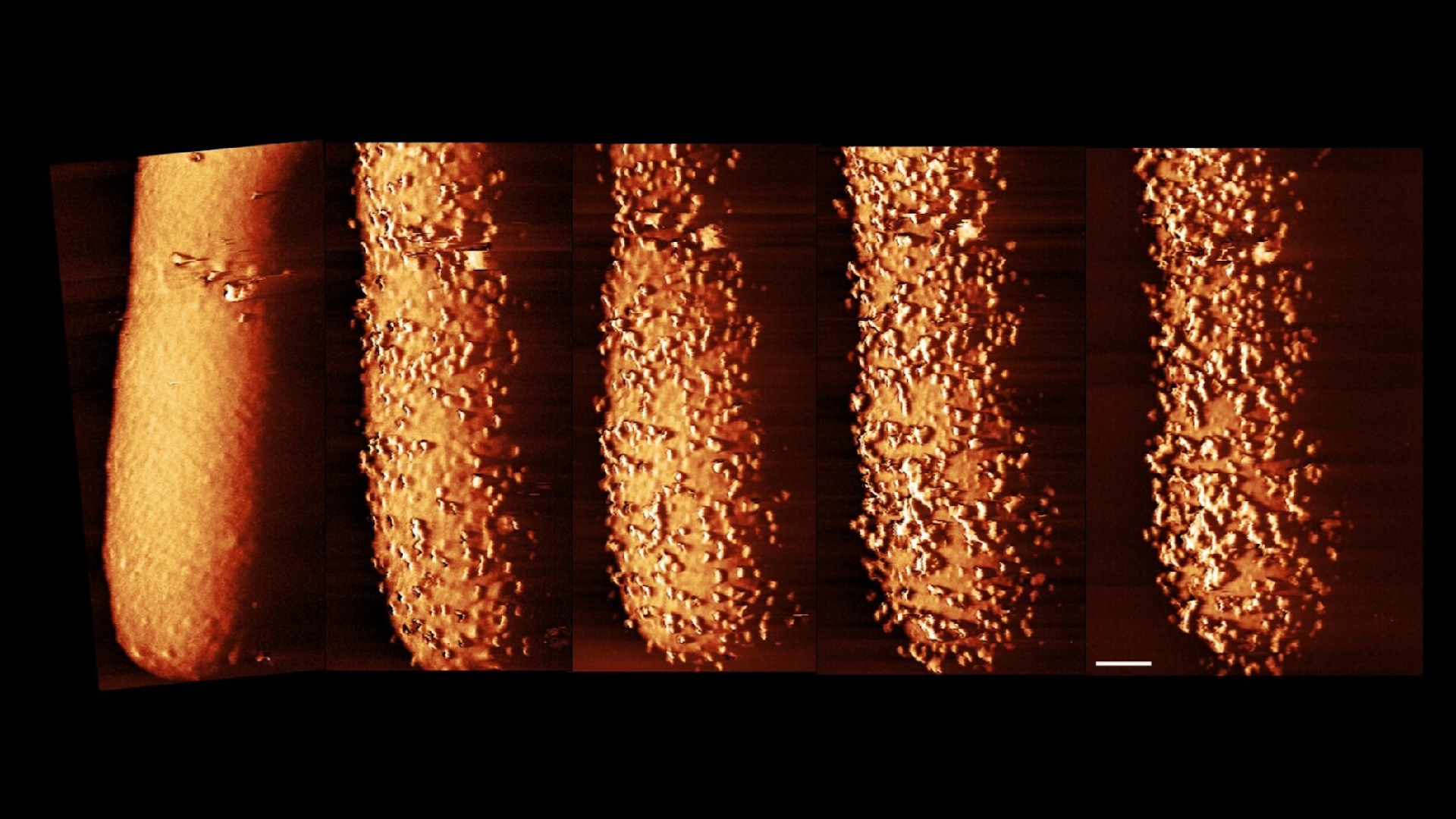
New observations shed light on the mechanism by which polymyxin antibiotics overcome the defenses of Escherichia coli. Researchers witnessed the drugs compelling the bacteria’s robust outer membranes to develop distinct bumps and bulges. Following this structural disruption, the E. coli cells were observed shedding these compromised outer layers, a process that effectively created openings for the antibiotic to infiltrate the bacterial cells.
Carolina Borrelli, a doctoral student specializing in biophysics and microbiology at University College London (UCL) and a co-author of the study, expressed profound amazement at observing an antibiotic’s real-time effects directly on bacterial surfaces.
Gram-negative bacteria comprise a broad classification of microorganisms, identifiable by a unique cellular structure. Each cell is enveloped by two distinct membranes, with a cell wall positioned between these layers. Notable examples within this bacterial group include E. coli, Salmonella, and Shigella, the latter being a pathogen known to cause dysentery.
Polymyxins serve as a vital defense against gram-negative bacterial infections that have developed resistance to other antibiotic treatments. These drugs operate by targeting the outer of the bacteria’s two membranes, a formidable defensive barrier designed to block antibiotic penetration. However, the precise mechanism by which polymyxins manage to breach this protective “armor” is not yet fully understood.
Polymyxins are a critical weapon against Gram-negative bacteria, the cause of many deadly and drug-resistant infections, according to Bart Hoogenboom, a biophysicist at UCL and a co-author of the study. He emphasized the vital importance of understanding precisely how these drugs function.
A recent study, published September 29 in the journal Nature Microbiology, showcased researchers’ success in capturing detailed images of an antibiotic in action. Scientists employed atomic force microscopy, a technique involving the precise movement of a tiny needle across bacterial surfaces, to map their shapes. This advanced method provided clear visual evidence of how the bacteria transformed under the antibiotic polymyxin’s attack.
Researchers have observed that polymyxins compelled E. coli bacteria to rapidly develop tiny bumps and protrusions on their outer membrane. As these growths expanded, the bacteria subsequently shed portions of this protective layer, creating critical breaches. These newly formed gaps then allowed antibiotics to penetrate the cell, leading to its elimination.
Borrelli detailed that the visual evidence directly illustrates the significant degree to which polymyxins compromise the bacterial outer defense. He further explained that it’s akin to the cell being driven to produce its outer wall components at such an unsustainable pace that the integrity of the wall itself breaks down, thereby enabling the antibiotic to infiltrate.
Polymyxin antibiotics demonstrate efficacy solely against actively multiplying bacteria, rendering them powerless against dormant strains. This dormant state serves as a critical survival strategy, allowing bacteria to persist through adverse conditions—sometimes for years—without needing to feed, grow, or reproduce, reactivating only when circumstances improve. Crucially, dormant bacteria halt the development of their protective outer membrane. Without this active membrane synthesis, the polymyxin antibiotic cannot exert its full effect, as its mechanism of action depends on targeting this “armor” as it is actively constructed by growing cells.
The next critical step, according to Hoogenboom, is to apply these findings to enhance antibiotic effectiveness. One proposed strategy, described as “counterintuitive,” involves combining polymyxin treatment with therapies specifically designed to either promote bacterial defense mechanisms or rouse dormant bacteria, thereby enabling their elimination.