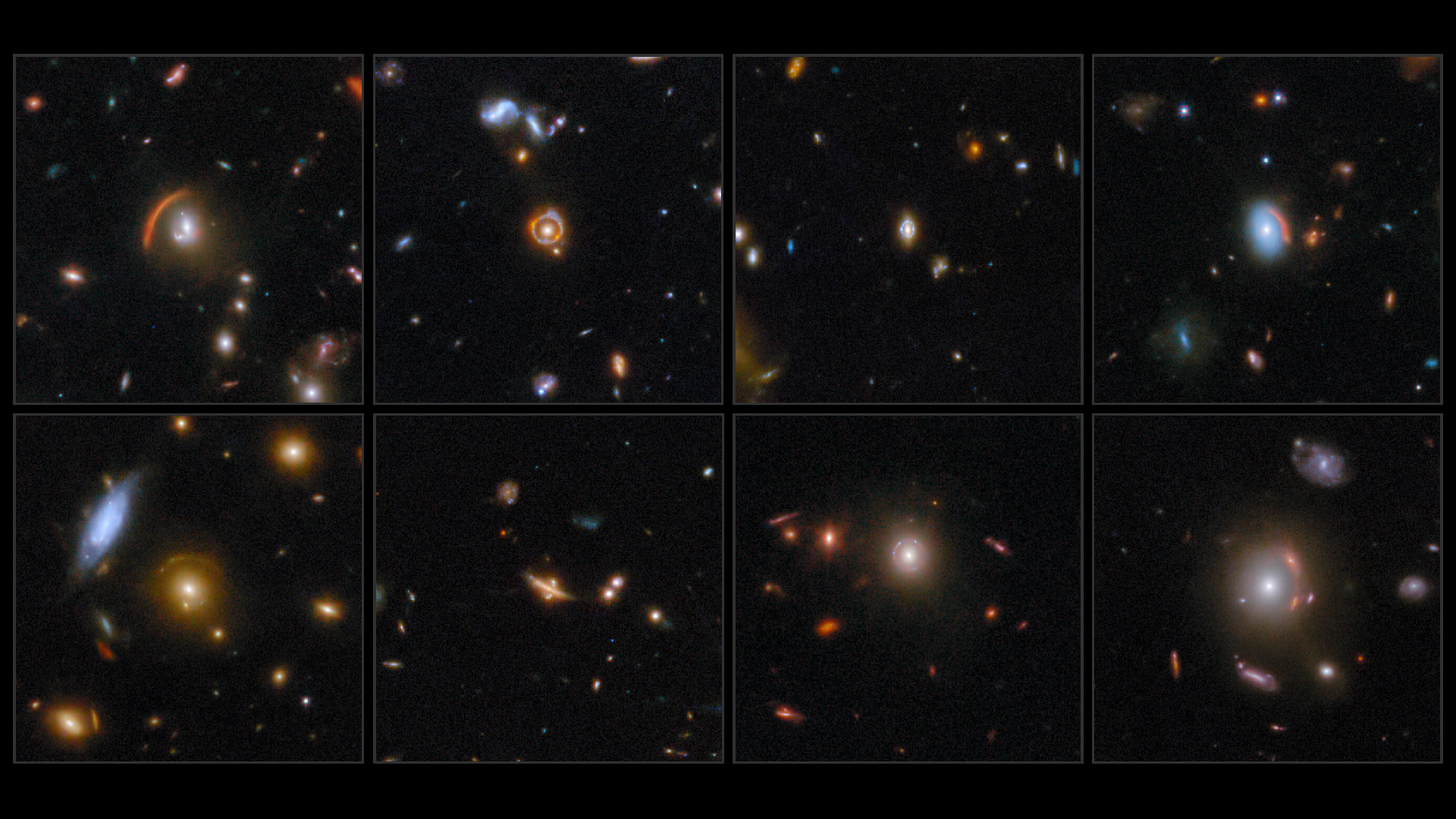
As telescopes gaze into the cosmos, they often detect natural phenomena that function as cosmic magnifiers for faraway objects. The James Webb Space Telescope (JWST) recently captured images of eight such galaxies, appearing either stretched, distorted, or precisely curved into perfect circles.
The peculiar shapes observed are no photographic trick. They arise from gravitational lensing, a cosmic effect that fundamentally transforms massive galaxies into powerful natural magnifying glasses.
Massive objects, such as galaxies, dramatically influence the cosmos by bending the very fabric of spacetime around them, much like a heavy weight distorts a stretched sheet. This gravitational distortion causes light from more distant galaxies to curve as it passes through these warped regions. When the celestial alignment is just right, the background galaxy’s light is stretched and magnified, appearing as brilliant arcs or, in rare cases, a complete luminous circle. This striking optical effect is known as an Einstein ring, a phenomenon predicted by Albert Einstein over a century ago. While full Einstein rings are uncommon, fragmented arcs and partial rings are observed more frequently.
Gravitational lensing has emerged as an indispensable tool, allowing astronomers to peer into the universe with unmatched depth and clarity. These cosmic lenses magnify and intensify the faint light emanating from exceptionally distant galaxies, making visible celestial bodies that would otherwise remain undetectable. Crucially, the phenomenon also enables scientists to accurately measure the mass of galaxies, encompassing the elusive dark matter that remains beyond direct observation.
The James Webb Space Telescope (JWST) has unveiled spectacular new deep-field galaxy images as part of the COSMOS-Web project, one of its largest observational programs to date. Scientists dedicated 255 hours to pointing the telescope at over 42,000 galaxies, uncovering more than 400 potential Einstein rings. Among these discoveries, the eight featured are particularly dramatic examples.
One particularly striking image, COSJ100024+015334, captivates with its perfectly circular form. This rare glimpse offers insight into a galaxy as it appeared when the universe was only a billion years old—a mere fraction of its current estimated age exceeding 13 billion years.
The James Webb Space Telescope (JWST) is unveiling previously unseen details in galaxies already cataloged by the Hubble Space Telescope, its sharper infrared vision penetrating what was once entirely obscured. Beyond these enhanced views, JWST has also made groundbreaking new discoveries, identifying galaxies that appear red due to immense distance and cosmic dust.
Rare celestial alignments, which produce the phenomenon known as Einstein rings, offer astronomers a unique lens through which to examine the foundational elements of galaxies, star clusters, and supernova explosions. These cosmic portals effectively peer into the universe’s deep past, shedding light on the mechanisms of galaxy formation and the pivotal role dark matter played in shaping the early cosmos.
For more sublime space images, check out our Space Photo of the Week archives.