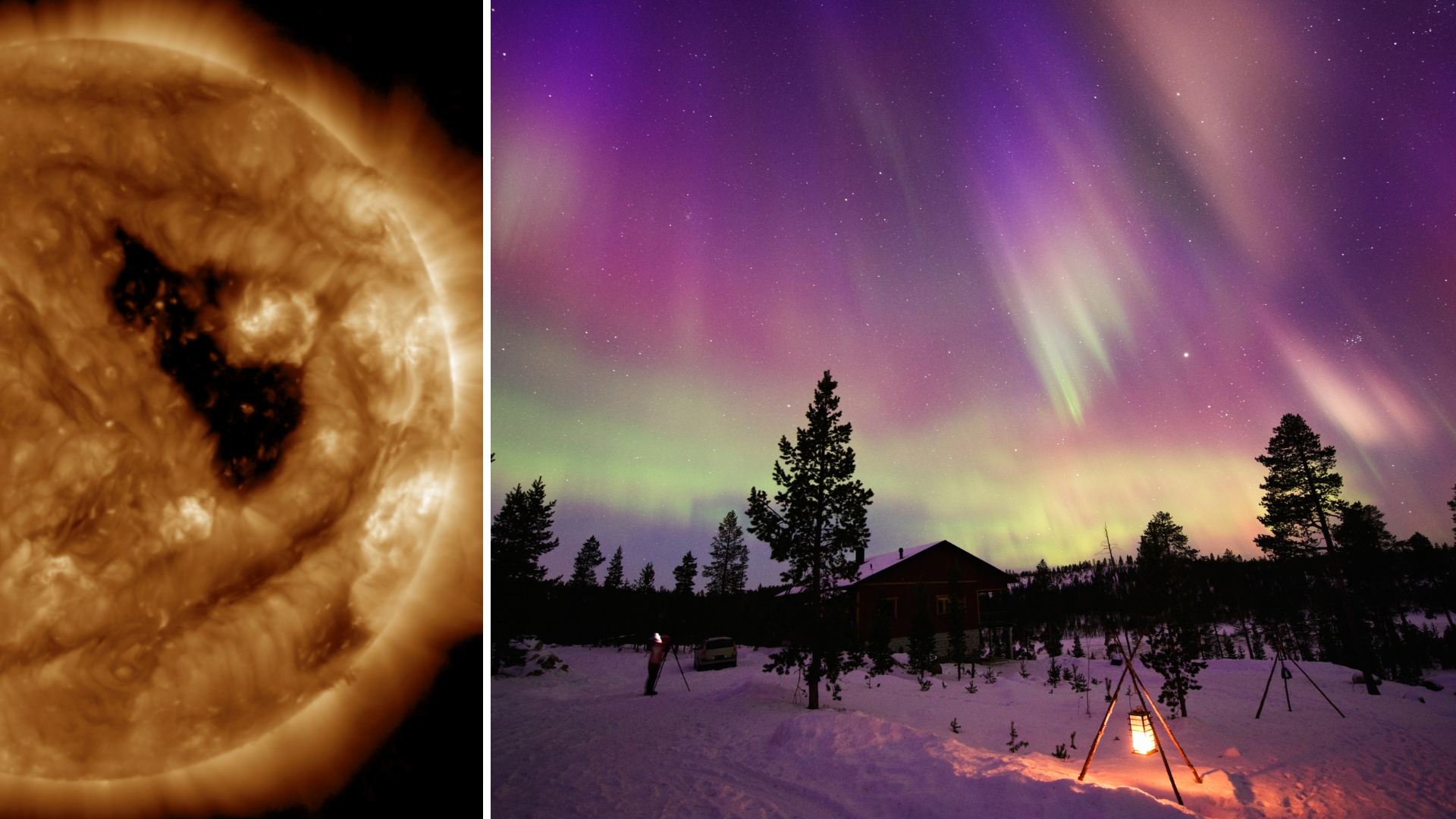
A substantial coronal hole on the sun’s surface is currently aimed at Earth, releasing a stream of high-speed solar wind. This solar influx could potentially trigger geomagnetic storms and visible auroras over the coming weekend.
A fast solar wind stream is projected to impact Earth between late Saturday and Sunday, October 11-12, according to space weather experts from both the NOAA Space Weather Prediction Center and the U.K. Met Office. Geomagnetic activity is expected to commence late on October 11, with the most significant intensity forecast for October 12, specifically between 5 a.m. and 5 p.m. EDT (0900-1700 GMT).
A minor (G1) geomagnetic storm, anticipated for October 12, could potentially make the aurora borealis visible in latitudes as far south as northern Michigan and Maine. This forecast is guided by NOAA’s G-scale, which assesses the strength of these space weather events. Experts note that the current time of year, immediately following the autumn equinox, could amplify the impact of even a slight increase in geomagnetic activity, significantly enhancing the prospects for more widespread aurora sightings over the coming weekend.

A previously observed coronal hole has re-emerged on the Sun, presenting a somewhat altered appearance since its last sighting. This is the same solar feature that was noted just a month prior, when it distinctively resembled a butterfly or a bird. Such coronal holes are known for their remarkable persistence, often enduring for months and reappearing approximately every 27 days, corresponding with the Sun’s rotational cycle.
Coronal holes, areas on the sun where the magnetic field extends outwards, allow solar wind to stream unimpeded into space. When this energetic solar wind reaches Earth, it interacts with our planet’s magnetic field, the magnetosphere. This interaction channels some of the high-energy particles along magnetic field lines toward the poles. Upon colliding with atoms and molecules—predominantly oxygen and nitrogen—in the upper atmosphere, these particles release energy in the form of light, creating the vivid, glowing displays known as the aurora.
This weekend presents a prime opportunity for aurora chasers. Around the autumn equinox, Earth’s tilt aligns in a way that significantly improves the solar wind’s connection with our planet’s magnetic field. This seasonal enhancement, known as the Russell-McPherron effect, is expected to boost auroral visibility.
The National Oceanic and Atmospheric Administration (NOAA) has issued a forecast predicting a peak Kp index of 5, a level that corresponds to minor (G1) geomagnetic storm conditions. The Kp index operates as a global measurement of geomagnetic activity, with a scale ranging from 0 (indicating quiet conditions) to 9 (extreme). A higher Kp index generally elevates the probability of auroral displays being visible at latitudes further removed from their customary polar regions.
Space weather physicist Tamitha Skov has released her latest forecast, detailing current solar activity and outlining anticipated space weather conditions for the upcoming weekend and the following week.