
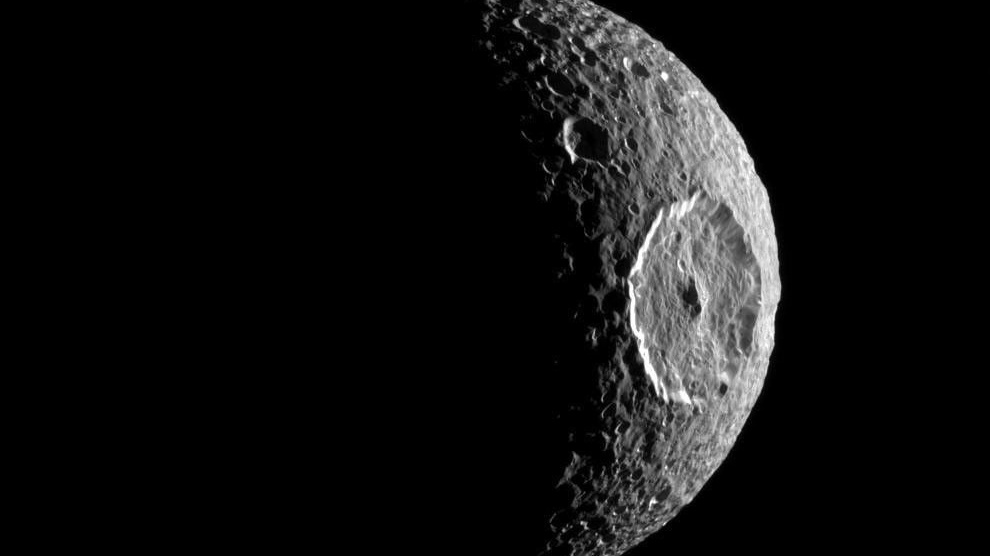
Scientific evidence increasingly suggests the presence of a newly formed ocean hidden beneath the surface of Saturn’s moon Mimas.
Global research charting the thickness of planetary icy crusts offers critical insights. This mapping not only helps estimate the age of existing subsurface oceans but also identifies their thinnest points, marking ideal locations for future missions designed to detect these hidden bodies of water. Simultaneously, a detailed examination of Mimas’ largest crater is contributing to a more precise determination of the potential age range for its hypothesized ocean.
Mimas lacks the characteristic features scientists typically associate with an ocean world, planetary scientist Alyssa Rhoden of the Southwest Research Institute (SwRI) in Boulder, Colorado, observed last month. Her remarks were made during the joint Europlanet Science Congress-Division for Planetary Sciences meeting.
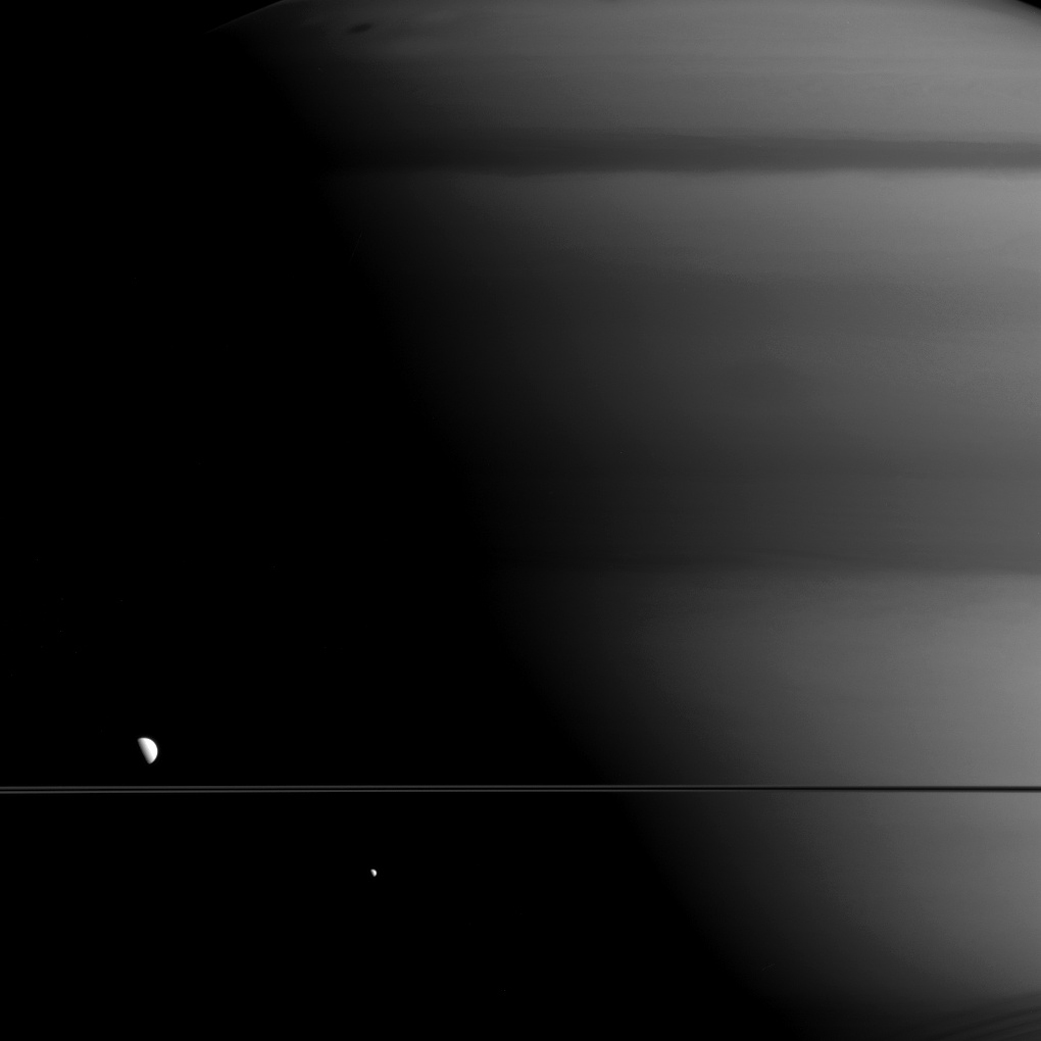
While Saturn’s moon Enceladus and Jupiter’s moon Europa, both believed to harbor subsurface oceans, display extensive networks of cracks and fissures on their surfaces—geological features that typically signal internal volume changes from ice melting into liquid water—Saturn’s smallest major moon, Mimas, presents a stark contrast. Its outer layer reveals remarkably few such disruptions. Furthermore, Mimas’s impact craters appear notably immutable, presenting as if they were etched into solid rock rather than a more pliable icy crust.
Last year, researchers unveiled compelling evidence from NASA’s Cassini spacecraft, pointing to the existence of a relatively newly formed subsurface ocean on Saturn’s moon Mimas. This revelation culminated a decade-long scientific inquiry, as Cassini’s continuous data stream progressively fueled the idea. While early mission data had initially offered hints of a young ocean within Mimas, the scientific community approached these preliminary findings with skepticism. However, subsequent detailed observations have now built a strong and persuasive case for a hidden ocean, which is believed to be buried beneath a substantial layer of solid ice measuring between 12 and 19 miles (20 to 30 kilometers) thick.
A research team led by Rhoden employed models originally developed to understand Europa’s heat shell, adapting them to study Mimas. Their investigation sought to determine the thickness of Mimas’s ice shell and chart the flow of heat across its surface. A key discovery from their work was that once melting began on the icy moon, the process accelerated swiftly.
The potential for a subsurface ocean on Saturn’s moon Mimas is intrinsically linked to its orbital behavior. While scientists continue to investigate the formation processes of Saturn’s diverse moon system, it is widely believed that any liquid water Mimas might have possessed at its inception would have long since frozen solid. Consequently, researchers propose that any existing ocean within Mimas is not a remnant from its formation, but rather a comparatively recent development, most likely a direct result of changes in the moon’s orbital path.
Planets and their orbiting moons are locked in a constant gravitational embrace, each exerting a pull on the other. On Earth, this celestial interaction is most clearly observed in the rhythmic rise and fall of ocean tides, driven by our moon’s gravitational influence on the planet’s vast water bodies. Less apparent, however, is the Earth’s reciprocal gravitational force, which subtly deforms the Moon’s solid, rocky surface.
In the Saturnian system, an ancient event appears to have propelled the moon Mimas into a significantly more eccentric orbit, departing from its earlier, more circular path. This dramatic shift altered how Saturn’s gravity interacts with the moon’s solid ice. Scientists theorize that the resulting intense gravitational push-and-pull generates substantial internal heat, sufficient to melt vast quantities of ice into water. This process could be actively fostering the formation of a nascent subsurface ocean. Simultaneously, Saturn’s persistent gravitational influence is gradually working to restore Mimas’s orbit to a more circular configuration.

Should the moon’s orbital path eventually stabilize into a perfect circle, scientists predict a significant outcome: the gravitational tidal forces would no longer be strong enough to melt ice. This fundamental shift would, in turn, lead to the gradual refreezing of a nascent ocean, which researchers currently hypothesize to exist.
Researchers led by Rhoden have investigated the degree of orbital eccentricity shifts required to account for Mimas’ current observed characteristics. Their findings indicate that any significant alteration to the moon’s orbit would have generated sufficient heat to completely melt its surface, thereby obliterating all existing craters and topographical features.
Crucially, the team determined that Mimas’ pivotal orbital transformation most likely occurred within the last 10 to 15 million years. This timeframe is considered remarkably brief on astronomical scales and aligns precisely with previous estimations regarding the age of the moon’s young subsurface ocean.
Scientists conducted simulations to understand heat transfer within the moon, with the goal of developing strategies for future missions to detect a subsurface ocean. Their models indicate that the movement of heat through the ice, and the subsequent melting and thinning of the moon’s outer shell, may not be a simple process. Despite this potential complexity, the research suggests that a future orbiting spacecraft could effectively use thermal measurements to identify the hidden ocean.
Rhoden acknowledged the endeavor would be challenging, but suggested its feasibility.
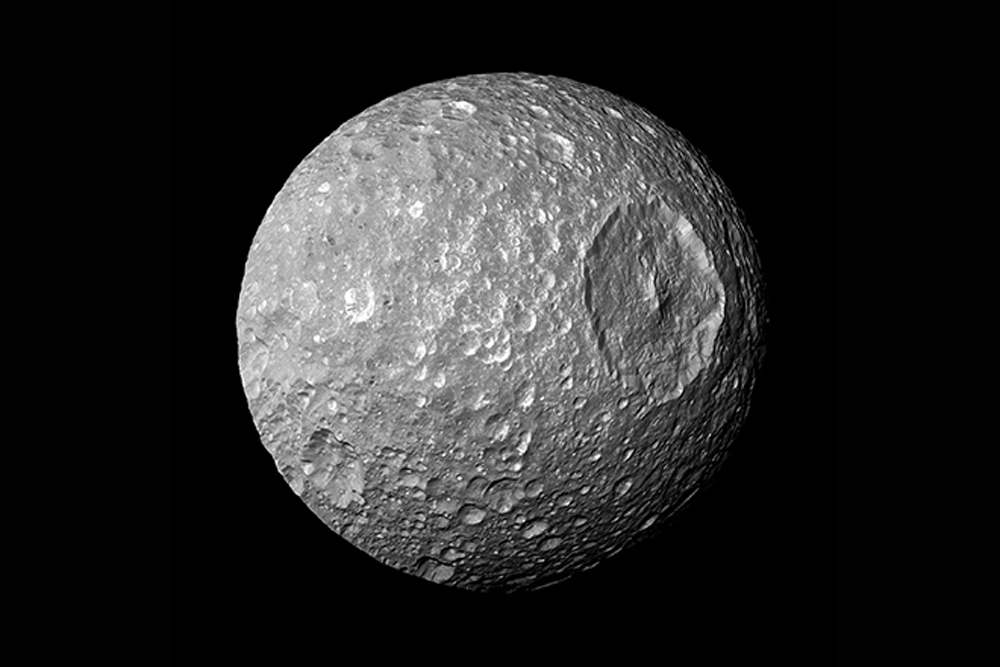
Mimas, Saturn’s innermost major moon, has earned the moniker “Death Star moon” due to its striking resemblance to the iconic Star Wars space station. This visual parallel is largely driven by Herschel crater, a colossal impact basin that stretches 80 miles (130 kilometers) across—encompassing more than a third of the moon’s total diameter. This immense geological feature, which evokes the fictional weapon’s superlaser, is now playing a critical role in ongoing scientific discussions regarding the potential existence of a subsurface ocean within Mimas.
The distinct geometry of a crater offers profound insights into the geological composition of the ground from which it was formed. While the impact event naturally excavates subsurface material, making it accessible for later scientific analysis, the resulting crater’s structural integrity provides crucial evidence. This allows researchers to precisely determine the rigidity of any regional ice present at the moment of its creation.
Recent simulations analyzing crater formation on Mimas indicate that the moon’s icy crust was not entirely rigid when its prominent Herschel impact basin was created. Scientists, through modeling Mimas’s historical evolution from an entirely solid state to one potentially harboring a subsurface ocean, determined that Herschel most likely formed during a period when the moon was on the threshold of internal melting.
Planetary scientist Adeene Denton of SwRI, speaking to Space.com, asserts that Mimas must be positioned precisely at a “tipping point.” She elaborated that while the moon can sustain this precarious state for millions of years, maintaining close proximity to that critical threshold is essential.
Denton’s findings were additionally presented at the EPSC conference. The comprehensive study, notably co-authored by Rhoden, recently appeared in the journal Earth and Planetary Science Letters.
A prominent central peak marks the surface of Mimas, Saturn’s smallest major moon, a distinctive feature formed by a colossal impact event. Such central peaks are common within large craters, with their formation being a direct consequence of the relative sizes between the impacting object and its target. Prior research conducted by Denton had previously established that a collision into a solid ice surface on Mimas would have resulted in a crater devoid of this specific geological formation.
Impact events serve as powerful excavators, carving deep into a celestial body’s crust. If Mimas had harbored a subsurface ocean, any significant collision would have violently dispersed its waters across space. Furthermore, the inherent fluidity of water would have prevented the formation of a distinct central peak, a characteristic feature typically observed in solid-body impacts.
Denton unequivocally stated that water could not be responsible for fashioning a structure of that nature.
The prevailing theory suggests Herschel came into being precisely as the ocean commenced its melting cycle. This pivotal period was defined by ice that, though elevated in temperature, had not yet fully liquified.
New research by Denton has substantially broadened the estimated timeframe for Herschel’s formation, extending the potential window from a mere one million years to a more extensive ten million years. Speaking at EPSC, Denton characterized this tenfold increase as a significant advancement, noting that while ten million years is “still geologically short,” it marks a considerable improvement over previous estimates, calling it an “order of magnitude game.”
A comprehensive understanding of the moon’s enigmatic nature is rapidly developing, propelled by a confluence of research efforts. This progress stems from a new study, combined with Rhoden’s pioneering investigations into the lunar thermal interior, and various other ongoing analyses of both its surface and deeper structures.
According to Denton, a growing body of evidence is now coalescing to present a unified understanding of Mimas as a nascent ocean world.





