A recent study proposes that ancient, explosive volcanic eruptions on Mars could provide a key explanation for the puzzling signs of buried ice discovered surprisingly close to the Red Planet’s equator.
While it has long been understood that the Martian surface holds abundant ice, with the majority of these frozen reserves clustered at its poles, mirroring Earth’s own icy caps, recent observations are revealing a more complex reality.
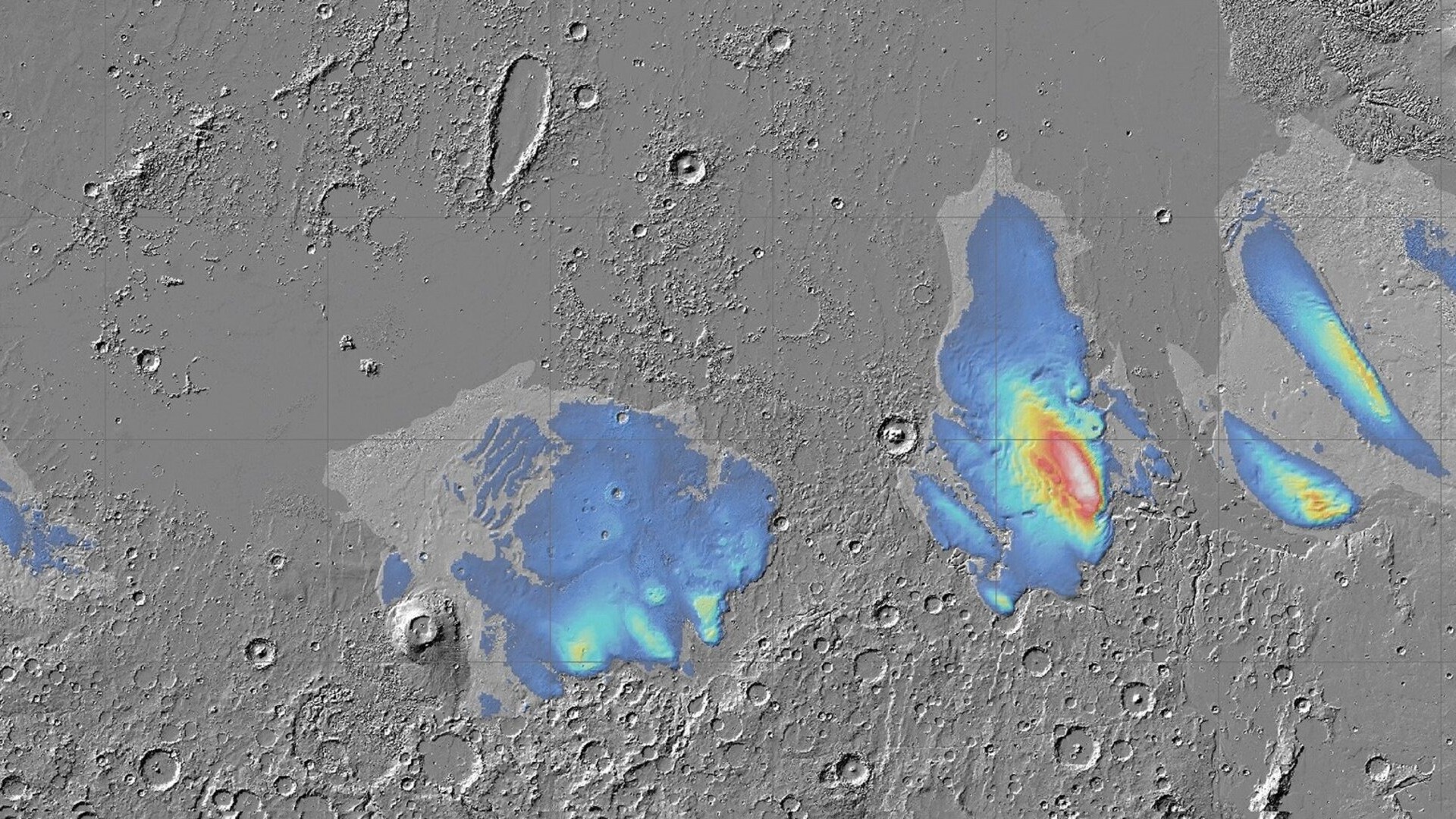
Data collected by the Mars Odyssey and ExoMars Trace Gas Orbiter spacecraft has detected unexpectedly high concentrations of hydrogen near the ground in Mars’ equatorial regions. This elevated hydrogen content is a strong indicator of subsurface water ice, suggesting that areas previously thought to be largely devoid of shallow ice may in fact harbor significant deposits.
Scientists posit that if shielded beneath protective layers of dust or volcanic debris, this equatorial ice could have endured for vast spans of time. This raises the intriguing possibility that substantial, long-preserved ice reserves may still lie hidden beneath the surface of the Red Planet’s equatorial belt.
Scientists are currently grappling with a fundamental question: how did this ice materialize in such an unexpected locale? Previous research has offered one compelling hypothesis, suggesting that volcanic activity, capable of expelling vast amounts of water vapor, could be the key to its formation.

New research, utilizing advanced computer models of Mars’ ancient climate, has simulated the powerful explosive volcanic eruptions that rocked the Red Planet between 4.1 and 3 billion years ago. The simulations indicate these geological events would have expelled substantial quantities of water vapor high into the atmosphere.
In the frigid Martian conditions at those altitudes, the vapor would likely have frozen and subsequently precipitated as ice. Remarkably, the models suggest that even a single three-day eruption could have resulted in localized ice deposits up to 16 feet (5 meters) thick in the immediate vicinity of a volcano.
Saira Hamid, a planetary scientist at Arizona State University and the study’s lead author, highlighted the profound impact of long-term geological activity on ice distribution. “Consider the immense volume of ice that could be deposited by repeated eruptions over millions of years,” Hamid explained to Space.com.
She proposed that such explosive volcanism would consistently introduce ice and ash into low-latitude regions, fostering the creation of buried or insulated ice deposits. These formations, Hamid noted, offer a plausible explanation for the excess hydrogen signals observed near the equator.
Researcher Hamid has introduced a cautionary note regarding the hydrogen detected by spacecraft near the Martian equator. She suggests these signals may not necessarily indicate ice deposits, but rather could stem from a variety of minerals or other potential sources. To definitively resolve this question, Hamid proposes that upcoming research focus on actively searching for ash-covered ice in Mars’s equatorial regions, a discovery that would either affirm or refute the likelihood of ice presence there.
Should equatorial ice pockets indeed exist on Mars, they would represent a crucial resource for human explorers. Research, as noted by Hamid, points to volcanic regions as prime candidates for these discoveries, thereby designating them as high-priority targets for future missions.
Another theory suggests that ancient Martian volcanic activity may have expelled sulfuric acid into the planet’s atmosphere. This acid would have formed sunlight-reflecting aerosols, leading to a significant cooling effect across the Red Planet. Such an event could have triggered a global ‘volcanic winter,’ creating conditions favorable for ice to accumulate and persist over extended periods.
While powerful, ancient Martian volcanic eruptions may have also inadvertently created brief pockets of habitability, according to scientist Hamid. These events, he explained, generated critical heat and chemicals, potentially giving rise to “short-lived habitable environments” where “transient but potentially life-supporting conditions” could have existed.
Hamid emphasized that mapping the formation of these unique ice-ash deposits is crucial, as such knowledge could guide future missions in their search for past or even preserved biosignatures on Mars.
The research team officially published their findings on October 14 in the esteemed journal *Nature Communications*.