A “super-Earth” exoplanet, located less than 20 light-years from our solar system, has been identified orbiting within its star’s habitable zone. This discovery immediately elevates the alien world to a prime candidate in the ongoing quest to find life beyond Earth.
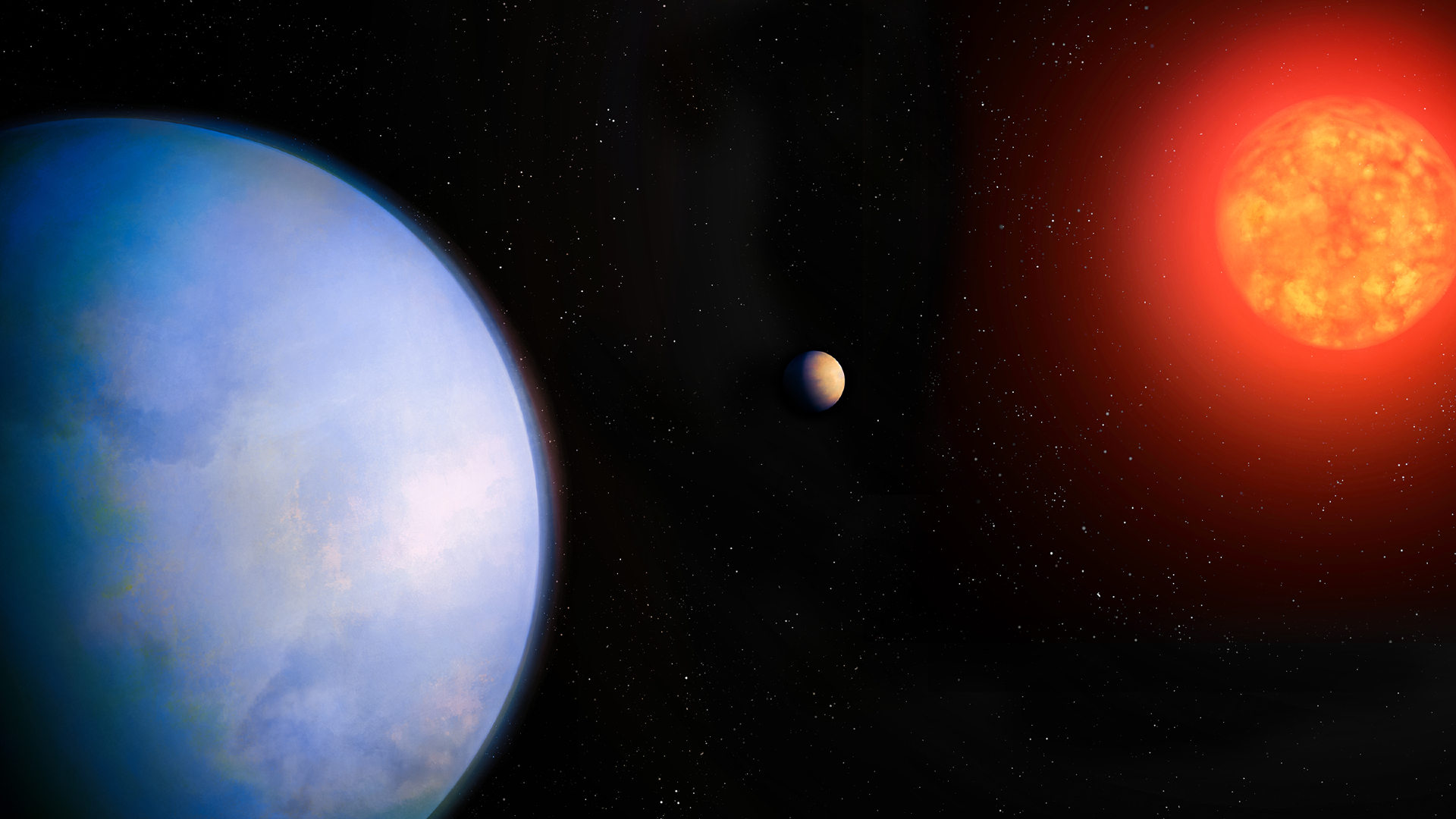
Designated GJ 251c, this celestial body is classified as a ‘super-Earth’ orbiting a red dwarf star. Located 18.2 light-years from our solar system within the constellation of Gemini, also known as ‘the Twins,’ the exoplanet boasts a mass four times greater than that of Earth. Its ‘super-Earth’ designation signifies a rocky planet considerably larger and more massive than our home world.
Penn State University astronomy professor Suvrath Mahadevan highlighted the exoplanet GJ 251c as a “promising target for future exploration,” despite the current lack of confirmed evidence for an atmosphere or life.
Often referred to as the “Goldilocks Zone,” the habitable zone defines the precise orbital band around a star where conditions are just right for liquid water to exist on a planet’s surface—a critical factor for life—provided it also possesses a suitable atmosphere.
The discovery of exoplanet GJ 251c materialized after a remarkable two-decade-long observational campaign. Astronomers employed a sophisticated technique, meticulously tracking the subtle ‘wobble’ of the planet’s host star—a minute oscillation caused by GJ 251c’s gravitational tug. This celestial movement, as the star periodically shifts closer to and further away from Earth, generates a measurable Doppler shift in its radial velocity, a phenomenon precisely quantifiable using a spectrograph.
The GJ 251 system is also known to host another planet, GJ 251b, which was initially discovered in 2020. This exoplanet completes a full orbit of its star every 14 days, situated approximately 7.6 million miles (12.2 million kilometers) away. A dedicated team of astronomers, including researcher Mahadevan, significantly enhanced the precision of GJ 251b’s radial velocity measurements by meticulously analyzing archival data gathered from telescopes worldwide.

Scientists integrated previously refined data with cutting-edge, high-precision observations from the Habitable-Zone Planet Finder (HPF), a near-infrared spectrograph operating on the Hobby-Eberly Telescope at Texas’s McDonald Observatory. This crucial combination led to the discovery of a second planetary signal: a world roughly four times the mass of Earth, circling its star every 54 days. The existence of this exoplanet was subsequently corroborated by independent measurements from the NEID spectrograph, mounted on the 3.5-meter WIYN telescope at Arizona’s Kitt Peak National Observatory.
Despite the seemingly straightforward nature of the objective, the actual process of detecting the planet presented an immensely formidable challenge.
Stars are far from static, constantly agitated by turbulent internal processes. Energetic convective currents push hot plasma to their visible surfaces, while immense prominences periodically erupt into space. This ceaseless stellar activity creates a “noisy” background of asteroseismic activity, detectable as Doppler-shifted lines in the star’s spectrum.
Distinguishing the faint Doppler-shifted radial velocity signals of orbiting planets from this intrinsic stellar interference is a significant challenge. Successfully isolating these subtle planetary signatures demands rigorous analysis and extensive computational modeling to accurately predict the appearance of a genuine planetary signal.
Mahadevan underscored the immense difficulty of the task, which involves simultaneously quelling a star’s intense activity and meticulously isolating minute signals from its volatile, magnetically turbulent surface.
With a more comprehensive understanding of the planet now established, astronomers are well-positioned to meticulously plan their forthcoming observational campaigns.
**Washington D.C.** — While the James Webb Space Telescope (JWST) has revolutionized exoplanet research, it is unlikely to be capable of detecting signs of an atmosphere around GJ 251c, primarily due to the planet’s considerable distance from its host star.
Future ground-based instruments, specifically the next generation of 30-meter-class telescopes, might offer a limited capacity to identify GJ 251c’s atmosphere. These powerful observatories could potentially achieve this by analyzing light reflected off the planet’s surface or atmospheric layers.
However, a comprehensive characterization of GJ 251c, including a detailed analysis of its atmospheric composition, will most likely require the Habitable Worlds Observatory. This ambitious planned giant space telescope is currently projected for a launch in the 2040s, promising the advanced capabilities necessary for such in-depth study.
Corey Beard, a researcher at the University of California, Irvine, who participated in the study, highlighted the groundbreaking technological and analytical capabilities of their current system. However, he stressed that directly imaging the identified candidate will necessitate the advanced power of next-generation telescopes.
Despite being lauded by Mahadevan as “one of the best candidates” in the scientific quest to identify atmospheric biosignatures—chemical markers indicative of life found within a planet’s gaseous envelope—a profound concern overshadows the promising outlook for GJ 251c: the characteristics of its stellar host.
GJ 251, a red dwarf star boasting just over a third of our sun’s mass, epitomizes a stellar type that has become a focal point in the search for exoplanetary life. Astronomers have excitedly discovered numerous rocky planets orbiting within the habitable zones of red dwarfs—regions where conditions could theoretically allow for liquid water. Notable examples include Proxima Centauri b, TRAPPIST-1e and f, and Teegarden’s Star b.
However, a significant challenge looms: red dwarfs, despite their diminutive size, are known for their volatile nature. They frequently erupt with powerful stellar flares that can, over vast stretches of time, systematically erode a planet’s atmosphere, potentially rendering it barren. This concern is underscored by recent data from the James Webb Space Telescope (JWST), which, after scrutinizing the TRAPPIST-1 system, found no evidence of atmospheres on its three innermost planets. Observations for the fourth planet, TRAPPIST-1e, are still pending conclusive results.
As a result, a growing contingent of astronomers is expressing skepticism about the long-term viability of Earth-like worlds around these tempestuous stars, questioning whether true sustained habitability can genuinely endure in such aggressive environments.
The exoplanet GJ 251c presents an intriguing prospect in the search for habitable worlds, primarily owing to its unique orbital characteristics. Unlike many other planets discovered within the habitable zones of red dwarf stars, GJ 251c maintains a notably greater distance from its parent star. This expanded ‘Goldilocks zone’ is a direct consequence of GJ 251’s star being both more massive and, critically, hotter than typical red dwarfs, thereby pushing the region where liquid water could potentially exist further out into space.
This increased separation offers a significant advantage: it’s plausible that GJ 251c has been sufficiently far from its star to largely circumvent the most destructive stellar flares and coronal mass ejections—often likened to the star’s ‘temper tantrums.’ Furthermore, if the exoplanet is equipped with a substantial atmosphere and a robust planetary magnetic field, it stands a much greater chance of having successfully resisted the relentless erosion from its star’s stellar wind, a critical factor for retaining an atmosphere vital for potential life.
Presently, much of this remains within the realm of conjecture. Lead researcher Mahadevan acknowledged an “exciting discovery,” but quickly tempered expectations, emphasizing that a comprehensive understanding of the planet’s characteristics is still a significant challenge.
The comprehensive findings were made public on October 23, as detailed in The Astronomical Journal.