
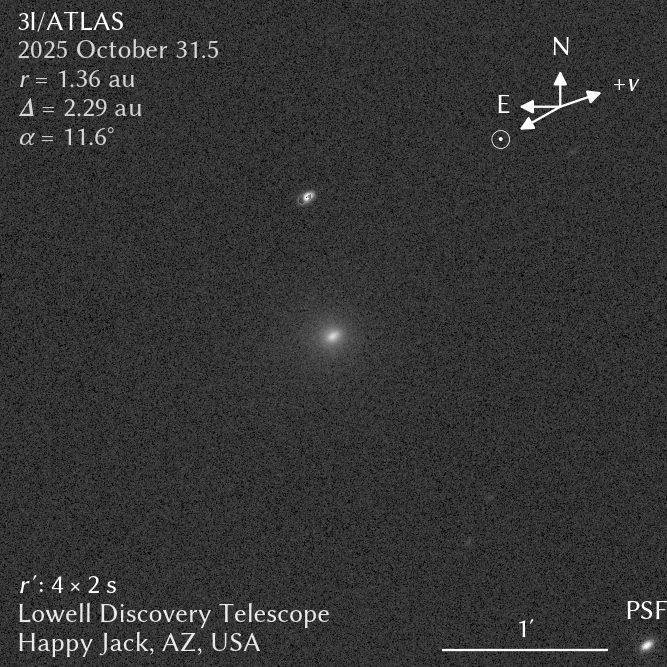
The interstellar comet 3I/ATLAS has re-emerged into view from Earth, confirmed by newly released images. This celestial visitor recently made its reappearance after completing a transit behind the sun.
From Arizona’s Lowell Observatory, an astronomer utilized the powerful Discovery Telescope to achieve a significant milestone: capturing what is believed to be the first optical image of the interstellar visitor following its closest approach to the Sun. This groundbreaking observation was made on Halloween, Friday, October 31st.
Good news for sky-watchers: Qicheng Zhang, a postdoctoral fellow at the observatory, has confirmed that the comet is now visible through small telescopes. Zhang shared compelling photographic evidence of this on his Cometary blog last Sunday, November 2. He further advises that amateur astronomers across much of the Northern Hemisphere should now begin to easily detect the celestial visitor with their standard equipment.
To successfully observe the phenomenon, a clear sky and an unobstructed eastern horizon are essential, Zhang informed Live Science on Friday. He cautioned that its initial appearance would be understated, describing it simply as “a smudge,” but emphasized that it is expected to become progressively more visible over the coming days.
Scientists have gained significant insights into comet 3I/ATLAS since its identification in July. This celestial wanderer, which holds the rare distinction of being only the third interstellar object ever recorded, is currently making a swift passage through our solar system. Researchers have noted its blistering speed, exceeding 130,000 miles per hour (210,000 km/h), as well as its remarkably distinct trajectory, characterized by an unusually flat and straight path.
A celestial visitor momentarily eluded direct observation from Earth as it performed a gravitational slingshot maneuver around the sun. On Thursday, October 29, the comet reached its perihelion—the point of its closest approach to our star—coming within a mere 1.4 astronomical units, or 130 million miles (210 million kilometers), of the solar surface. Despite this temporary solar obscuration, scientists and amateur astronomers alike continued to meticulously track its trajectory, relying on invaluable data streamed from orbiting space telescopes.
**New research indicates that comet 3I/ATLAS experienced a swift surge in brightness leading up to its perihelion, or closest approach to the sun. A study posted on the preprint server arXiv on October 28 by Zhang and his colleague revealed the comet to be distinctly bluer than the sun.**
**This striking blue hue, according to the researchers, is consistent with substantial gas emissions significantly contributing to the comet’s visible luminosity as it neared perihelion. Zhang noted that while the comet’s brightness might still be increasing, further observational data is necessary to confirm this ongoing trend.**
The Lowell Discovery Telescope is poised to play a crucial role in observing Comet 3I/ATLAS during the critical period immediately after its perihelion. According to researcher Zhang, its unique capability to point exceptionally close to the horizon likely makes it one of the largest instruments capable of capturing the comet at this specific stage.
From our perspective, the comet is currently moving northward, progressively receding from the northeastern horizon. Observers have a narrow window of opportunity during the morning twilight hours. This brief period allows for viewing when the comet is just above the horizon, yet the sun remains sufficiently below to ensure the sky is dark enough for successful observation.
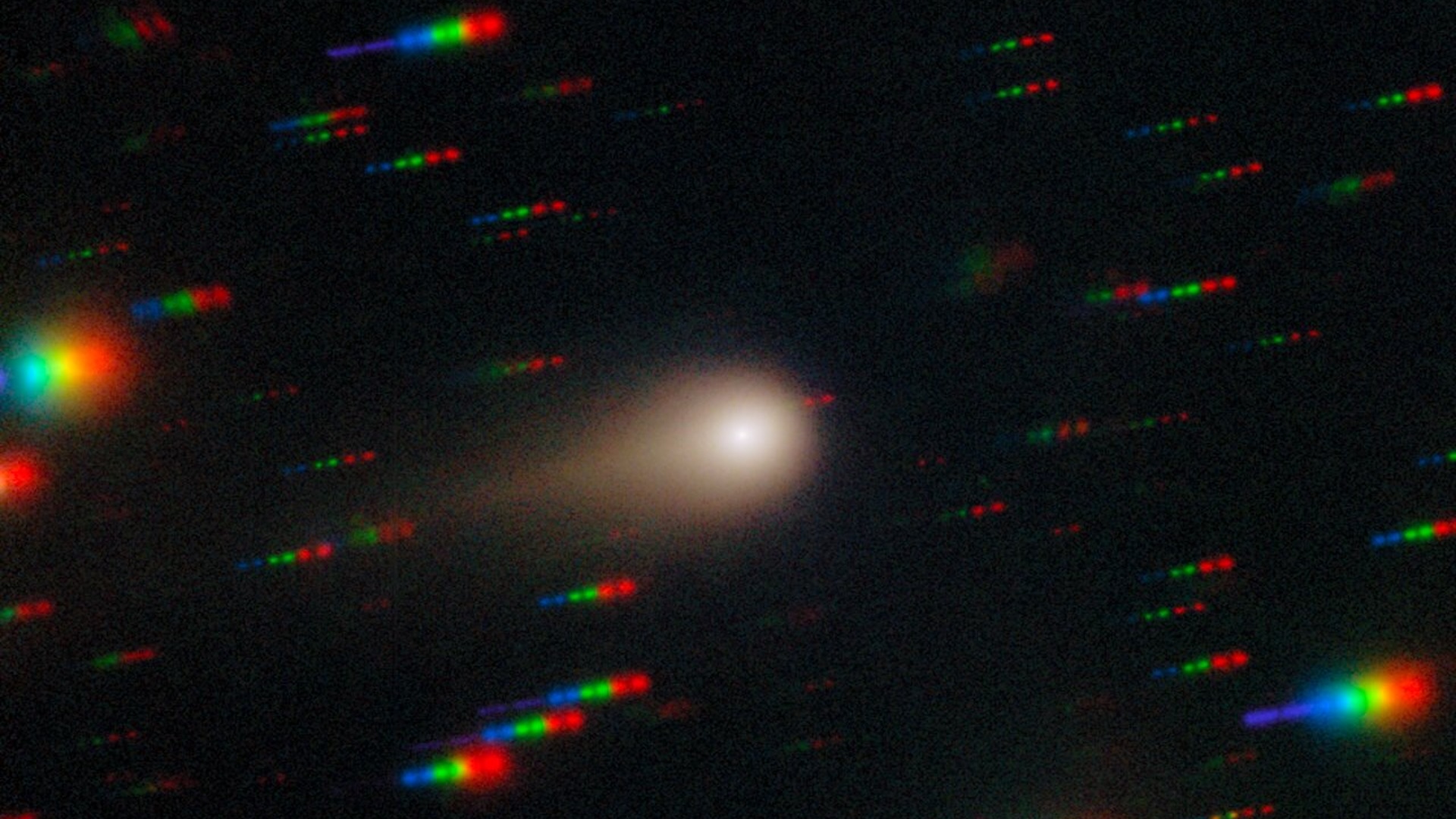
Observation time on large telescopes is a highly sought-after commodity, prompting astronomer Zhang to employ a strategic approach. He utilizes a smaller, personal 6-inch telescope for preliminary experiments, using it as a critical tool to anticipate and understand viewing conditions ahead of his scheduled windows on the more powerful Lowell Discovery Telescope.
It was during one of these preparatory sessions that Zhang achieved a notable success: he managed to capture a new image of the comet. This accomplishment was particularly impressive given the challenging circumstances, with the comet positioned a mere 16 degrees away from the sun and a low 5 degrees above the horizon.
According to Zhang, comet 3I/ATLAS was consistently monitored via radio frequencies during its perihelion passage. While he made a post-perihelion optical observation himself, Zhang acknowledged the possibility of an earlier visual sighting by another astronomer. However, he stressed that, to his knowledge, no other such observations preceding his own have been publicly reported or confirmed.
Scientists are poised to begin a crucial observation period for comet 3I/ATLAS. As comets draw closer to stars, their surface ice warms and sublimates, transforming directly into gas. This natural phenomenon will offer researchers an unparalleled opportunity to decipher the comet’s precise chemical makeup, particularly as it recedes from the Sun.
Astronomers are largely confident that 3I/ATLAS, an intriguing interstellar visitor, is a conventional comet originating from an unknown star system within the Milky Way. This scientific consensus comes despite initial frenzied media speculation that floated theories of an alien spacecraft. Further enhancing its unique profile, Comet 3I/ATLAS may also hold the distinction of being the oldest comet ever observed, with one study estimating its age at approximately three billion years older than our solar system.
Preliminary investigations suggest that comet 3I/ATLAS, an interstellar visitor, may have undergone a profound transformation due to prolonged exposure to space radiation. This relentless bombardment is theorized to have formed a thick, irradiated crust that now obscures any discernible resemblance to its home star system. Should these early findings be confirmed, scientists could face significant hurdles in pinpointing the comet’s true cosmic origins.
Regardless of these complexities, the astronomical community anticipates a surge of new research into comet 3I/ATLAS in the coming months, coinciding with its much-anticipated reappearance in the night sky.
Zhang stated that the comet is rapidly emerging from the sun’s glare. He anticipates that within approximately one week, the celestial body will have achieved an angular separation of 25 to 30 degrees from the sun. This increased distance is crucial, as it will enable a multitude of large telescopes worldwide to commence comprehensive observations of its trajectory.





