
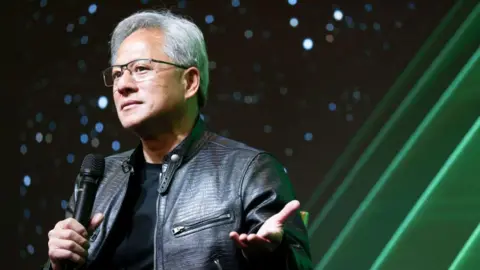
US chip giant Nvidia will supply more than 260,000 of its most advanced artificial intelligence (AI) chips to South Korea’s government, as well as Samsung, LG, and Hyundai.
The companies will all deploy the AI chips in factories to make everything from semiconductors and robots to autonomous vehicles and meant that South Korea can “now produce intelligence as a new export,” chief executive Jensen Huang said.
Mr Huang did not disclose the value of the South Korean deals.
It caps off a busy week for Nvidia, which on Wednesday became the first company to be valued at $5 trillion and on Thursday saw signs of a thaw in US-China trade relations that may mean it can export more of its chips to China .
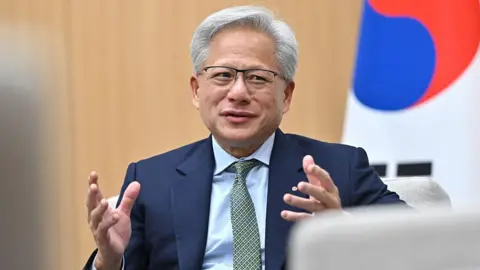
Speaking at a CEO summit on the sidelines of Asia Pacific Economic Cooperation (Apec) in Gyeongju, South Korea, Mr Huang added that with the chips, companies would be able to create “digital twins” with other factories around the world.
These deals form part of Nvidia’s latest effort to expand AI infrastructure globally, to further integrate AI into products and services.
Nvidia has been striking international partnerships which helped it become the first company ever to be valued at $5tn (£3.8tn) on Wednesday.
The South Korea deals come as Nvidia grapples with the fallout of the China-US trade war.
China made up more than a tenth of Nvidia’s revenue last year, but the extent of China’s access to Nvidia’s chips has been a point of friction with Washington.
“We used to have 95% share of the AI business in China. Now we’re at 0% share. And I’m disappointed by that,” Huang said in Gyeongju on Friday.
Trump said after his meeting with Xi on Thursday that Beijing will hold talks with Nvidia to discuss sales of its chips in China.
Trump said the talks remained between China and the US company, but that the US government will play the role of a “referee” of sorts.
On Friday, Huang said he would like to sell Nvidia’s state-of-the-art Blackwell chips to China, although the decision needed to be made by the US President.
The US imposes export controls on sales to China of Nvidia’s most-advanced AI chips.
The tech boss had no news on China sales, or the talks between the two leaders but that he hopes they’ll find a way to have new policies that allow chips back into China.
“It’s in the best interest of America to have the China market and it’s in China’s interest to have an American company bring technology to the country,” Huang said.
“We’d like to see American technology be the global standard.”





