Mars is poised to become the focus of significant scientific inquiry this weekend, as NASA readies for the dual launch of a pair of identical satellites. These advanced probes are specifically designed to investigate one of the Red Planet’s most enduring mysteries: the mechanisms behind its dramatic loss of a thick atmosphere and its once-abundant liquid water. Unraveling this ancient enigma is considered crucial to understanding Mars’ profound transformation from a world potentially capable of sustaining life into the frigid, desolate landscape it is today.
A pioneering $80 million mission, ESCAPADE — or Escape and Plasma Acceleration and Dynamics Explorers — is set to launch twin probes to Mars, marking a significant first for NASA. Scheduled for liftoff no earlier than Sunday, November 9th, from Cape Canaveral, Florida, aboard Blue Origin’s New Glenn rocket, this dual-satellite endeavor aims to provide an unprecedented 3D view of how the solar wind interacts with the Martian atmosphere.
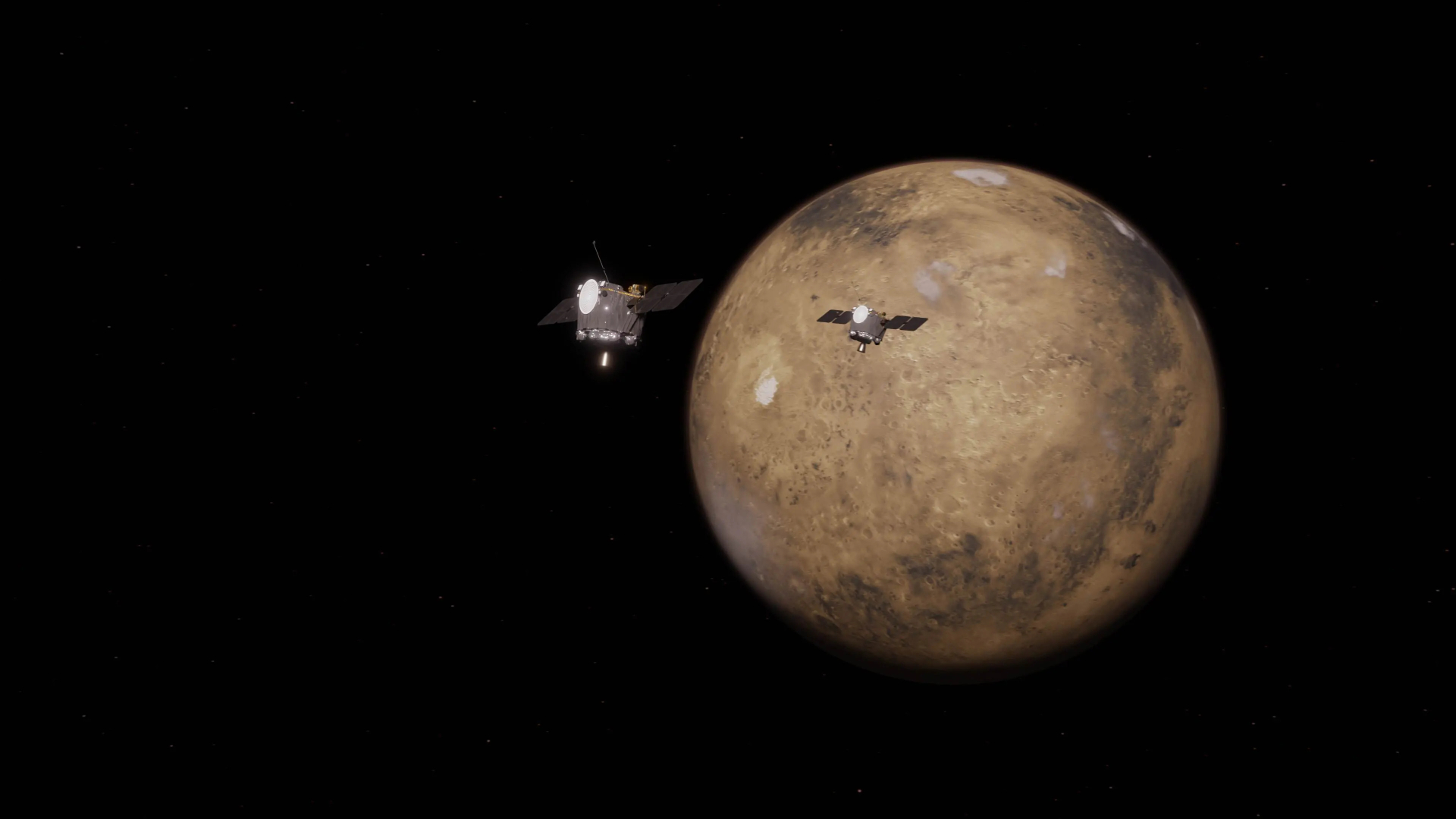
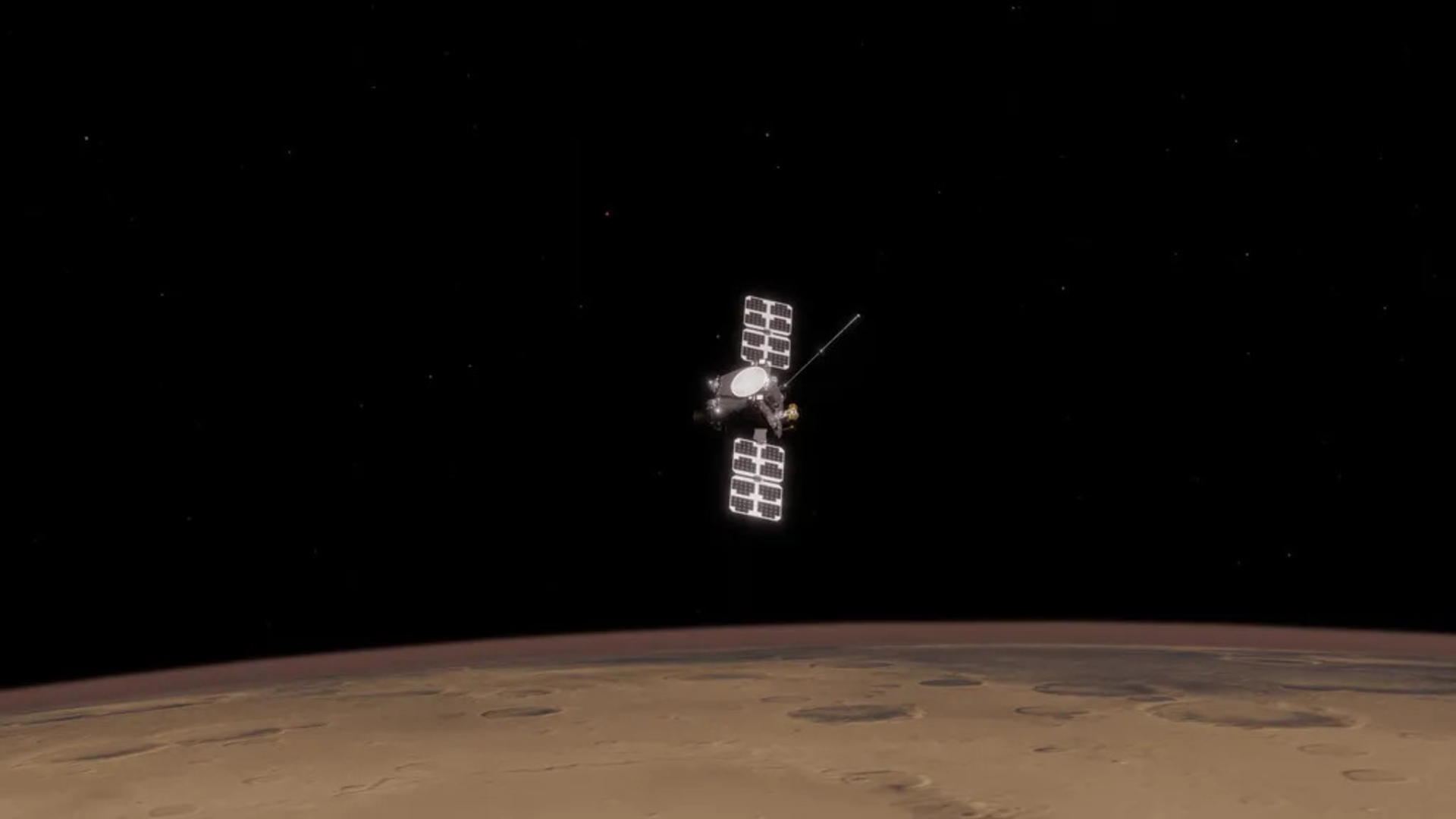
The two probes, affectionately nicknamed “Blue” and “Gold,” will orbit the Red Planet in tandem. Their primary objective is to meticulously map how the stream of charged particles from the sun energizes and gradually strips away Mars’s atmospheric gases, offering critical insights into the planet’s atmospheric evolution.
Understanding how the solar wind strips away a planet’s atmosphere is a key piece in deciphering Mars’ past climate evolution, explained Robert Lillis, principal investigator for ESCAPADE and associate director for planetary science at the University of California, Berkeley’s Space Sciences Laboratory.
In a statement released Wednesday (Nov. 5), Lillis highlighted ESCAPADE’s unique capability to advance this research: “ESCAPADE gives us what you might call a stereo perspective — two different vantage points simultaneously,” which will provide unprecedented insights into these crucial atmospheric escape mechanisms.
Mars once boasted liquid water, a fact revealed by geological evidence such as ancient river valleys and water-formed minerals. This presence of surface water also indicates the planet sustained a much thicker atmosphere in its early history. However, around four billion years ago, a critical transformation began. Mars’s magnetic field – the unseen shield that protects a world from the sun’s potent radiation – started to dissipate. Without this crucial planetary defense, the solar wind relentlessly eroded the Martian atmosphere, gradually stripping it away. The outcome is the thin, tenuous air Mars possesses today, less than one percent as dense as Earth’s atmosphere.
Previous groundbreaking missions, including NASA’s Mars Global Surveyor, MAVEN, and the Emirates Mars Mission Hope, have definitively shown that Mars does not possess a planet-wide magnetic field. However, these investigations also revealed the presence of distinct, localized magnetic “bubbles” firmly embedded within the Martian crust. A significant challenge for scientists has been the inherently restrictive nature of past observations: typically, only one spacecraft could orbit the planet at any given time. This limitation meant researchers were often confined to viewing single regions, frequently with observational delays spanning several hours, thus hindering a comprehensive, simultaneous understanding of these crustal magnetic anomalies.
Dr. Lillis emphasized the groundbreaking capability of the ESCAPADE satellites, explaining that they will allow scientists to meticulously track regional variations at intervals as precise as two minutes, extending up to 30 minutes. This unprecedented temporal resolution, according to Lillis, will enable novel measurements and facilitate a comprehensive characterization of dynamic systems in a way that was previously unattainable.

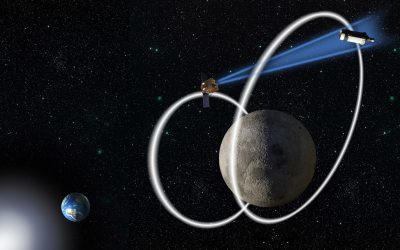
Arriving at Mars in September 2027, a specialized robotic duo will embark on a complex mission to map the planet’s atmospheric dynamics. Following approximately seven months dedicated to fine-tuning their orbits, the probes are slated to begin a unique close-formation flight. They will operate like “a pair of pearls on a string,” maintaining a precise altitude of just 100 miles (160 kilometers) above the Martian surface.
Should this initial phase proceed successfully, the pair will then conduct six months of joint observations. Afterwards, they are programmed to separate into distinct orbits for an additional five months. The primary objective of this multi-phase mission is to construct a comprehensive three-dimensional map detailing the intricate flow of energy and matter between Mars and the solar wind—a critical process understood to govern the planet’s atmospheric loss.
Over approximately 11 months of dedicated scientific operations, the ESCAPADE mission is poised to unravel three pivotal mysteries surrounding Mars. The spacecraft will investigate the precise structure and configuration of the Red Planet’s magnetic bubble, analyze how energy streaming from the sun interacts with this magnetic field, and ultimately determine the profound impact these interactions have on the movement of particles into and out of the Martian atmosphere.
To achieve its objectives, each probe, approximately the size of a copy machine, carries an identical suite of scientific instruments engineered to work in concert. Central to this array are electrostatic analyzers, developed at UC Berkeley. These instruments will detect charged particles escaping from Mars, and by meticulously measuring their direction and energy, scientists can determine whether these particles are drawn back to the planet or are irreversibly swept away by the relentless solar wind.
A sophisticated magnetometer from NASA’s Goddard Space Flight Center will precisely monitor the strength and orientation of magnetic fields. Simultaneously, plasma sensors developed at Embry-Riddle Aeronautical University are set to investigate various plasma properties. Providing a visual component, student-built cameras from Northern Arizona University will document the Martian landscape, offering the exciting possibility of capturing glimpses of the planet’s enigmatic green auroras.
The ESCAPADE mission is pioneering a novel trajectory to Mars, departing from the traditional direct route. Instead, the spacecraft will first navigate towards a Lagrange point – a gravitationally stable “sweet spot” positioned between Earth and the sun. After spending approximately one year at this celestial waystation, ESCAPADE will utilize a gravity assist to slingshot towards Mars, targeting a 2026 arrival. Researchers suggest that this extended yet more adaptable flight path offers crucial flexibility, potentially reducing future missions’ dependence on the narrow, biennial launch windows typically dictated by planetary alignment for Martian voyages.
Understanding the intricate relationship between solar radiation and Mars’ upper atmosphere, known as the ionosphere, is proving vital for future exploration. This electrically charged layer plays a critical role in Martian communications, as it can reflect radio waves, enabling them to travel beyond the horizon. Therefore, accurately mapping the ionosphere’s behavior will be indispensable for robust communication and precise navigation systems for both robotic and human missions.
Furthermore, the insights gained from studying this atmospheric interaction could offer tantalizing clues about one of Mars’ most profound mysteries: the potential presence of liquid water hidden beneath its surface. This possibility has recently been reinforced by analyses of seismic data from NASA’s InSight lander, and confirming the existence of subterranean water would represent a pivotal discovery, profoundly impacting the strategy and viability of future human exploration on the Red Planet.
Lillis affirmed that establishing a human settlement on Mars presents a monumental challenge. However, he quickly tempered this assessment with a note of optimism, underscoring humanity’s inherent tenacity as the key factor in surmounting such a formidable endeavor.