
Blue Origin’s powerful New Glenn rocket is poised for a significant launch this weekend, as it prepares to send a critical NASA mission on its journey to Mars. The public will have the opportunity to watch the momentous liftoff live.
This Sunday, November 9, a pair of ESCAPADE Mars probes are slated to embark on their journey from Florida’s Cape Canaveral Space Force Station. The mission will see the twin spacecraft lift off atop the partially reusable New Glenn rocket during a 2.5-hour launch window, which is set to commence at 2:45 p.m. EDT (1945 GMT).
Live coverage of Blue Origin’s New Glenn rocket’s second-ever launch will be provided directly by the aerospace company, founded by Amazon’s Jeff Bezos. Space.com also anticipates carrying the broadcast, contingent on Blue Origin making the feed publicly available.
The upcoming ESCAPADE mission, an acronym for “Escape and Plasma Acceleration and Dynamics Explorers,” is poised to break a more than five-year hiatus in Mars exploration. Its launch will mark the first dedicated journey to the Red Planet since NASA’s Perseverance rover and its Ingenuity helicopter departed Earth together on July 30, 2020.
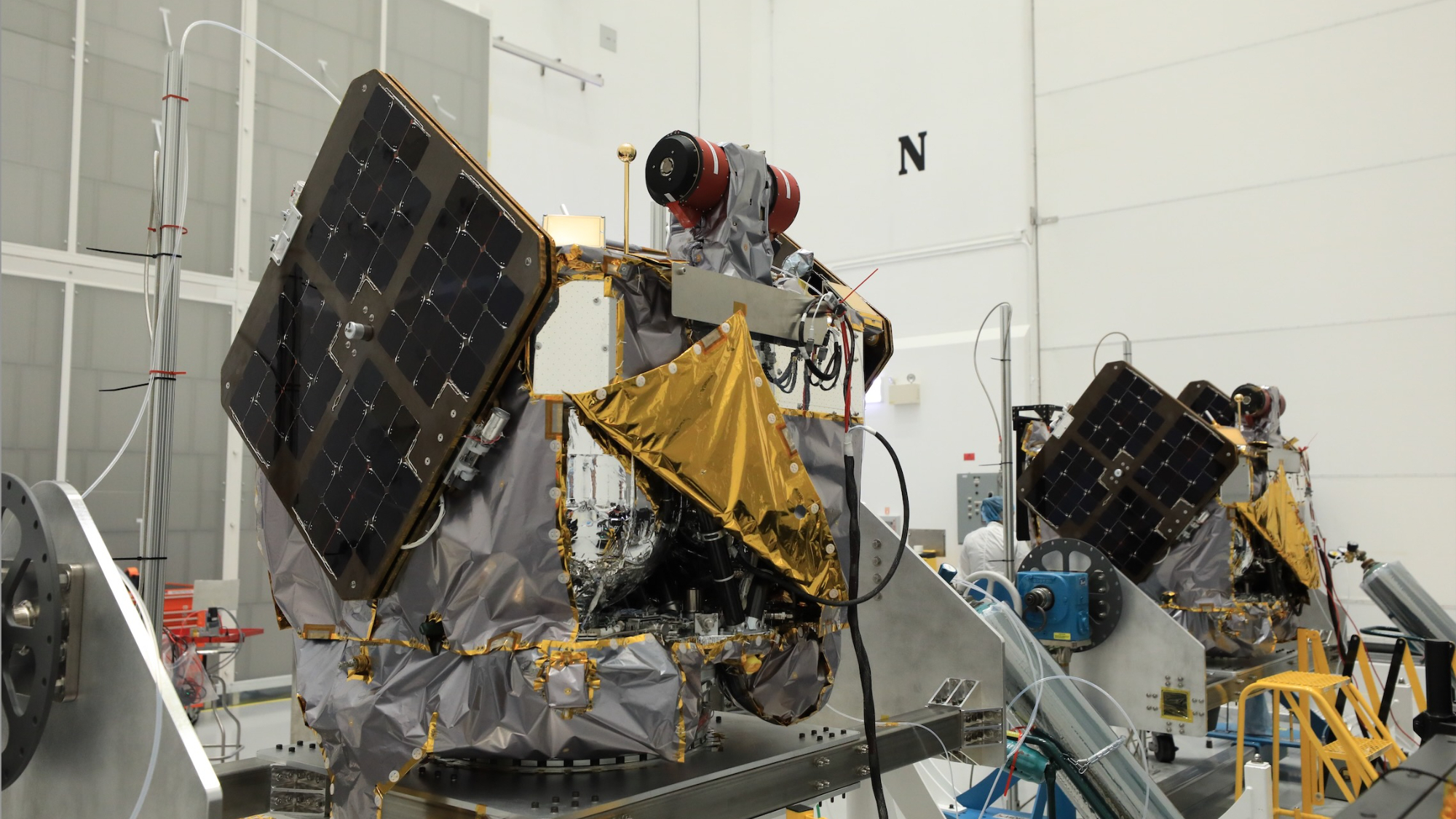
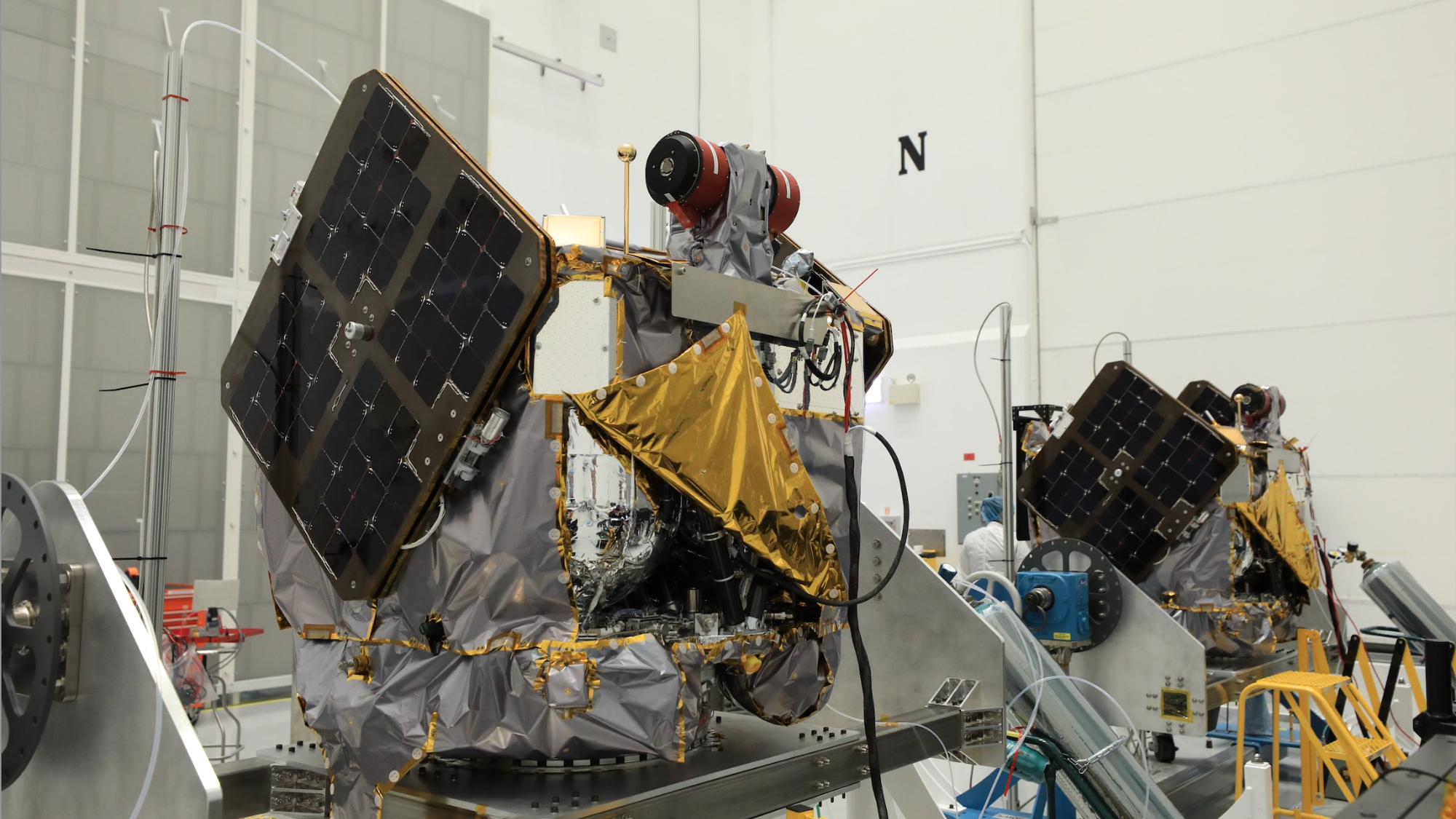
The $80 million ESCAPADE mission will deploy two spacecraft, both developed by Rocket Lab. These probes are slated for operation by the University of California, Berkeley, on behalf of NASA. Their names, “Blue” and “Gold,” serve as a direct nod to UC Berkeley’s iconic school colors, reflecting the institution’s integral role in the mission’s oversight.
Blue Origin’s New Glenn rocket is slated to carry the Blue and Gold mission to the Earth-sun Lagrange Point 2 (L2). This specific orbital position, known for its inherent gravitational stability, is situated approximately 930,000 miles (1.5 million kilometers) past our planet.

For an initial 12-month period, the two probes will dedicate themselves to an intensive study of space weather from their current orbital position. This critical observational phase will culminate in November 2026 with a pivotal Earth flyby. Harnessing our planet’s gravitational field, the mission will execute a slingshot maneuver, gaining the necessary velocity to propel itself onto an extended trajectory toward Mars. Arrival at the Red Planet is anticipated approximately 10 months following this crucial gravitational assist.
Interplanetary travel to Mars demands a precise and complex trajectory, a requirement dictated by the immutable laws of orbital dynamics. Earth and the Red Planet achieve optimal alignment for efficient journeys just once every 26 months. Consequently, the next critical launch window for such missions is slated for late 2026.
Upon their arrival at Mars, the ESCAPADE probes are slated for an approximate seven-month deployment phase, during which they will meticulously maneuver into their precisely aligned operational orbits. Following this critical positioning, the spacecraft are scheduled to commence an intensive data collection mission, expected to last for a minimum of 11 months.
In a groundbreaking endeavor detailed by UC-Berkeley, a fleet of orbiters is set to fly in precise formation around Mars. Their mission is to generate the first-ever three-dimensional, stereo map of the Red Planet’s magnetic fields, upper atmosphere, and ionosphere, offering an unprecedented perspective on its unique near-space environment.
The university further explained that these forthcoming discoveries are poised to significantly advance scientific understanding of when and how Mars lost its atmosphere. Crucially, the findings will also furnish vital data regarding the planet’s prevailing conditions, which are essential for informing future human missions aimed at landing on or establishing settlements on Mars.
This Sunday, the New Glenn heavy-lift rocket is set for its second-ever launch. The powerful vehicle boasts a significant capacity, capable of transporting approximately 50 tons (45 metric tons) of payload into low Earth orbit.
On January 16, 2025, a new rocket completed its successful maiden voyage, propelling a prototype of Blue Origin’s Blue Ring spacecraft platform into orbit during its inaugural test flight.
While its initial attempt to land the New Glenn rocket’s first stage on a recovery vessel at sea proved unsuccessful, the company is poised for a second try at this crucial maneuver. The next high-stakes recovery operation is scheduled for this Sunday, promising significant action for space enthusiasts and observers.