

In a groundbreaking scientific first, physicists have meticulously studied a rare molecule to precisely map how magnetism is distributed within a radioactive nucleus.
The fundamental principles governing the natural world are remarkably immutable. Whether a ball is tossed in Seattle or Tokyo, its trajectory and descent remain precisely the same. Physicists identify this universal uniformity as ‘symmetry,’ employing it as a crucial guide to anticipate and comprehend the universe’s behavior. This consistent framework is essential for maintaining cosmic order; without it, a reality where physical laws arbitrarily changed, perhaps daily, would quickly devolve into inexplicable chaos.
While nature often suggests a delicate balance, not all cosmic phenomena adhere to this principle of perfect symmetry. A prime example is the universe’s striking imbalance between matter and antimatter. Despite the intuitive expectation that the cosmos would host an equal distribution of both, our observable universe is overwhelmingly composed of matter—a profound asymmetry whose origins continue to baffle physicists.
Scientists are increasingly turning their attention to radioactive nuclei, which are emerging as a highly promising frontier in the quest for new physics. The inherently imbalanced structure within these nuclei, characterized by an uneven arrangement of protons and neutrons, can dramatically magnify even the most minuscule breaks in fundamental symmetries.
Should researchers successfully detect these amplified asymmetries, it could unveil groundbreaking physics that extends beyond the established Standard Model of particle physics. This is according to Silviu-Marian Udrescu, an MIT physicist and co-author of a recent study examining this phenomenon.
In a surprising and groundbreaking discovery, scientists from CERN and MIT have achieved a significant first: the direct observation of how magnetism is distributed within the nucleus of a molecule. This phenomenon, known as the Bohr–Weisskopf effect, had previously never been witnessed in a molecular structure.
Detailed in the October 23 issue of the journal *Science*, the finding emerged unexpectedly. The research team was initially focused on measuring the energy spectrum of radium monofluoride (RaF), a short-lived radioactive molecule, when they instead uncovered the intricate magnetic mapping within its nucleus.
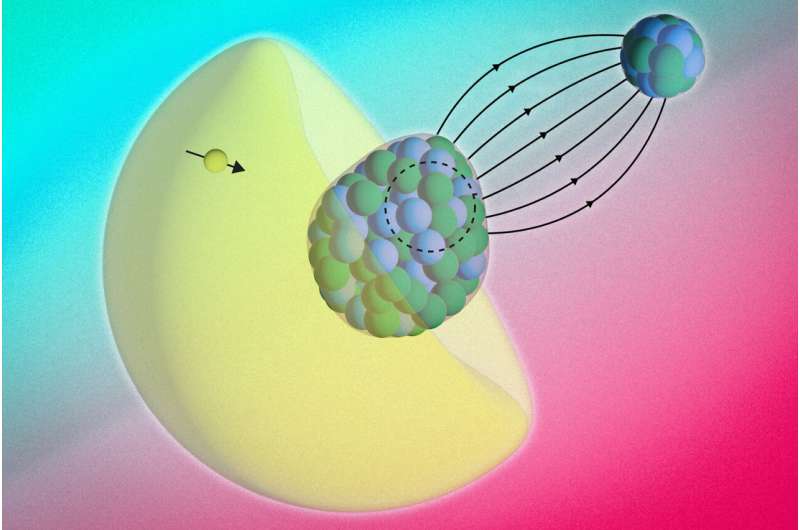
The RaF molecule is comprised of two distinct atomic constituents: radium and fluoride. While each of these atoms contains its own nucleus, a particularly significant characteristic arises from the radium nucleus, which is notably defined by a unique property known as “octupole deformation.”
Imagine an atomic nucleus shaped not like a perfect sphere, but rather a pear or an avocado. This striking asymmetry characterizes the nucleus of RaF, as explained by MIT physicist Shane Wilkins, who served as the study’s lead author. This distinctive, lopsided geometry is precisely what makes RaF an exceptional candidate for researchers endeavoring to uncover fundamental asymmetries within the subatomic realm.
Udrescu highlighted the extreme rarity of this property, explaining that it manifests in only a select few atomic nuclei across the entire nuclear chart. Crucially, every nucleus identified with this distinctive “pear shape” is, without exception, radioactive.
Studying certain atomic nuclei presents a significant challenge due to their inherent radioactivity and fleeting existence. These specific isotopes are both unstable and remarkably short-lived, often decaying within approximately 15 days. This rapid disintegration means they frequently vanish before researchers can conduct comprehensive measurements. Compounding the difficulty, as explained by Wilkins, is the fact that these isotopes can only be produced in very small quantities.
Scientists have successfully observed the Bohr-Weisskopf effect in individual atoms, a phenomenon characterized by electron interaction with a single nucleus. However, probing this delicate effect within the confines of a molecule proves significantly more difficult. The principal hurdle lies in the relentless movement of electrons oscillating between two nuclei. This constant flux inevitably blurs crucial magnetic signals, rendering them exceedingly challenging to discern.
To circumvent this challenge, researchers are leveraging the unique properties of the RaF molecule. Here, the fluoride atom, serving as a relatively simple bonding partner, strategically allows scientists to sharpen their focus directly on the intricate magnetic structure of the much heavier radium nucleus.
At CERN’s ISOLDE facility, a team of scientists achieved a significant breakthrough by successfully creating radium monofluoride for the first time. The complex process involved bombarding a uranium target with high-energy protons, which yielded the rare and elusive radium-225 isotope. This isotope was then reacted with fluorine gas to form the novel compound.
However, the existence of these radium monofluoride molecules proved remarkably fleeting, with each surviving for only fractions of a second. This inherent instability presented a considerable challenge for researchers, who could detect approximately fifty molecules per second that were stable enough for critical measurement and analysis.
Scientists initiated the experiment by precisely targeting molecules with an array of laser beams, each calibrated to a subtly distinct frequency. As the molecules absorbed or emitted light, researchers meticulously documented the minute changes within those beams, a process that yielded a detailed spectrum. While such spectral patterns typically provide insights into the dynamics of electrons orbiting an atom’s nucleus, a significant finding emerged from this study: certain observed shifts undeniably revealed that the electrons were being influenced by forces originating from *within* the nucleus itself.
According to Wilkins, the traditional view of electron-nucleus interaction needs revision. Electrons, he explained, don’t merely interact from a distance; they ‘probe’ deep within the nucleus itself. This penetration fundamentally transforms the interaction from a long-range force to one that directly senses and is influenced by the radium nucleus’s internal properties.
Researchers have observed the Bohr–Weisskopf effect, a phenomenon described as unprecedented in a molecular context. According to Wilkins, this marks the first time the effect has been witnessed within a molecule.
The successful combination of experimental observation and theoretical description, Wilkins noted, offers crucial insights into the remarkable potential of these molecules for future high-precision measurements.
Having successfully charted the intricate internal structure of RaF molecules, researchers are now poised to delve into even the most minute effects that could challenge the fundamental symmetries of nature. The next critical phase, as outlined by Wilkins, involves harnessing sophisticated laser technology to meticulously slow and trap these molecules, paving the way for unprecedentedly precise measurements.
Udrescu highlighted a significant shift in understanding, noting that these entities are now recognized as potent instruments in the ongoing quest for novel physics.





