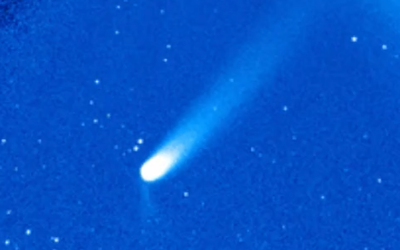
The cosmos frequently transforms an object’s demise into a breathtaking display, and this holds true for the “other” Comet ATLAS. Stunning new images now reveal the comet’s slow, beautiful disintegration, a dramatic aftermath to its explosive end earlier this month.
A celestial visitor from the distant Oort Cloud, comet C/2025 K1 (ATLAS), has recently captured astronomical attention due to an extraordinary display. Discovered in May by astronomers utilizing the Asteroid Terrestrial-impact Last Alert System (ATLAS), this comet reached its perihelion—its closest approach to the sun—on October 8, coming within a remarkable 31 million miles (50 million kilometers) of our star.
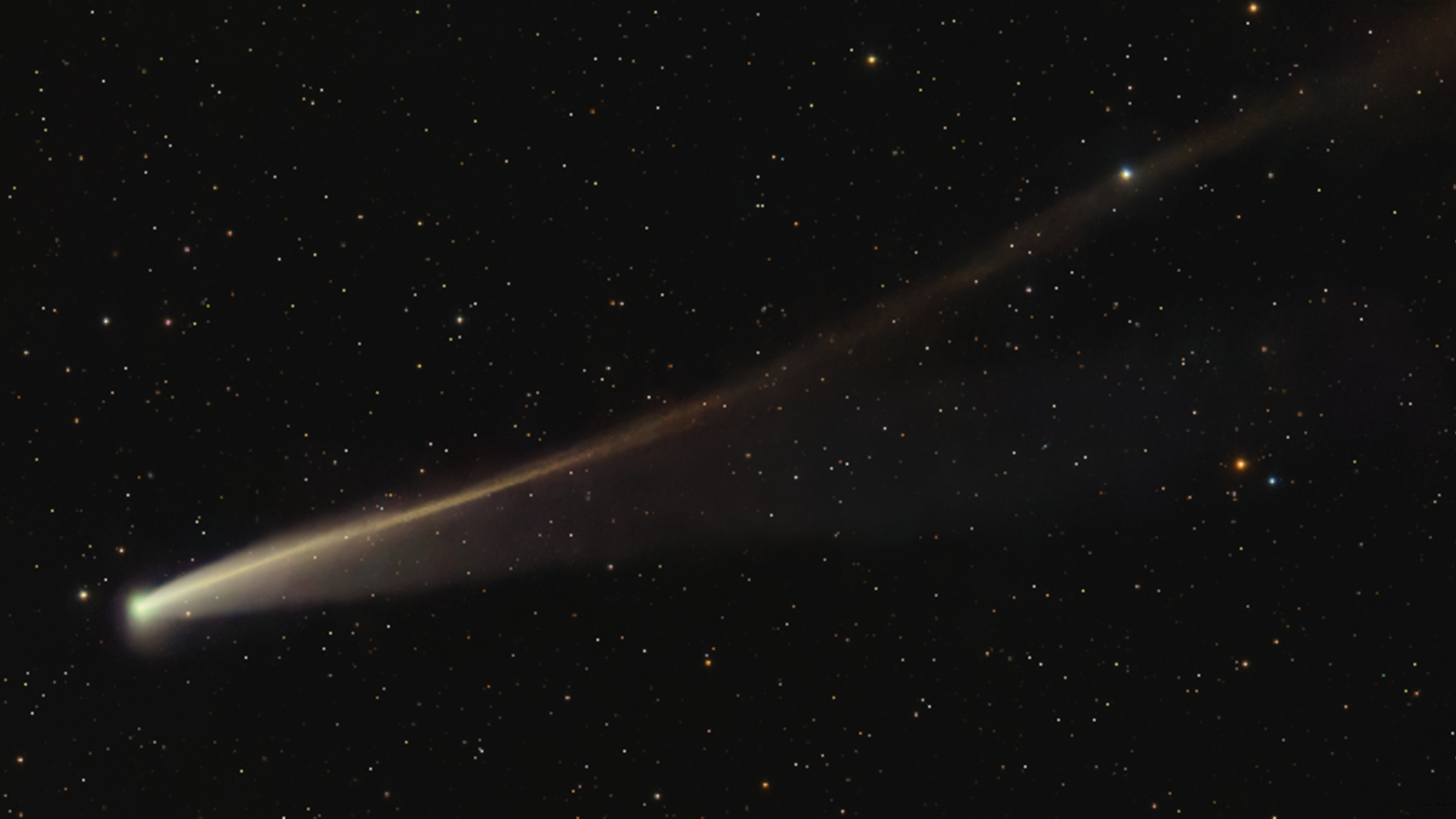
Despite its close solar encounter, the comet largely went unnoticed until earlier this month. It was then that C/2025 K1 (ATLAS) began to emit a distinctive, rare golden glow from its coma and tail, transforming it into a captivating spectacle for observers.
A new celestial discovery has been informally dubbed “the other ATLAS,” distinguishing it from the interstellar comet 3I/ATLAS, which has dominated headlines since its initial sighting streaking through the solar system in July. Despite sharing a name, these two comets are fundamentally unrelated. Their only commonality stems from being detected by the same telescope network within a similar timeframe.
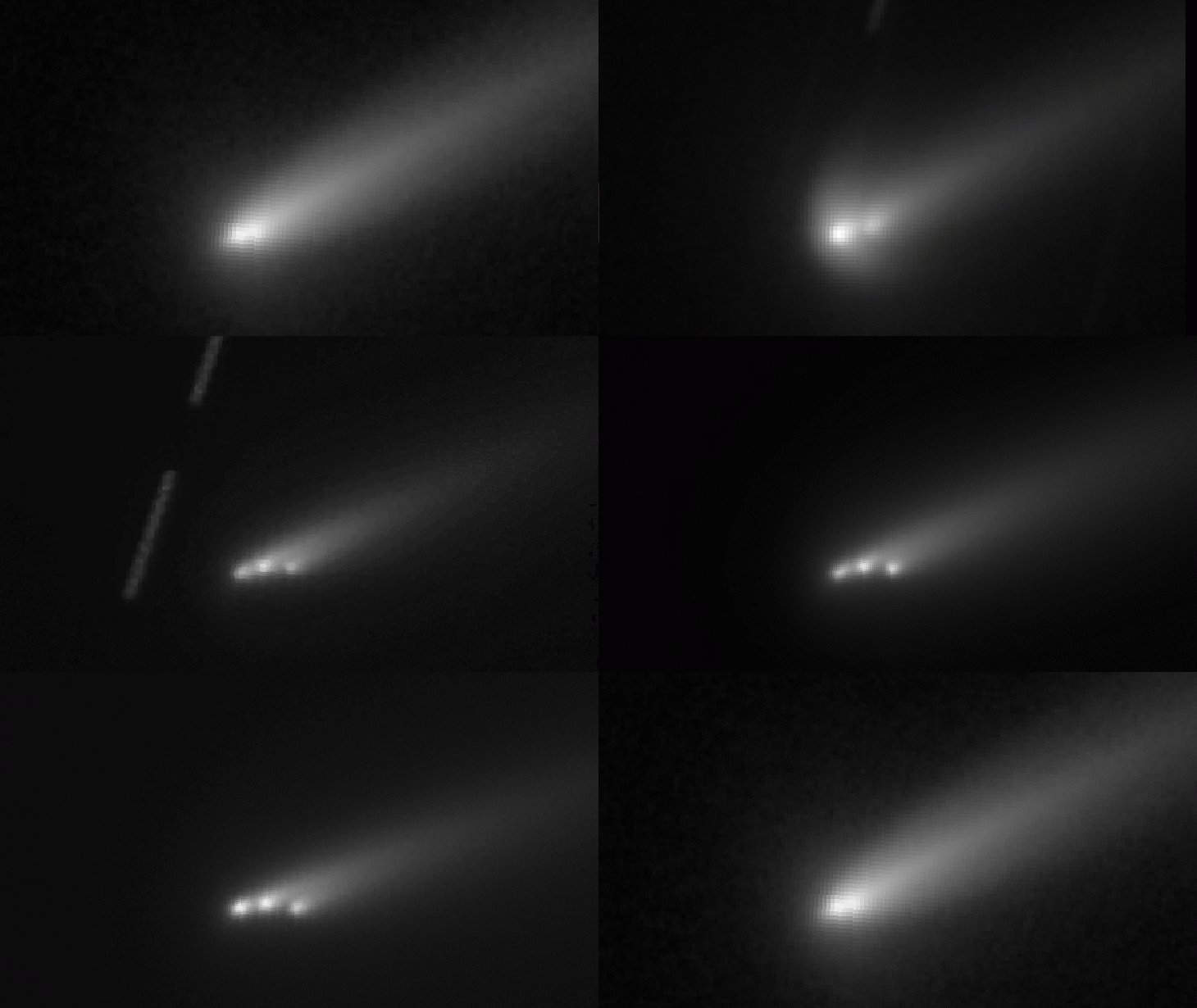
Astronomers first noted the dramatic breakup of comet C/2025 K1 on November 13, as it fragmented into multiple pieces. Since this celestial event, Austrian astrophotographer Michael Jäger has maintained a vigilant watch, closely monitoring the comet’s ongoing disintegration. He has now released a stunning timelapse animation that vividly illustrates the comet’s fragments slowly separating and drifting apart, offering a unique glimpse into this rare astronomical phenomenon.
For the past two weeks, observers have witnessed a comet undergoing a dramatic transformation, fracturing into three distinct and brighter fragments. This celestial event follows a series of significant brightness surges recorded earlier in November, as confirmed by Jäger to Spaceweather.com. An accompanying animation visually chronicles this fragmentation on November 12, 14, 18, 19, and 20.
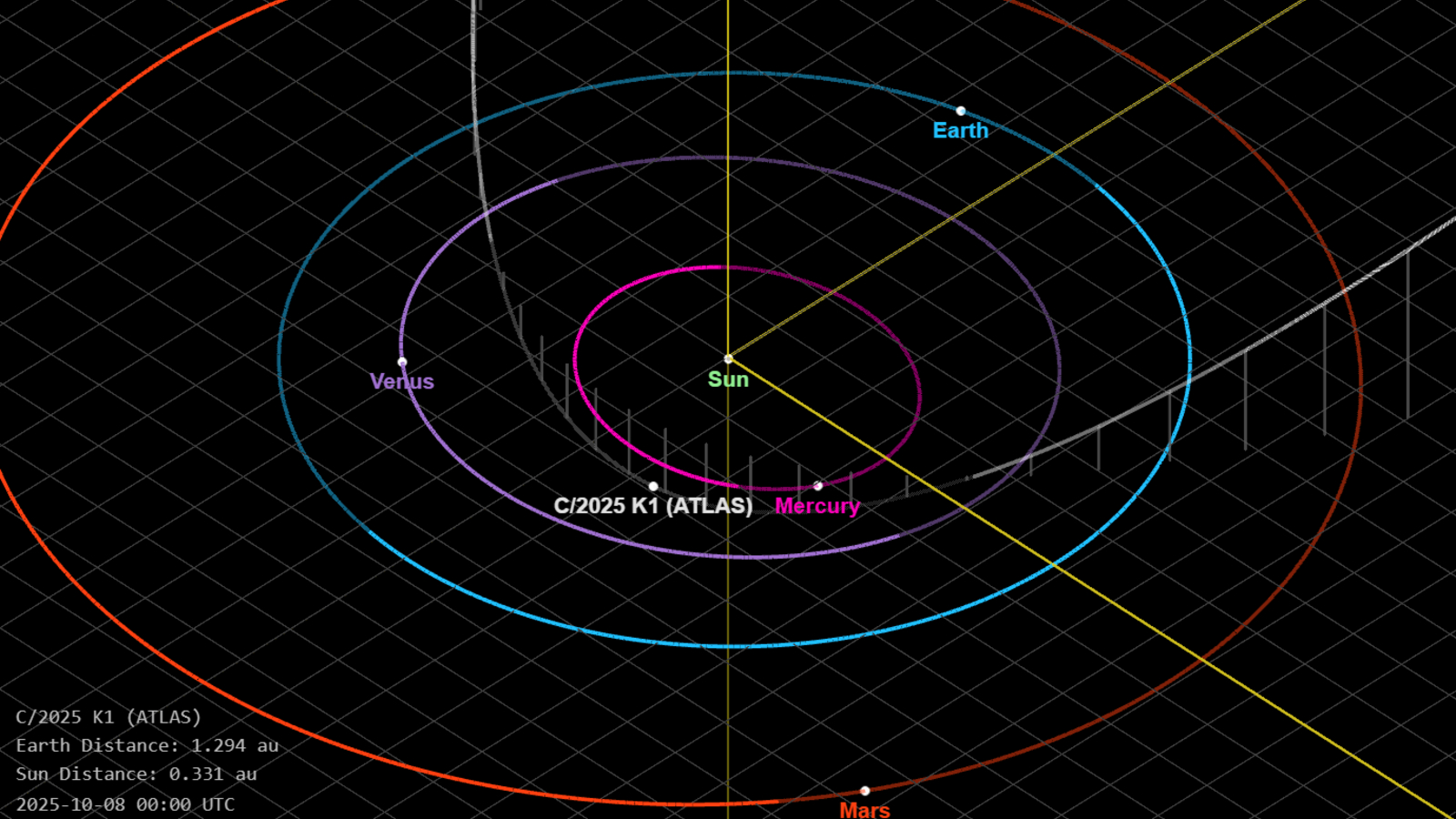
Astronomers had widely predicted the comet’s demise at its closest approach to the sun, known as perihelion, due to the immense gravitational strain it would endure. Initially, after its scorching solar flyby, observations suggested the icy wanderer had miraculously survived, appearing to emerge intact. However, this apparent triumph was short-lived. Following a sudden and dramatic brightening event, the celestial body dramatically fragmented into three distinct pieces.
Recent photographic evidence has confirmed the detachment of an additional, smaller fourth fragment from the comet, as reported by Spaceweather.com. Despite its discovery, this newly identified piece is notably absent from the latest animation.
Comet C/2025 K1 has captured scientific attention with its rare golden hue, a distinctive characteristic attributed to an unusual scarcity of carbon-bearing molecules—including dicarbon, carbon monoxide, and cyanide—within its nucleus. This remarkable composition places C/2025 K1 among the most carbon-poor comets ever observed. According to recent reports from astronomer David Schleicher of Arizona’s Lowell Observatory, only two other known comets have exhibited an even more pronounced depletion of these crucial compounds.
Scientists had aimed to gather critical new data on the comet’s surprising composition during its anticipated close approach to Earth on Tuesday, November 25. However, their hopes of learning more during this rare event now appear unlikely to materialize.
Nonetheless, the comet’s dispersed fragments will continue to grace the night sky. For those equipped with a capable telescope or quality stargazing binoculars, these celestial remnants will be observable against the backdrop of the constellation Leo.
C/2025 K1 is not an isolated discovery for the Asteroid Terrestrial-impact Last Alert System, better known as ATLAS. This latest celestial visitor joins dozens of other comets previously identified by the NASA-funded robotic survey. Since its inception in 2015, ATLAS has meticulously scanned the night sky from a network of telescopes situated in Hawaii, South Africa, and Chile, consistently expanding our catalog of these distant ice worlds.
In recent years, a succession of ATLAS comets has repeatedly captured public and scientific interest, providing a series of spectacular celestial events. This past year alone highlighted several notable examples that graced the night sky.
Among them, Comet C/2024 G3 garnered significant attention earlier this year after International Space Station (ISS) astronauts captured its stunning presence in breathtaking photographs. Adding to the cosmic displays throughout 2024 were a fated sungrazer comet, the memorable Halloween ATLAS comet, and Comet Tsuchinshan-ATLAS, all of which made brilliant appearances for observers.
Among the celestial objects identified by the ATLAS program, 3I/ATLAS stands as the most renowned. This celebrated interstellar comet is now on a trajectory through our solar system, a cosmic visitor ejected from its primordial star system. Its ancient voyage potentially predates the very formation of our solar system.
Comet 3I/ATLAS is now on its expansive journey out of the solar system, having passed its perihelion—the closest point to the sun—on October 29. The celestial body is set for its closest approach to Earth on December 19, when it will be a considerable 168 million miles (270 million kilometers) from our planet. Despite various public speculations, the scientific consensus among astronomers is clear: 3I/ATLAS is unequivocally not an alien spacecraft.
The precise nature of the wonders that future ATLAS comets are poised to reveal will only become clear as time unfolds.