In a potentially groundbreaking development for astrophysics, scientists suggest they may have achieved the first direct observation of dark matter. This significant finding, attributed to data from NASA’s Fermi gamma-ray space telescope, could mark the inaugural direct detection of the universe’s most enigmatic substance.
The elusive concept of dark matter, an invisible force shaping the cosmos, first emerged in 1933. Astronomer Fritz Zwicky observed a critical gravitational deficit within the Coma Cluster: the visible galaxies lacked the necessary mass to prevent the entire cluster from flying apart, leading him to theorize the presence of unseen matter.
Decades later, in the 1970s, astronomer Vera Rubin and her colleagues unearthed further compelling evidence. Their studies of spiral galaxies revealed an unexpected phenomenon: the outer edges of these galactic systems were spinning at the same rapid rate as their centers. This defied conventional gravitational models, which predicted a decrease in speed with distance from the galactic core, strongly suggesting that the bulk of a galaxy’s mass was not concentrated at its center but rather widely dispersed throughout its expanse.
It’s important to note that these groundbreaking discoveries are not direct observations of dark matter itself. Instead, they are powerful inferences derived from its profound gravitational interactions with ordinary matter and light. Thanks to these findings, scientists have since calculated that all large galaxies are enveloped within vast, invisible halos of dark matter, stretching far beyond the observable limits of stars and gas.
The universe’s elusive dark matter is now estimated to possess a staggering five-to-one mass advantage over the ordinary, visible matter we encounter daily. This profound imbalance signifies that everything perceivable around us—from distant stars and planets to our own bodies and even the neighborhood cat—collectively accounts for a mere 15% of the cosmos’s total material composition. The overwhelming remaining 85% is attributed to this mysterious, unseen substance.
Adding to its enigma is dark matter’s peculiar interaction, or lack thereof, with electromagnetic radiation. Incapable of emitting, absorbing, or reflecting light, it remains fundamentally invisible across all wavelengths of the spectrum. Or at least, that has been the long-standing scientific consensus.

The universe’s elusive dark matter, long considered entirely invisible, may harbor a surprising mechanism to reveal itself through light. Scientists propose a compelling scenario where dark matter particles could “annihilate” when they meet and interact, much like matter and antimatter.
This theoretical annihilation event would trigger a cascade of particles, critically including high-energy photons in the form of gamma-rays. While these powerful gamma-rays are imperceptible to the human eye, they could be detected by advanced, sensitive gamma-ray space telescopes designed to capture such cosmic emissions.
Among the leading theoretical candidates for these self-annihilating dark matter constituents are “Weakly Interacting Massive Particles,” universally known by their acronym, WIMPs, which remain a primary focus in the quest to understand the universe’s hidden mass.
A research team, spearheaded by University of Tokyo astronomer Tomonori Totani, meticulously directed the Fermi spacecraft to key regions of the Milky Way. Their primary focus was the galactic center and other areas where dark matter is theorized to congregate, as they sought a distinctive gamma-ray signature that could unveil the elusive substance’s presence.
According to Totani, the research team has successfully identified the long-sought signature.

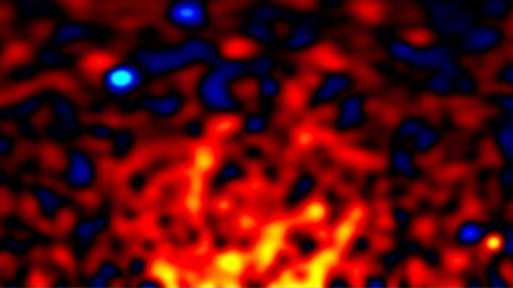
Astronomers have detected remarkably high-energy gamma rays, at an unprecedented 20 gigaelectronvolts (or 20 billion electronvolts), emanating from a halo-like structure stretching towards the heart of the Milky Way galaxy.
According to researcher Totani, this distinct gamma-ray emission pattern strikingly aligns with the expected shape and distribution of the elusive dark matter halo, offering a potential new window into the galaxy’s invisible mass.
This correspondence isn’t unique; the specific energy signature of these gamma-rays strikingly aligns with theoretical models predicting emissions from the annihilation of colliding Weakly Interacting Massive Particles (WIMPs). These elusive particles, often hypothesized as key components of dark matter, are theorized to possess a mass approximately 500 times greater than that of a proton—the fundamental building block found at the heart of atoms. Scientist Totani further asserts that there are no other readily available astronomical phenomena that can easily account for the gamma-rays observed by the Fermi space telescope, underscoring the potential significance of the WIMP connection.
Scientists may have achieved a monumental breakthrough, potentially observing dark matter for the first time in human history. According to Totani, this groundbreaking finding suggests dark matter is not merely an elusive substance but an entirely new particle, one currently unrecognized by the Standard Model of particle physics. Should this observation be confirmed, Totani emphasized, it would mark “a major development in astronomy and physics,” fundamentally reshaping our understanding of the universe.
Astrophysicist Totani and his colleagues are confident they have pinpointed the distinct signature of dark matter WIMPs (Weakly Interacting Massive Particles) annihilating within the Milky Way’s galactic core. However, the broader scientific community maintains that more definitive evidence is crucial. This potential breakthrough, while promising, represents another key moment in the nearly century-long quest to unravel the fundamental mystery of dark matter, a riddle that requires unequivocal proof before it can be considered solved.
According to Totani, the accumulation of additional data could lead to a pivotal discovery. Should this occur, it would provide significantly stronger evidence to support the theory that dark matter is the elusive source of these gamma rays.
The team’s research findings were formally published on Tuesday, November 25, in the *Journal of Cosmology and Astroparticle Physics*.