
Groundbreaking new research suggests a NASA telescope may have achieved a historic first: the observation of elusive dark matter. This invisible and mysterious substance is believed to constitute the vast majority of matter across the universe. However, scientists, including the study’s lead author, are urging caution, emphasizing that extensive further investigation is essential to fully understand and confirm the significance of this potential discovery.
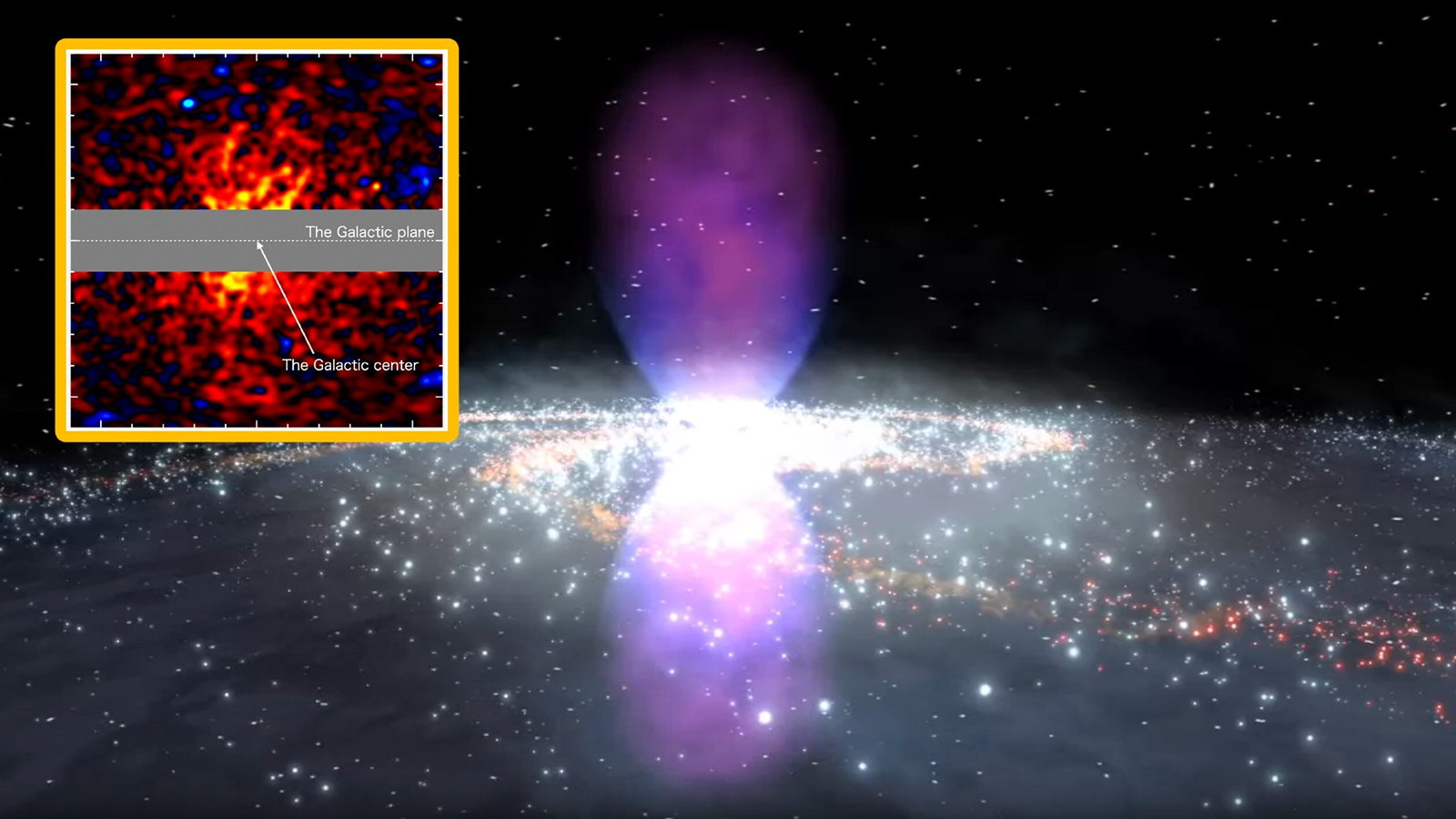
NASA’s Fermi Gamma-ray Space Telescope, an observatory specializing in the detection of high-energy gamma-rays, has identified intriguing emissions at the heart of the Milky Way galaxy. These unusual gamma-ray signals, according to a study published Tuesday (Nov. 25) in the Journal of Cosmology and Astroparticle Physics, may offer a significant clue in the ongoing hunt for dark matter, potentially stemming from interactions involving its elusive particles.
University of Tokyo astronomy professor Tomonori Totani, the sole author of a new study, has announced a potentially historic milestone. In a statement, Totani indicated that if his findings are confirmed, it would mark the first time humanity has “seen” dark matter, an observation he believes to be unprecedented to the best of his knowledge.
The study itself emphasizes a crucial caveat: independent corroboration of this observed signal is imperative. This validation must extend beyond our own galaxy, the Milky Way, to include “other objects or regions” exhibiting comparable characteristics.
Further underscoring the demand for scrutiny, Sean Tulin, a theoretical physicist and assistant professor of physics and astronomy at York University in Toronto, conveyed to Live Science his desire for an independent analysis of the findings. Tulin’s caution, he explained, stems from previous instances where similar claims have been advanced based on data from the Fermi telescope.
The “galactic center excess,” an enigmatic source of gamma-ray light first detected in 2009 using Fermi data, stands as a prominent astrophysical puzzle. Despite nearly two decades of intensive research, scientists remain deeply divided over its true nature. The central debate revolves around whether this unexplained emission signals the presence of dark matter or originates from more conventional astronomical phenomena, such as rapidly spinning stars known as pulsars.
Dark matter, an invisible and enigmatic substance, is widely believed to constitute the vast majority of matter in the cosmos. Its presence remains undetectable through direct observation; instead, scientists infer its existence solely by tracking its profound gravitational influence on visible objects.
A cornerstone in this understanding dates back to 1933, when astronomer Fritz Zwicky made a groundbreaking observation. He noted that distant galaxies within clusters were moving at velocities far exceeding what could be explained by the gravitational pull of their observable mass. This inexplicable speed led Zwicky to postulate that an unseen gravitational force – now attributed to dark matter – was providing the additional mass necessary to explain their rapid movements.
While the precise composition of dark matter has long been the subject of various scientific theories, the prevailing consensus among astronomers today suggests it is made up of subatomic particles. Specifically, Totani’s research centers on a particularly popular candidate within this category: the weakly interacting massive particle, or WIMP.
Weakly Interacting Massive Particles (WIMPs) pose a significant challenge to the prevailing Standard Model of particle physics. While this widely accepted framework largely succeeds in detailing the interactions of matter’s fundamental building blocks, it notably fails to incorporate the force of gravity or explain the existence of dark matter, according to insights from CERN.
Weakly Interacting Massive Particles, or WIMPs, are characterized as being heavier than protons and are renowned for their elusive nature, interacting minimally with other forms of matter. However, theoretical models predict a dramatic outcome should two WIMPs collide: their mutual destruction. This energetic annihilation would trigger the release of various other particles, most notably high-energy gamma-ray photons.
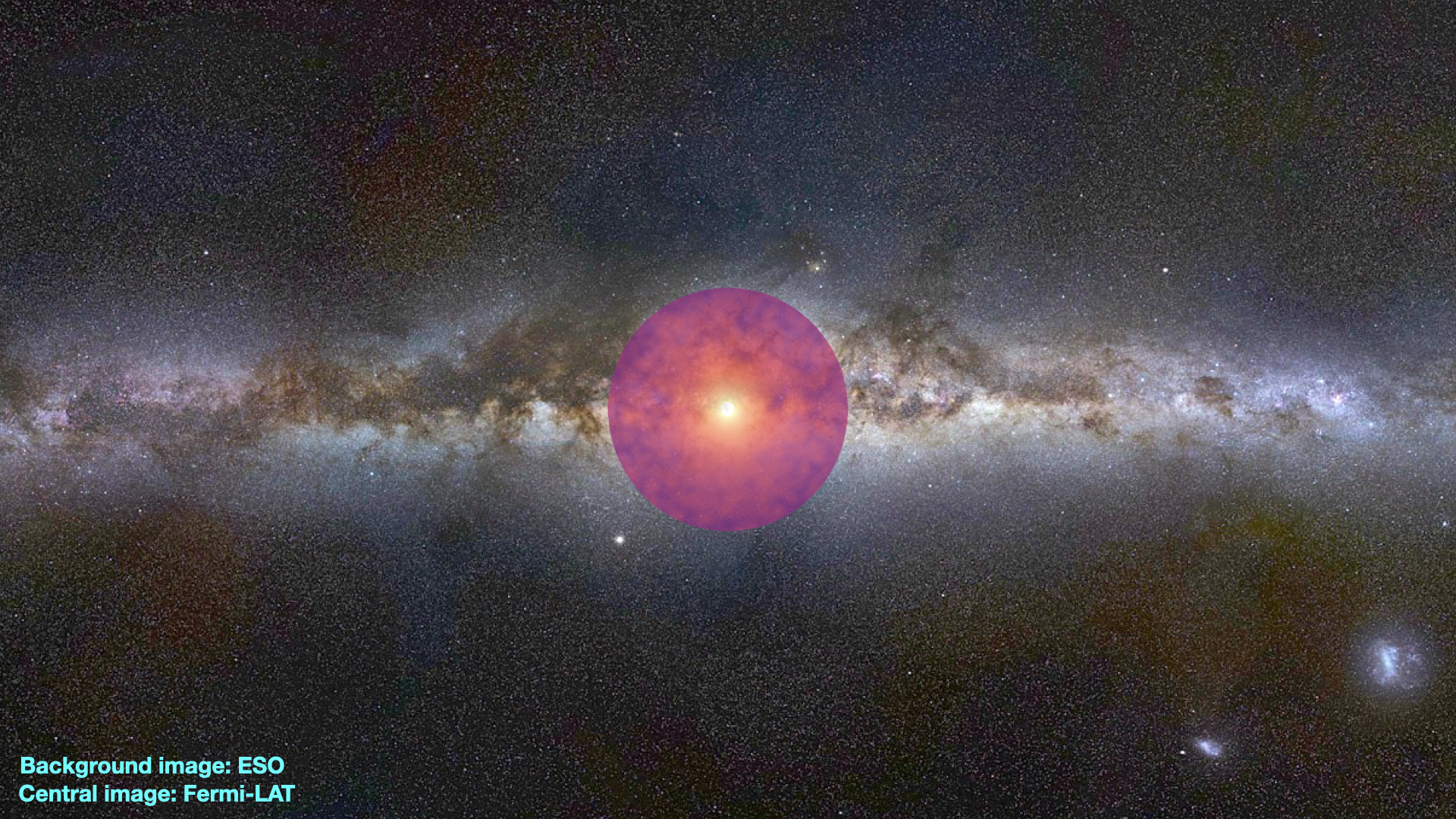
Scientists searching for gamma-rays produced by WIMP (Weakly Interacting Massive Particle) collisions have frequently targeted regions dense with dark matter, notably the center of our own Milky Way galaxy. After 15 years of continuous observation, data from the Fermi telescope has revealed gamma-ray emissions forming a “halo-like structure” around the galactic core. Significantly, the shape of these emissions closely matches what is expected from a dark matter halo.
Newly detected gamma-rays exhibit a profound energy level, reaching 20 gigaelectron volts (20 billion electron volts) per photon. This exceptionally high energy signature, according to a recent statement, offers a compelling match for the predicted emission resulting from the annihilation of hypothetical Weakly Interacting Massive Particles, commonly known as WIMPs. Furthermore, the observed energy aligns with the anticipated frequency at which such WIMP annihilation events are expected to occur.
Tulin, however, emphasized that the elusive signal only becomes discernible once all pervasive background energy is meticulously accounted for. This includes filtering out energetic photons originating from across the Milky Way, particularly its central region and disk. Furthermore, a portion of this background energy emanates from the “Fermi bubbles,” which are identified as two immense zones of gas and cosmic rays looming above the galaxy.
When scientists investigate energy sources within the Milky Way, they face a fundamental challenge: distinguishing genuine signals from the pervasive background cosmic noise. As Tulin explained, researchers must meticulously model and subtract this noise to “reveal the underlying signal.”
The integrity of any conclusions drawn about these signals, he underscored, is directly dependent on the precision of that background removal. An incorrect subtraction, Tulin warned, carries a significant risk of misleading researchers and producing erroneous results.
Physicist Tulin highlighted that the characteristics of a potential dark matter signal depend critically on the nature of the dark matter particle itself, beyond merely accounting for background noise. He explained that understanding this signal necessitates a clear definition of the particle’s theoretical model, including its mass, fundamental properties, and how it interacts with other matter.
However, physicist Tulin confirmed that the conventional model of WIMP annihilation aligns “perfectly reasonably” with the signal Totani observed. This compatibility, Tulin noted, hinges on two critical assumptions: that the study accurately observes WIMPs according to current theoretical understanding, and that any background interference has been correctly subtracted from the data.
Accessing an early version of the research, Tulin remarked to Live Science that while prudence was essential, the implications would be extraordinary if the observations truly indicated dark matter. He emphasized that such a breakthrough would not only redefine the scope of astronomical inquiry but also allow for this specific dark matter particle to be explored and potentially confirmed across a spectrum of experiments, from subterranean labs to powerful particle colliders.
Despite the new findings, Tulin urged considerable caution, indicating that the scientific community is far from convinced of their definitive truth. He reflected on the historical pattern of scientific anomalies, noting that while many emerge, most eventually dissipate without further substantiation. Only a select few, he added, have endured over time, necessitating continued scrutiny and exploration.





