Prepare for a unique astronomical observation this Sunday, November 30, as near-Earth asteroid (433) Eros makes a close apparent approach to the Andromeda Galaxy (M31).
The Virtual Telescope Institute, in partnership with the Asteroid Foundation, will host a live webcast, offering real-time telescopic views of this celestial conjunction. Viewers can tune in to witness the asteroid seemingly “buzz” our galactic neighbor from Earth’s perspective.
This Sunday, an eagerly awaited astronomical livestream is scheduled to commence at 3 p.m. EST (2000 GMT). The event will feature insightful commentary from Gianluca Masi, founder of the Virtual Telescope Project, complementing stunning live telescopic views of the Andromeda galaxy and the asteroid Eros. These real-time observations will be captured directly from the organization’s wide-field robotic telescopes located in Manciano, Italy, pending favorable weather conditions.
Astronomer Gianluca Masi sees a current celestial alignment as an “invaluable opportunity” to highlight key astronomical concepts. With a significant near-Earth asteroid appearing just a couple of degrees from the iconic Andromeda Galaxy (Messier 31), this rare proximity provides a unique chance. Masi told Space.com that the event allows for a focus on both the vital importance of minor planets and the breathtaking beauty of our closest galactic neighbor, the Messier 31 “island-universe.”
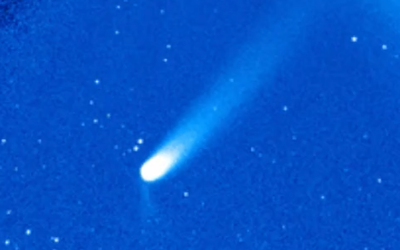
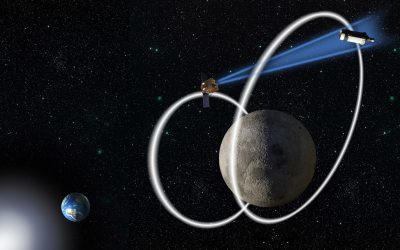
In 1898, Eros achieved distinction as the first near-Earth asteroid ever discovered. Decades later, this 20-mile-wide (33-kilometer) celestial object became the destination for NASA’s NEAR (Near Earth Asteroid Rendezvous) Shoemaker spacecraft. After an initial period spent orbiting the body, the probe made history on February 12, 2001, by successfully performing the first-ever landing on an asteroid.
On the night of November 30, skygazers will witness an intriguing celestial alignment as the asteroid Eros makes a relatively close approach to Earth, passing within just 37 million miles (60 million kilometers). During this cosmic rendezvous, Eros will visually align within two degrees of the luminous core of the Andromeda galaxy. This impressive visual proximity stands in stark contrast to the Andromeda galaxy’s true distance, which lies a staggering 2.5 million light-years away from our solar system.
Thanks to its considerable size, the asteroid Eros is poised to become a bright fixture in the night sky, shining at roughly magnitude 10 for several weeks. This extended period of luminosity will make it easily observable, even for those with a modest 60 mm telescope, as detailed by Masi in an email to Space.com.
Astronomers utilize a unique measurement system called magnitude to quantify the brilliance of objects visible in the night sky. On this scale, a lower numerical value indicates a significantly brighter celestial body.
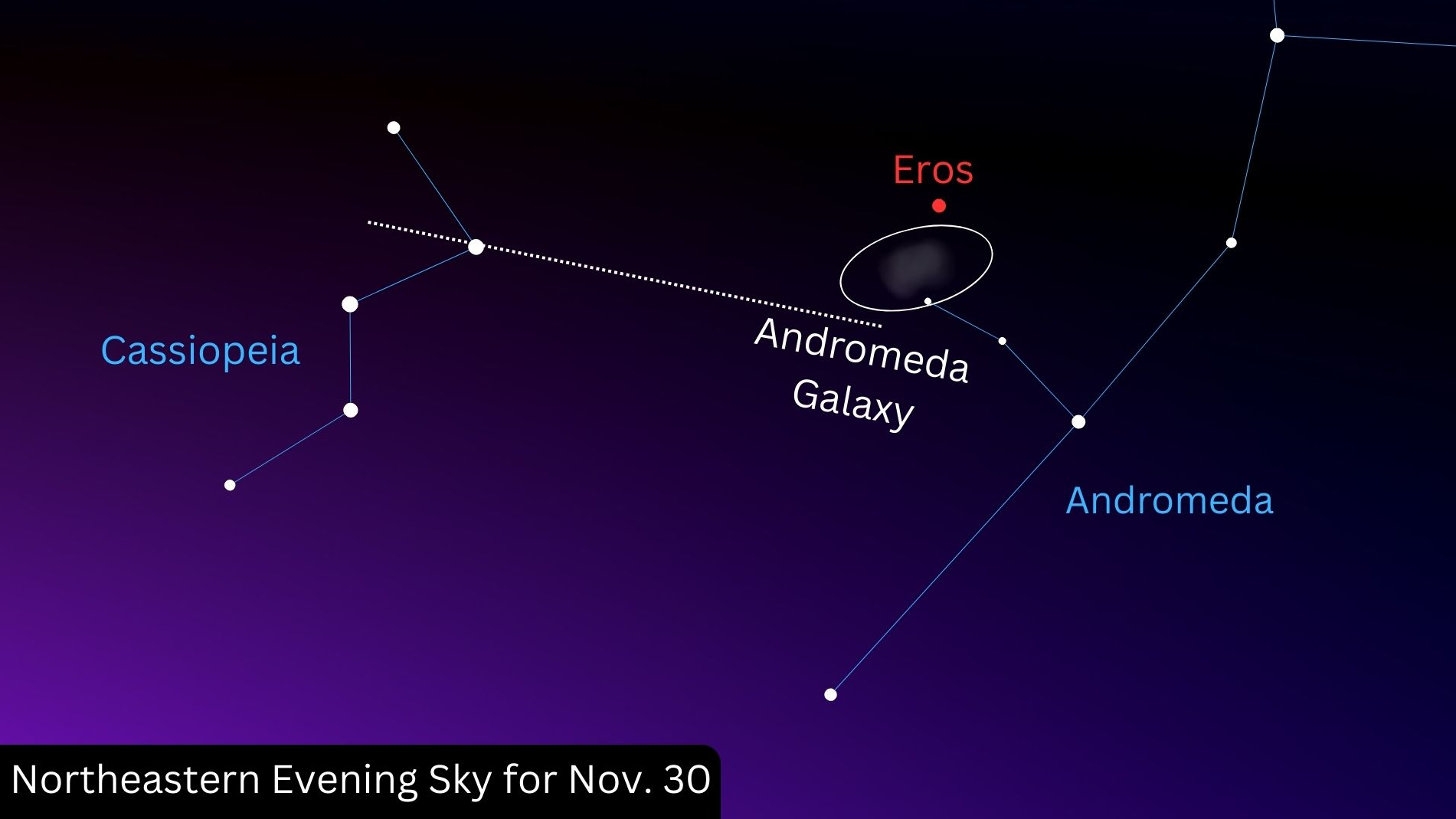
For those hoping to spot a distant celestial wanderer, the asteroid Eros will be visible alongside Andromeda. On the evening of November 30, both objects can be observed high above the eastern horizon in the hours following sunset.
To locate these celestial targets, stargazers should first use a star-finding astronomy application to identify the constellations Cassiopeia and Andromeda. Once oriented, pinpoint the uppermost three stars of Cassiopeia; these stars will act as a guide, directing your gaze towards Andromeda and the nearby asteroid.
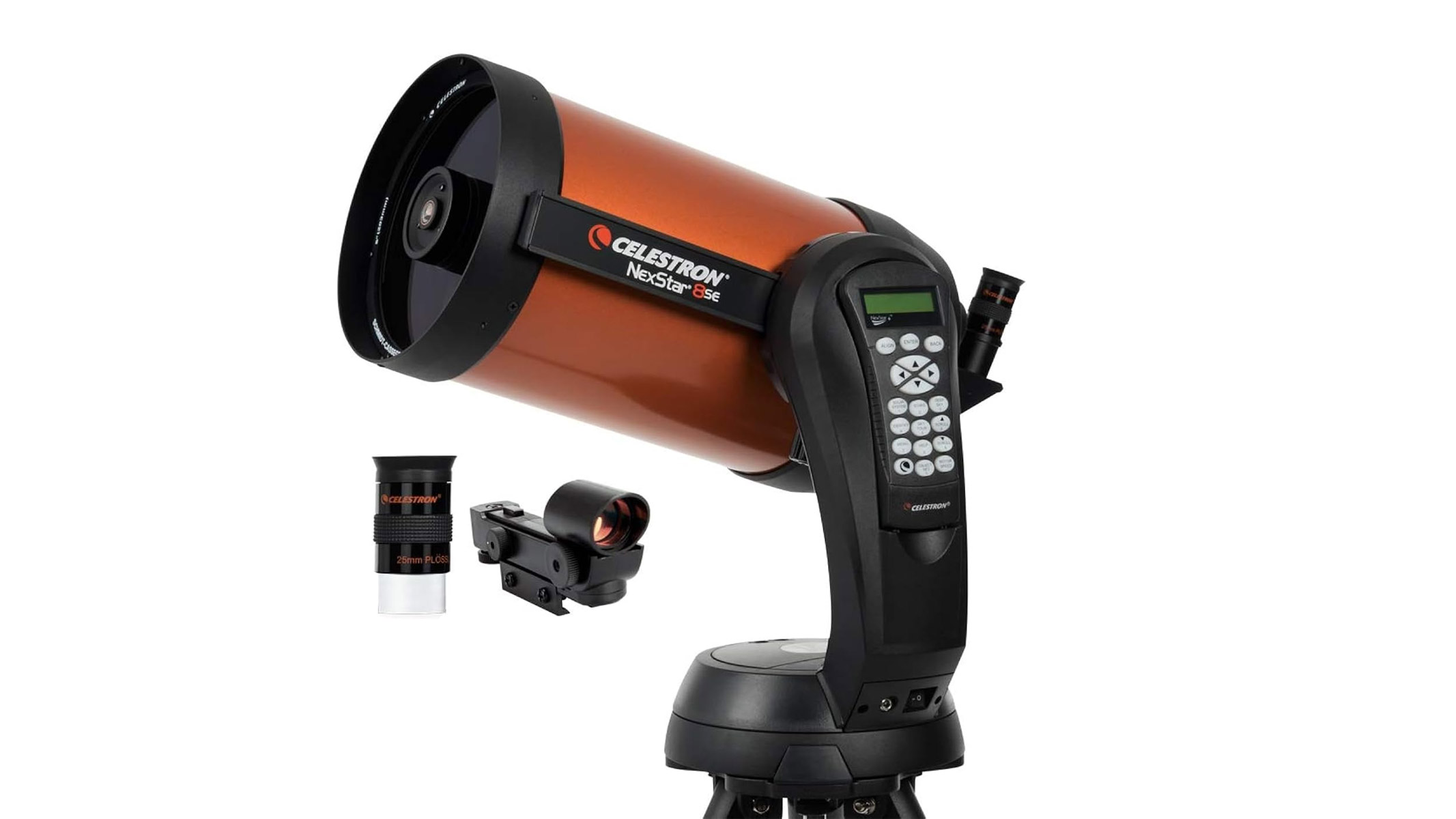
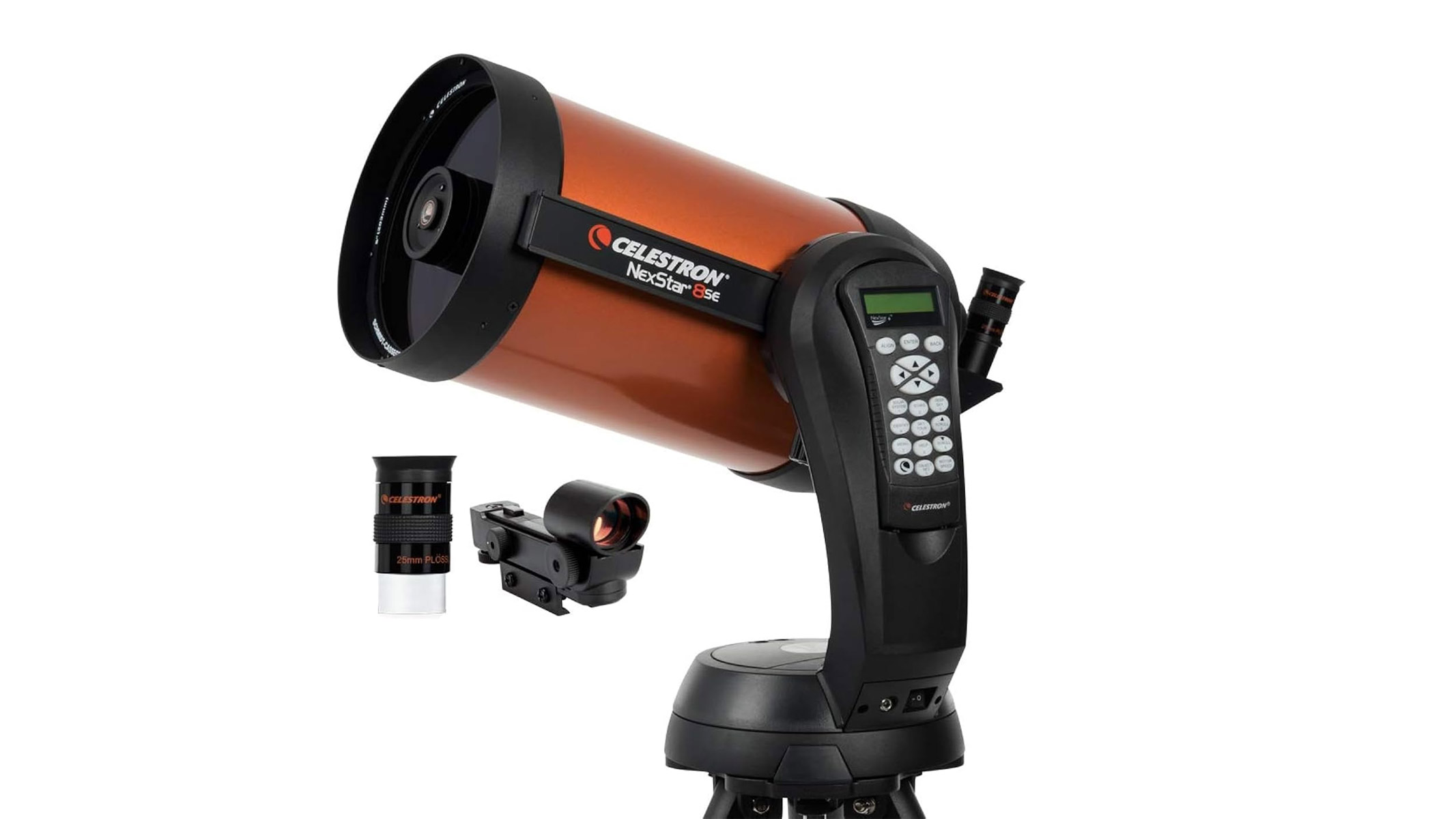
Elevate your stargazing experience with our expertly curated selection. We present the definitive guide to the premier binoculars and telescopes poised to reveal the wonders of the night sky throughout 2025.