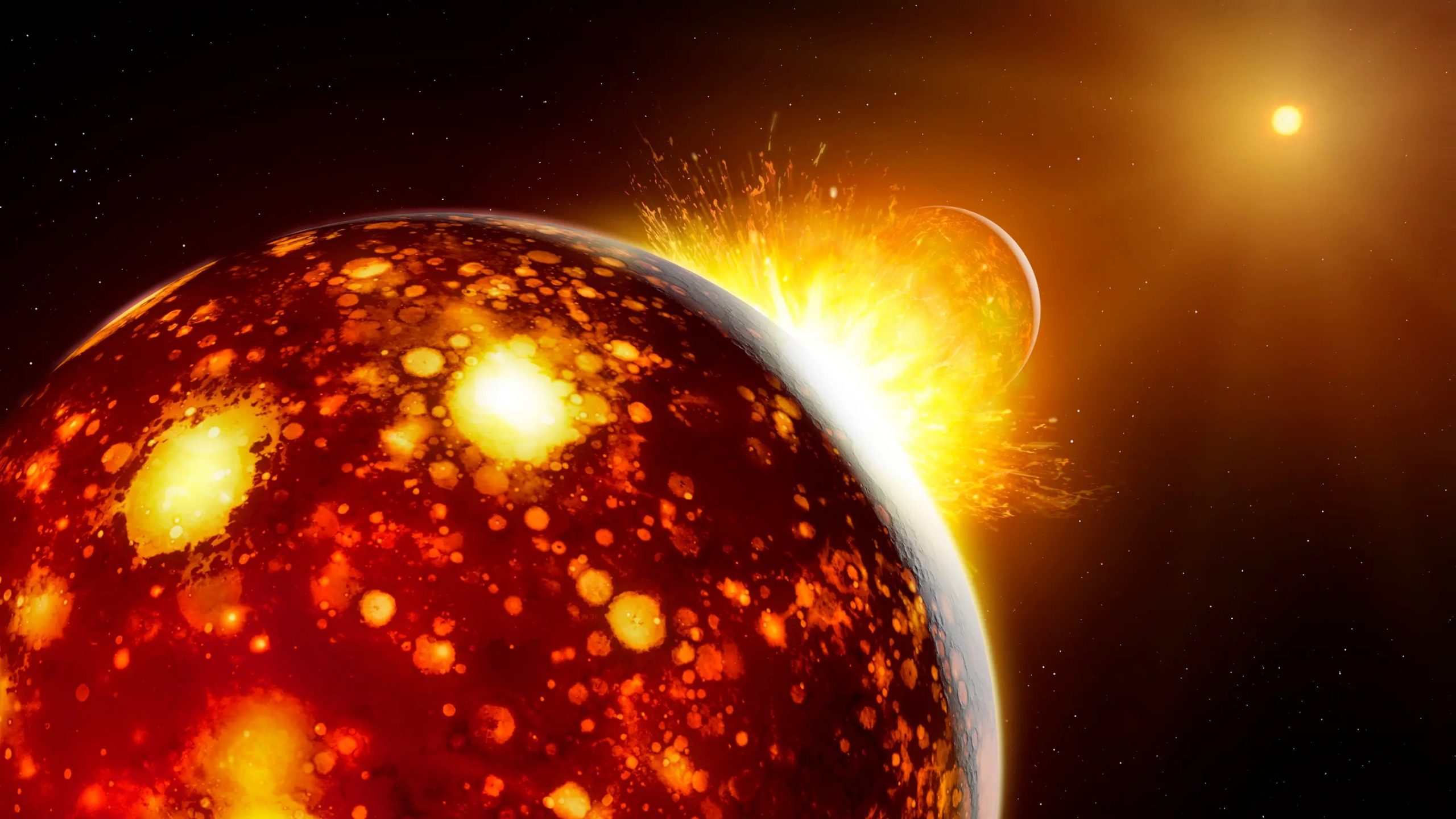
A groundbreaking new study is challenging conventional wisdom regarding the Moon’s dramatic genesis, suggesting the colossal impact that forged our celestial neighbor – a pivotal event in Earth’s early history – was not caused by a distant rogue object. Instead, researchers now propose the cataclysm was triggered by a “sibling world” that matured in Earth’s immediate cosmic vicinity.
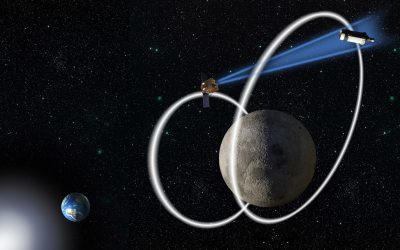
Approximately 4.5 billion years ago, a catastrophic collision between the young Earth and a Mars-sized celestial body profoundly shaped our planet. This tremendous impact was forceful enough to melt vast portions of Earth’s mantle and eject a massive disk of molten debris into orbit. Over time, this orbiting wreckage gradually coalesced, giving rise to the Moon we observe today. While scientists widely accept this “giant impact” theory for lunar formation, the precise origin and composition of the long-lost impacting world, known as Theia, remain unresolved scientific mysteries.
A comprehensive new analysis, drawing on Apollo moon samples, terrestrial rocks, and meteorites, now contends that Theia — the ancient protoplanet believed to have collided with Earth to form the Moon — was a rocky world. The findings suggest Theia originated in the inner solar system, likely even closer to the sun than our own planet.
Speaking to Live Science, Timo Hopp, the lead geoscientist from Germany’s Max Planck Institute for Solar System Research, affirmed that both Theia and proto-Earth originated from a common region within the inner solar system.
The findings, unveiled in a *Science* paper on November 20, robustly support the long-standing picture of how rocky planets came together billions of years ago, Hopp stated.
The research findings do not indicate any unexpected shifts in the underlying processes, according to Hopp. Instead, the results strongly affirm the classical theories associated with the formation of terrestrial planets.
During the tumultuous first 100 million years following the Sun’s birth, the inner solar system was a chaotic cosmic arena. It teemed with dozens, perhaps hundreds, of nascent worlds—planetary embryos ranging in size from Earth’s Moon to Mars. These developing celestial bodies were locked in a dynamic gravitational ballet, frequently colliding, merging, or being violently flung into new orbits. This relentless upheaval was driven by the inherent gravitational instability of early planet formation, profoundly amplified by the colossal pull of Jupiter.
Theia, described as one of “dozens to hundreds” of planetary embryos that were the building blocks for our solar system’s planets, according to Hopp, presents a significant challenge for scientists. Efforts to trace Theia’s precise origin are complicated by a remarkable finding: lunar samples returned from the Apollo missions show that Earth and its Moon share a nearly identical chemical composition. This profound chemical kinship, scientists explain, makes pinpointing Theia’s birthplace an exceedingly difficult task.
To investigate the colossal impact that likely formed our Moon, Hopp and his team meticulously scoured Earth’s mantle for minute chemical traces. They focused on elements such as iron and molybdenum, which, under normal circumstances during early planetary formation, would have been gravitationally drawn into Earth’s core.
The unexpected presence of these elements persisting in the mantle today, however, suggests a later introduction. According to the researchers, these specific geochemical signatures were likely delivered by the protoplanet Theia during its cataclysmic collision with early Earth, thus providing invaluable clues about the lost planet’s original composition.
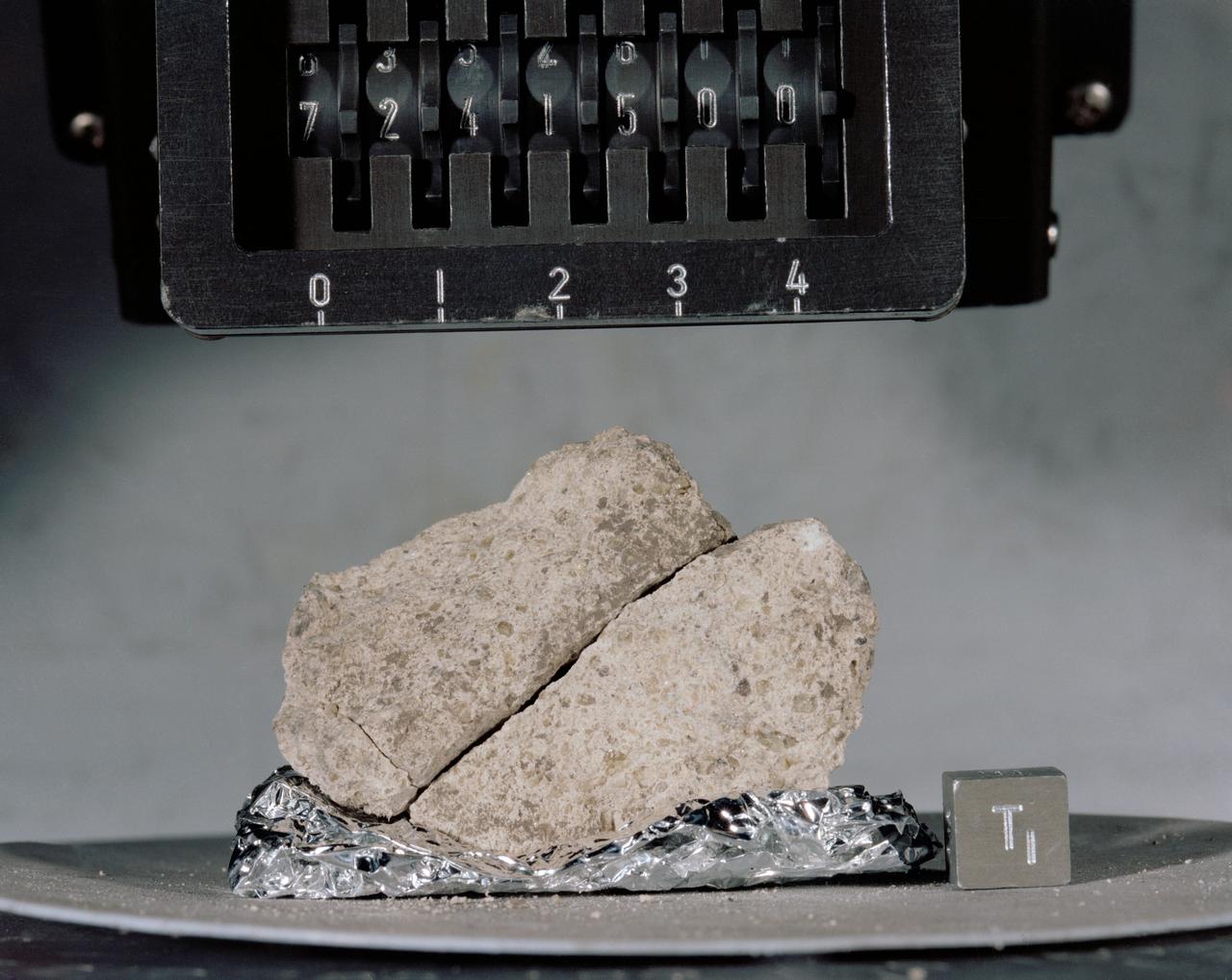
Scientists conducted a comprehensive analysis, scrutinizing six lunar samples returned by the Apollo 12 and 17 missions. Their investigation also incorporated 15 terrestrial rocks, encompassing volcanic specimens from Hawaii’s Kīlauea and meteorites unearthed in Antarctica, which are preserved in significant museum collections.
In a novel approach, the research team meticulously examined the faint isotopic fingerprints of iron. This technique, informed by recent studies, allows scientists to precisely trace where celestial material originated in relation to the sun. To further refine their analysis, these iron measurements were then synthesized with the distinct isotopic signatures of molybdenum and zirconium. By comparing this comprehensive dataset against established meteorite compositions, the researchers sought to reconstruct the precise planetary building blocks that contributed to the formation of Theia.
After modeling hundreds of diverse cosmic scenarios, from minor impacts to colossal collisions with bodies nearly half Earth’s mass, researchers have identified the singular configuration capable of replicating the unique chemistry shared by Earth and its moon. According to the study, this crucial scenario places the formation of the protoplanet Theia squarely within the inner solar system. The team further posits that Theia was a rocky, metal-cored world, with an estimated mass ranging from 5 to 10 percent of Earth’s.
Groundbreaking new models are shedding light on the early formation of our planet, revealing that both proto-Earth and the theorized ancient impactor Theia contained a unique and previously “unsampled” type of material. This distinctive matter, originating from an unknown reservoir within the inner solar system, is conspicuously absent from all known meteorite collections.
Scientists hypothesize that this mysterious component coalesced in extreme proximity to the sun. In this turbulent region, early solar system material was either assimilated by the rapidly forming inner planets—Mercury, Venus, proto-Earth, and Theia—or simply failed to endure as free-floating bodies robust enough to eventually become meteorites.
Hopp acknowledged that “sample bias” might be influencing the current findings, a limitation he believes could be addressed by future investigations. He proposed that samples retrieved from Venus or Mercury might ultimately unveil a higher concentration of this “missing material,” a discovery that would either decisively confirm or challenge their existing conclusions.
A new study suggests Earth and the ancient protoplanet Theia originated as “local siblings,” forming in close proximity. However, according to Hopp, the exact process by which their colossal collision so thoroughly mixed their materials—making their chemical compositions nearly indistinguishable—remains an open scientific question.
Solving this intricate puzzle is poised to unveil the final, crucial chapter in the moon’s tumultuous origin story. This breakthrough promises to be fundamental to fully grasping the very genesis of both our planet and its celestial companion.