
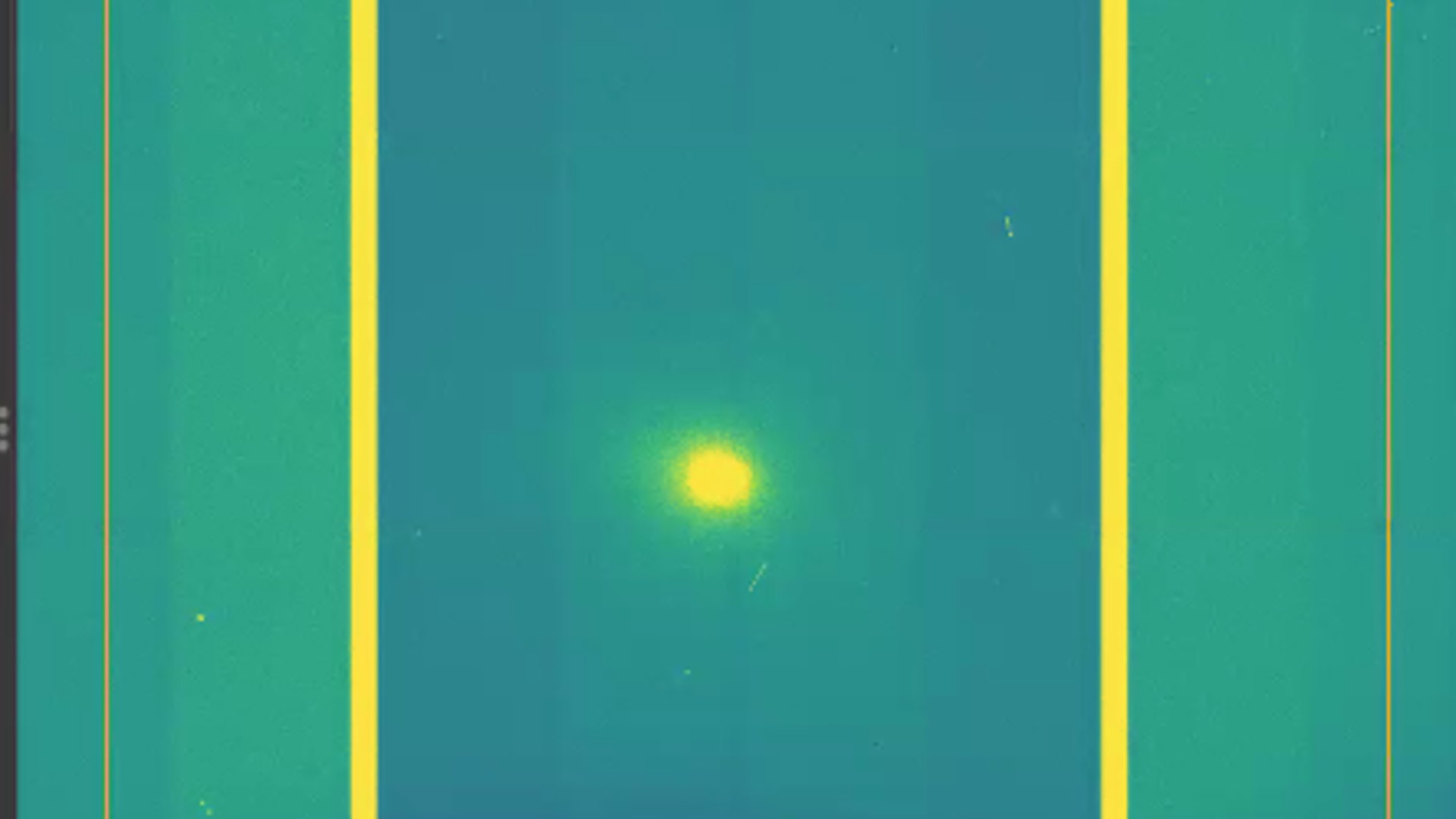
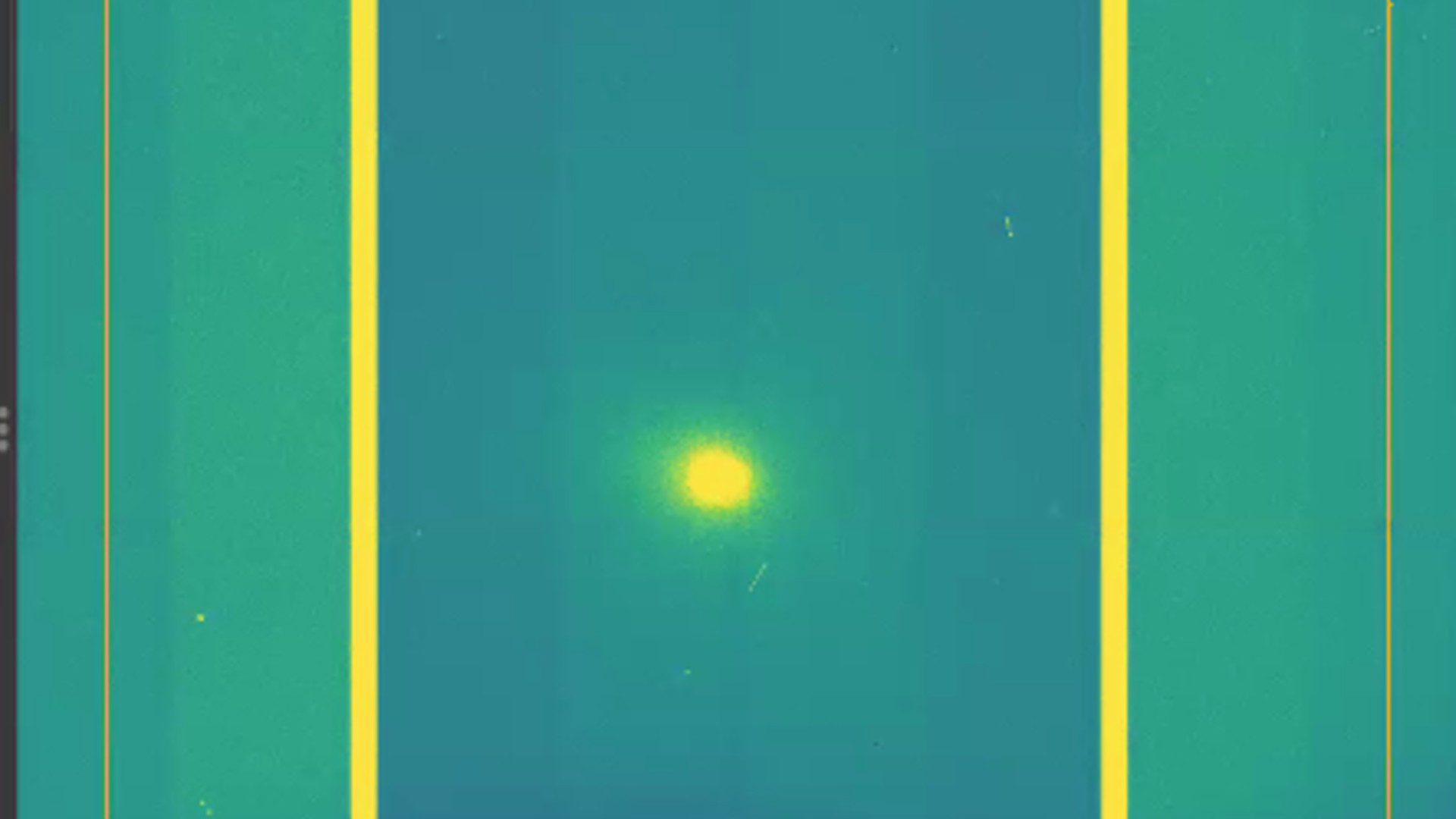
At 4 a.m. on November 25, from the lofty summit of Hawaii’s dormant Maunakea volcano, the scheduled viewing of the comet proved remarkably efficient, concluding in less time than observers had anticipated.
On one screen, interstellar comet 3I/ATLAS was observed as a faint, blurry speck, navigating a dense field of stars. Simultaneously, an adjacent display offered a critical spectroscopic view: its light had been meticulously stretched into a vibrant, barcoded spectrum. The varying brightness of each distinct line within this spectrum precisely indicated the specific gases actively sublimating from the comet’s nucleus.
Addressing a global audience during a recent online skywatching session, Bryce Bolin, principal investigator of an interstellar comet study, enthusiastically declared, “This is some prime-time science happening in real-time right now.” The virtual seminar, which provided a direct connection between experts and non-experts, was a collaborative effort. It was hosted jointly by Shadow the Scientists—an organization dedicated to fostering such engagement through online events—and the Gemini North Telescope, a vital component of the international Gemini Observatory.
The object observed on the control room’s screen was far more profound than a mere comet; it was a genuine cosmic time capsule. This ancient chunk of ice and rock, potentially predating the very formation of our sun, is now departing our solar system after an accidental detour during its vast interstellar journey. Remarkably, the visitor managed a close encounter with our star—the dazzling orb it had spent eons observing from the distant reaches of the universe before its brief, unexpected pass.
This particular observation marked a return engagement for the International Gemini Observatory with 3I/ATLAS, as the facility had previously trained its instruments on the celestial object.
In August, while the comet was still on its inbound trajectory toward the sun, Chile’s Gemini South telescope—a key component of the international Gemini Observatory—captured crucial early observations. The instrument secured pre-perihelion spectra and images, documenting the moment its tail first activated and began to extend. Analysis of this data revealed a distinctively comet-like object, characterized by a luminous coma and prominent jets of gas. Intriguingly, these jets were notably rich in carbon dioxide and cyanogen, presenting a striking contrast to the water-dominated behavior typically observed in most comets within our solar system.
In late October, Comet 3I/ATLAS executed its dramatic perihelion, slingshotting past the sun at an incredible speed of approximately 130,000 miles per hour (roughly 209,000 kilometers per hour). Following this close encounter, the comet temporarily disappeared from Earth’s view, obscured by our star.
This significant celestial spectacle was extensively observed and recorded by a range of space-based instruments, including the Mars Reconnaissance Orbiter and even the Perseverance rover on Mars. Conversely, terrestrial observatories such as the Gemini Observatory were unfortunately unable to capture the event due to their vantage point on Earth.
By November, I was remotely tracking the celestial event from my laptop as the object, identified as 3I/ATLAS, made its ascent into the northern skies. Concurrently, the advanced Gemini North Telescope, located in Hawaii, had assumed primary observation duties.
Astronomers at Gemini have commenced their initial observations since the telescope re-emerged from behind the sun, confirmed scientist Brian Lemaux. Lemaux emphasized that the “Shadow the Scientists” program is a dedicated endeavor focused on authentic data analysis and comprehension, distinguishing it from a mere public exhibition. He further highlighted the comet’s highly dynamic characteristics, noting considerable alterations in its brightness and spectral features since its last examination during the Gemini South run.
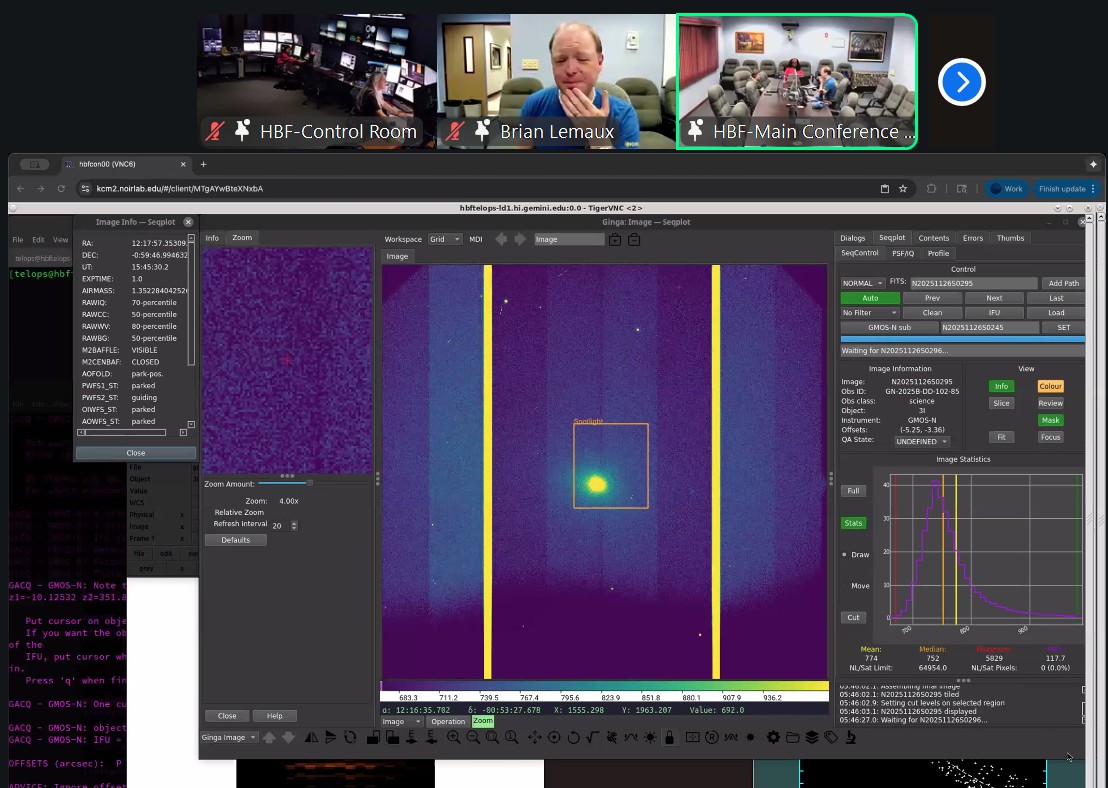
Before the Gemini North Observatory could direct its sophisticated instruments toward the celestial object 3I/ATLAS, a crucial and intricate sequence of calibration procedures was meticulously overseen.
During his presentation, Lemaux unveiled a crucial visual: a detailed spectrum. This display was characterized by prominent, bright vertical lines, each corresponding to an identified chemical element. These spectral signatures, Lemaux clarified, were instrumental in precisely calibrating the wavelength scale. Such meticulous calibration, he emphasized, was paramount for accurately discerning the interstellar comet. He further explained that these distinct markers represented “different chemical species of known origin,” providing an indispensable reference point for the entire observational process.
Following these initial observations, researchers implemented crucial calibration steps. This involved acquiring “flat fields”—uniformly illuminated frames specifically designed to correct for any inherent imperfections within their instruments. Additionally, a carefully selected “solar analog” star was observed. This step was critical because comets primarily reflect sunlight; to accurately isolate and study the comet’s unique emissions, it was necessary to precisely account for and subtract this reflected solar light.

Astronomical observations are frequently hampered by a trifecta of challenges: the inherent imperfections of telescope optics, the distorting influence of Earth’s atmosphere, and the unavoidable flaws in even the most sophisticated instruments. As Lemaux articulated, the overarching scientific imperative is to transcend these obstacles. “We want to get to the intrinsic nature of any source that we observe,” he stated, emphasizing the goal to discern the true characteristics of celestial objects, unhindered by terrestrial or instrumental shortcomings.
With preparatory groundwork complete, the scientific team initiated the core observational phase. This began with the acquisition of a long-slit spectrum, meticulously sweeping across the comet’s expansive coma. The subsequent, crucial step involved an Integral Field Unit (IFU) observation — a sophisticated technique that generates a three-dimensional data cube, effectively assigning a full spectral signature to every discrete point within a confined, high-resolution image of the celestial body.
During a prior observation at Gemini South, a comprehensive data analysis uncovered a startling discovery: an immense, unexpected plume of cyanogen gas emanating from a comet. This colossal gaseous cloud, as recalled by scientist Bolin, extended across remarkably vast distances from the celestial body.
With its closest approach to the sun now complete, the research team shifted its focus to analyzing the post-perihelion evolution of the comet’s coma. Scientists aimed to determine how the aging of this atmospheric cloud, following its intense solar encounter, manifested in changes to its chemical composition and overall morphology.
During a brief interlude in a recent webinar, a participant in the chat posed a seemingly straightforward question that revealed a deeper astronomical complexity: “How long does it take this comet to complete an orbit around the galaxy?”
Astronomer Bolin has revealed that the interstellar object 3I/ATLAS completes a galactic orbit approximately every 250 million years. This monumental duration, he noted, is roughly equivalent to the time it takes our Sun to make a single revolution around the Milky Way galaxy.
Bolin suggested that this lengthy journey was likely not 3I/ATLAS’s first traverse of the galaxy. He humorously underscored the vastness of cosmic timescales, adding that experts in extragalactic astronomy often consider a period of 100 million years to be “instantaneous.”
What appeared to be a casual remark, however, proves crucial in unraveling the complex narrative surrounding the true age of 3I/ATLAS.
To unravel the complexities of 3I/ATLAS, two research teams pioneered an analytical method typically applied to stars. They meticulously compared the object’s velocity to the galaxy’s known correlation between stellar age and random motion.
A new study by scientists Aster Taylor of the University of Michigan and Darryl Seligman of Michigan State University has calculated a “kinematic age” for the interstellar comet 3I/ATLAS.
By analyzing the comet’s significant velocity — approximately 36 miles per second (58 kilometers per second) faster than the Sun’s systemic motion — the researchers estimate 3I/ATLAS to be remarkably ancient, ranging from 3 billion to 11 billion years old. This age determination relies on the critical assumption that interstellar objects, much like stars, adhere to a consistent age–velocity relationship.
In an independent investigation, a team led by Dr. Matthew Hopkins at the University of Oxford employed a specialized model to analyze the Milky Way’s thick disk. This ancient galactic component is characterized by its population of older, dynamically “hotter” stars, moving with greater internal energy. By focusing on this stellar group, the researchers were able to deduce the probable age of an interstellar comet, estimating its origin to be between approximately 7.6 billion and 14 billion years ago.
All lines of scientific inquiry are converging on a remarkable conclusion: Comet 3I/ATLAS almost certainly predates our own 4.6-billion-year-old sun, positioning it among the most ancient celestial relics ever observed.
During a recent seminar, Bolin unveiled a compelling visualization detailing 3I/ATLAS’s orbital path within the galaxy. The presentation highlighted that the object’s trajectory is far from a simple, elegant ellipse. Instead, it traces a complex, looping, and spiraling journey, continually distorted and reshaped by gravitational encounters with interstellar gas clouds, the dense structures of galactic spiral arms, and the pervasive influence of dark matter.
The ellipses in question, he stated, have proven to be far more intricate than their initial straightforward appearance suggested.
Unlike asteroids, which follow stable, predictable elliptical orbits around our Sun, interstellar comets traverse the Milky Way on far more complex and erratic trajectories. These cosmic nomads are subjected to the constant gravitational pull from the galaxy’s “very inhomogeneous clumps of matter,” as described by researchers. This perpetual celestial tug-of-war makes it virtually impossible to accurately trace an interstellar visitor, such as 3I/ATLAS, back to a specific parent star.
After an extensive period adrift, the comet 3I/ATLAS has deviated so significantly from its original path that its return is now impossible. Its prolonged journey has irrevocably altered its trajectory, ensuring it will not revisit its previous celestial neighborhood.
As dawn began to break over Hawaii, signaling the close of a night’s crucial astronomical work, the Gemini North team concluded its intensive study of an interstellar comet. During their observations, researchers systematically employed four distinct filters to gather comprehensive data.
In a series of captured images, the comet exhibited subtle fluctuations in its luminosity, appearing to brighten and then gently dim. This dynamic variability was directly attributable to the distinct spectral components of the comet’s light that were being resolved and recorded in each successive frame.
Bolin emphasized that the images’ significance extends beyond their visual appeal. Instead, they are crucial tools being used to meticulously chart the precise celestial coordinates of 3I/ATLAS with unparalleled accuracy.
Upon the arrival of the final images, Jameeka Marshall, a staff member with Shadow the Scientists, announced a significant development for scientific collaboration: all collected data would be made immediately public. Marshall underscored the commitment to open access, explicitly stating, “There’s zero proprietary time associated with the data.” She further explained that any interested party could readily acquire, reduce, and transform this raw information into a scientifically viable format, leveraging the specialized tools available at the Gemini Observatory.
As dawn broke outside the control room, the increasing ambient light began to compromise the clarity of incoming observational data. Despite the challenging external conditions, the comet displayed on the internal monitors presented an unchanging spectacle: a diffuse, fuzzy patch of light, its trailing tail only faintly discernible against the ever-brightening celestial backdrop.
Encoded within the captured frames and spectra lies the extraordinary saga of an interstellar traveler. This ancient visitor has traversed the depths of space for an immense period, its journey predating the very formation of Earth. Scientists consider it a rare relic, originating from a primitive, metal-poor region of the galaxy, now briefly glimpsed by our telescopes as it continues its cosmic passage.
Comet 3I/ATLAS has presented scientists with an astonishingly rare opportunity: a direct glimpse into the ancient debris of a planetary system beyond our own. Initially observed for a brief period from Maunakea, this unique celestial object will be extensively tracked by observatories worldwide for several months between 2025 and 2026, offering an unprecedented view of cosmic remnants shaped over billions of years.
Here are several ways to paraphrase “But not erased,” maintaining a clear, journalistic tone:
1. **Its presence, however, endures.**
2. **Nevertheless, it persists.**
3. **While challenged, it was not extinguished.**
4. **The impact, crucially, remains.**
5. **Its traces, undeniably, are still discernible.**





