In an unprecedented astronomical observation, scientists have witnessed a distant exoplanet actively shedding its atmosphere into the vacuum of space. This real-time phenomenon reveals the world generating a colossal companion cloud of gas, which remarkably precedes the planet as it orbits its host star.
The James Webb Space Telescope (JWST) has delivered an unprecedented observation of helium gas actively evaporating from WASP-107b, a distant, colossal exoplanet.
Scientists report that the escaping gas forms a vast plume, stretching an astonishing distance equivalent to nearly ten times the planet’s radius. Remarkably, this gaseous trail precedes the planet along its orbital path around its parent star.
This pivotal discovery sheds new light on how the atmospheres of giant worlds like WASP-107b can slowly erode under the relentless barrage of radiation emanating from their host stars.
In a significant astronomical breakthrough, the James Webb Space Telescope has achieved the unprecedented feat of directly observing helium escaping from an exoplanet. This landmark detection also represents the most definitive identification of pre-transit helium absorption ever recorded for any exoplanet, affirmed Vigneshwaran Krishnamurthy, lead author of the study from McGill’s Trottier Space Institute.

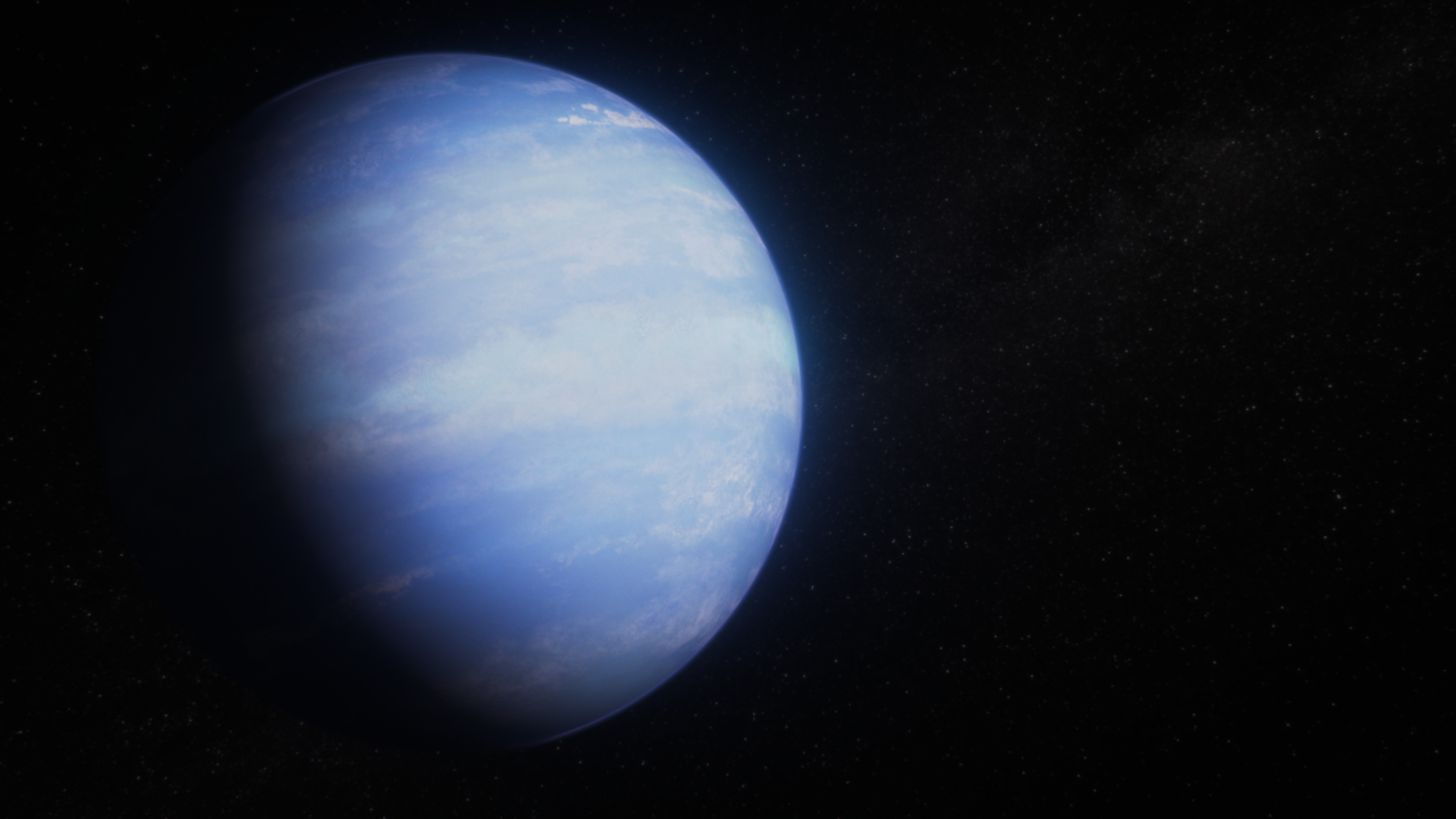
The exoplanet WASP-107b stands out as a remarkable “super-puff” world, a celestial anomaly due to its exceptionally low density. While its radius nearly matches Jupiter’s, its mass is merely a fraction of the gas giant’s.
Orbiting seven times closer to its host star than Mercury is to our sun, WASP-107b’s close proximity combined with its ethereal composition makes it highly vulnerable to atmospheric escape. This process generates a vast helium exosphere composed of the planet’s evaporating gases.
Notably, this helium cloud has been observed to pass in front of the star a full 1.5 hours *before* WASP-107b itself begins its transit. This distinct phenomenon, where the exosphere precedes the planet, is scientifically termed “pre-transit helium absorption.”
Astronomers utilizing the James Webb Space Telescope’s Near Infrared Imager and Slitless Spectrograph (NIRISS) have achieved an unprecedented observation: directly witnessing the exoplanet WASP-107b actively shedding its atmosphere. The team identified the infrared signature of helium streaming ahead of the planet, which manifested as a distinct “mini-transit”—a subtle dimming of the host star’s light occurring just before WASP-107b itself passed into view. While evidence of helium escape has been detected on other exoplanets, this marks the first time scientists have observed such atmospheric loss in real-time and with this level of intricate detail.
Observations from the James Webb Space Telescope (JWST) are shedding light on WASP-107b’s tumultuous past. Scientists detected both helium and water vapor high in the planet’s atmosphere, yet notably, an absence of methane. This distinctive chemical profile suggests robust atmospheric mixing, where hotter, methane-poor gases are vigorously cycled upwards.
This unique chemical fingerprint, combined with evidence of extreme atmospheric escape, strongly supports a compelling theory about the planet’s origins. WASP-107b likely began its existence much farther from its host star. It then embarked on an inward migration, moving closer to its star, where intense stellar radiation subsequently began to strip away its outer atmospheric layers.
Exoplanet WASP-107b harbors an unexpectedly high concentration of oxygen in its atmosphere, a discovery that challenges current theories of its formation.
Scientists, analyzing observations modeled by study co-author Caroline Piaulet-Ghorayeb, found the oxygen levels far exceed what would typically be expected if the planet had coalesced in its current close-in orbit around its star. This anomaly strongly suggests that WASP-107b may have migrated from a different, more distant region of its planetary system.
Piaulet-Ghorayeb, who specifically modeled the NIRISS transmission spectrum for the study, further posited that the presence and gravitational influence of WASP-107c, another planet orbiting significantly farther out, could have been a key factor in this orbital shift.
The direct observation of planets actively shedding their atmospheres offers crucial insights into the dynamic processes that shape celestial bodies over eons. Crucially, it illuminates how some worlds can be completely stripped of their gaseous envelopes, ultimately leaving behind only a desolate rocky or icy core.
Here are a few options, maintaining the core meaning with a unique, engaging, and journalistic tone:
**Option 1 (Concise and Direct):**
“The team’s findings were unveiled December 1 in the prestigious journal *Nature Astronomy*.”
**Option 2 (Emphasizing Detail):**
“The full details of their research were published on December 1 in *Nature Astronomy*.”
**Option 3 (Slightly More Active):**
“Their groundbreaking discoveries made their debut December 1 in the pages of *Nature Astronomy*.”
**Option 4 (Focus on the Journal):**
“The December 1 edition of *Nature Astronomy* featured their compelling findings.”