
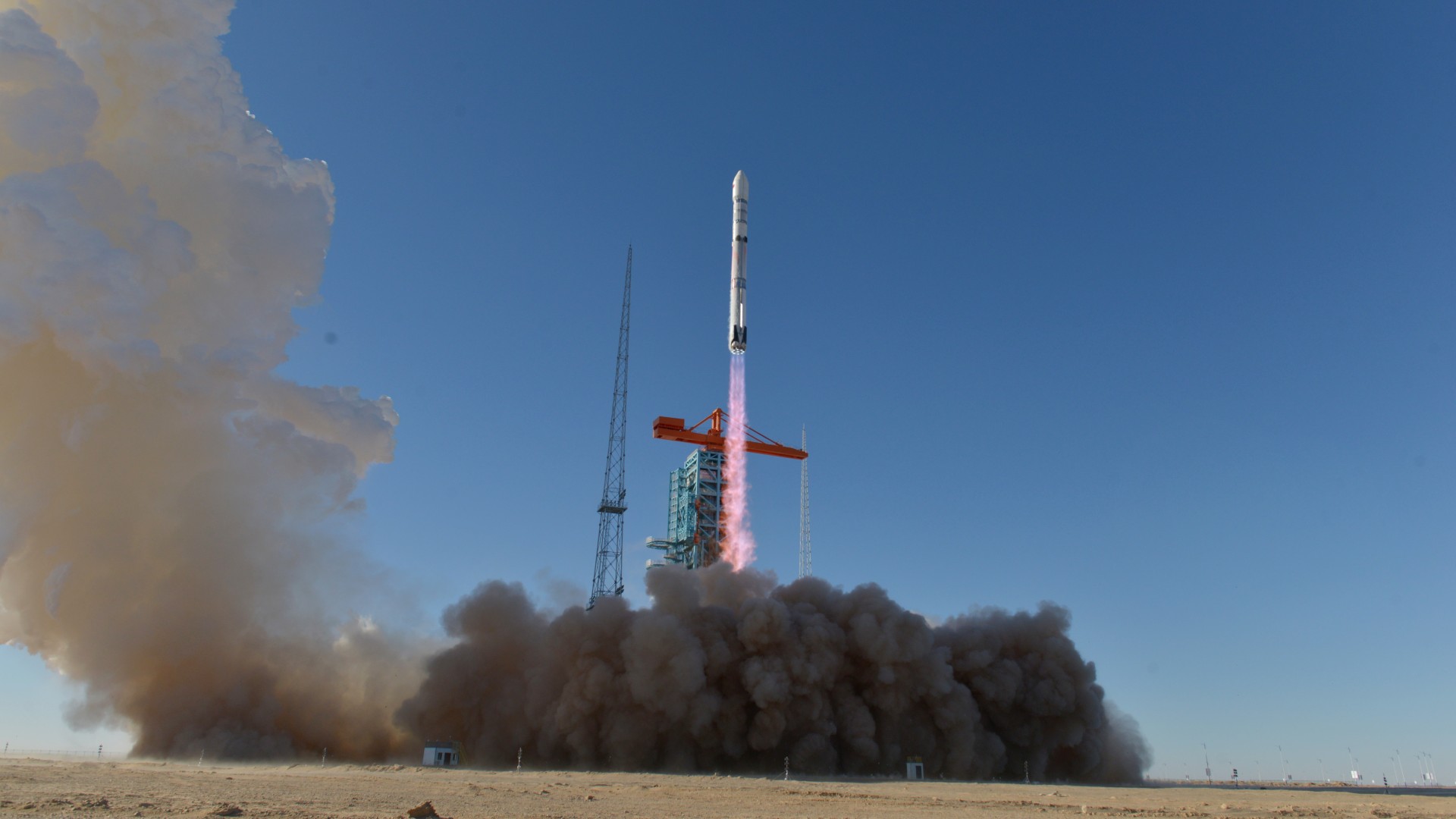
The inaugural test flight of Landspace’s Zhuque-3 rocket culminated in a fiery explosion, despite the vehicle having successfully achieved orbit.
In a significant aerospace development, China’s private firm Landspace successfully launched its Zhuque-3 rocket on Tuesday, December 2. The 66-meter (216-foot) stainless steel rocket, designed for reusability and powered by methane and liquid oxygen, lifted off from the Jiuquan Satellite Launch Center in the Gobi Desert of northern China. Landspace confirmed that the mission successfully placed the rocket’s expendable second stage into orbit.
Despite a seemingly successful reentry, the rocket’s first stage booster encountered a critical engine malfunction during its final landing burn. The booster subsequently caught fire and culminated in a catastrophic explosion upon impact with the ground.
Developer Landspace quickly addressed the incident on social media, stating, “An anomaly occurred as the first stage approached the designated recovery zone.” The company confirmed that “No personnel safety issues occurred” and has since launched a full investigation to pinpoint the root cause of the unforeseen event.

Despite a dramatic landing mishap, Chinese private aerospace company Landspace is hailing its recent test flight as a significant success. The firm announced via social media that “China’s first rocket recovery attempt achieved its expected technical objectives.” These crucial objectives included the successful verification of the Zhuque-3 rocket’s recovery system, engine throttling capabilities, and attitude control mechanisms. Remarkably, visual evidence from the crash landing reveals the first stage impacted the ground mere meters from its intended landing zone, showcasing considerable precision.
China’s Zhuque-3 rocket bears a striking resemblance to SpaceX’s dependable Falcon 9, mirroring its fundamental design principles. Both launch vehicles incorporate a reusable first stage and an expendable upper stage, and are notably powered by a cluster of nine engines.
A key distinction in propulsion technology separates the Zhuque-3 and Falcon 9 rockets. The Zhuque-3’s Tianque-12A engines are powered by a methalox mixture, utilizing liquid methane and liquid oxygen. In contrast, the Falcon 9’s Merlin engines operate on a blend of liquid oxygen and traditional rocket-grade kerosene.
The Zhuque-3 rocket is engineered to carry substantial payloads, with a design capacity to loft 40,350 pounds (18,300 kilograms) into low Earth orbit (LEO). For comparison, SpaceX’s operational Falcon 9 rocket demonstrates a higher lift capability, able to deliver a greater mass of 50,265 pounds (22,800 kg) to the same orbital destination.
In a significant aerospace milestone, Landspace’s Zhuque-2 rocket made history in July 2023 by becoming the world’s first methane-powered vehicle to successfully achieve orbital flight. This innovative propulsion technology is also a key feature of SpaceX’s designs, with its Raptor engines utilizing a combination of liquid methane and liquid oxygen to propel both the Super Heavy booster and the Starship second stage.
The Zhuque rockets bear a distinctive name, drawn from the legendary vermillion bird of Chinese mythology. This mythical creature holds significant symbolic weight, representing the fire element within the intricate Taoist five-element cosmological system.





