Future earthquake rescue missions could soon be revolutionized by the deployment of miniature flying robots. These advanced drones, designed to mimic the agility of insects, would navigate the treacherous landscapes of post-seismic devastation. Their primary role: to meticulously search for survivors trapped beneath collapsed structures.
Crucially, these nimble robots could access confined spaces beyond the reach of larger rescue machinery, while simultaneously employing sophisticated evasion tactics to steer clear of both static obstacles and dynamically falling debris, thus dramatically improving the chances of locating individuals in critical need of aid.

The era of sluggish, predictable movement for aerial microrobots is officially over. For years, these tiny machines could only navigate slowly along smooth paths, a stark contrast to the swift, agile aerial ballet performed by real insects. But that technological gap has now been bridged.
**MIT Microrobots Achieve Unprecedented Agility with AI Controller**
Researchers at the Massachusetts Institute of Technology (MIT) have unveiled aerial microrobots demonstrating flight speed and agility on par with their biological counterparts. This significant advancement in robotics is attributed to a novel AI-based controller designed by a collaborative team.
The innovative control system enables the tiny robotic devices to execute complex, gymnastic flight paths, including the impressive feat of performing continuous body flips with remarkable precision.
Leveraging a novel two-part control scheme, designed for both high performance and computational efficiency, researchers have dramatically boosted their robot’s capabilities. Its speed surged by an impressive 450 percent, while acceleration increased by approximately 250 percent, significantly surpassing their previous best demonstrations.
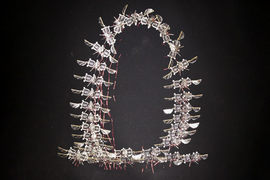
A high-speed robotic system recently showcased its extraordinary agility, completing ten consecutive somersaults in an impressive 11 seconds. The automaton maintained flawless precision even as significant wind disturbances attempted to push it off course.
Researchers have achieved a significant breakthrough in robotic flight, developing a bioinspired control framework that allows their robots to mimic the agility of insects. This advancement could pave the way for robotic systems to navigate environments previously inaccessible to conventional drones.
Kevin Chen, an associate professor in the Department of Electrical Engineering and Computer Science (EECS) and head of the Soft and Micro Robotics Laboratory at the Research Laboratory of Electronics (RLE), explained that the ultimate goal is to deploy these robots in scenarios too complex for traditional quadcopters, yet easily traversable by insects.
According to Chen, who is also a co-senior author of the paper detailing the robot, the new framework has dramatically improved the robot’s capabilities. Its flight performance now rivals that of insects in critical aspects such as speed, acceleration, and pitching angle. He characterized this development as “quite an exciting step” toward achieving their ambitious objective.
The groundbreaking research, published today in *Science Advances*, was a collaborative effort led by Chen, who was joined as co-lead authors by Yi-Hsuan Hsiao, an MIT graduate student in Electrical Engineering and Computer Science (EECS); Andrea Tagliabue, who received their PhD in 2024; and Owen Matteson, a graduate student from the Department of Aeronautics and Astronautics (AeroAstro).
Additional contributors to the study included EECS graduate student Suhan Kim and Tong Zhao MEng ’23. Guiding the team as co-senior author was Jonathan P. How, the Ford Professor of Engineering in Aeronautics and Astronautics and a principal investigator at the Laboratory for Information and Decision Systems (LIDS).
An AI controller refers to a sophisticated and autonomous management system, powered by artificial intelligence. It is engineered to intelligently oversee, optimize, and direct various operations or processes, making real-time decisions, adapting to dynamic environments, and driving enhanced efficiency or performance across diverse applications, from industrial automation to complex digital ecosystems.
For more than five years, the research group spearheaded by Dr. Chen has been at the forefront of developing sophisticated robotic insects.
Engineers have announced a significant advancement in micro-robotics with the development of a more durable iteration of their minuscule robot. This impressive device, comparable in size to a microcassette and weighing less than a standard paperclip, now features enlarged, actively flapping wings. These new additions are specifically engineered to facilitate notably more agile and precise movements. Powering this enhanced maneuverability are innovative ‘squishy’ artificial muscles, designed to propel the wings at an exceptionally rapid rate.
However, the robot’s intricate control system—its operational ‘brain’ responsible for pinpointing location and charting its aerial course—was subjected to manual adjustments by human technicians. This hands-on calibration, while precise, ultimately constrained the robot’s performance capabilities.
Achieving the swift, aggressive flight dynamics of a genuine insect demanded a significantly more robust control system for the robot. This advanced controller was crucial, designed to adeptly manage inherent uncertainties and rapidly execute complex optimizations.
Deploying such a control system in real-time environments would be computationally prohibitive. This challenge is further compounded by the complex aerodynamic characteristics inherent to the lightweight robotic platform.
To address a specific challenge, Chen’s group collaborated with How’s team to engineer a sophisticated, two-step AI-driven control scheme. This innovative system is meticulously designed to provide the unwavering robustness crucial for complex, rapid maneuvers, alongside the computational efficiency vital for real-time deployment.
How articulated the reciprocal relationship between hardware and software development, noting that advances in one invariably propel the other. He explained that enhanced hardware capabilities open new avenues for software innovation, which in turn inspires further hardware refinements. This ongoing collaboration is evident, How added, remarking, “As Kevin’s team demonstrates new capabilities, we demonstrate that we can utilize them.”
The team initiated the project by developing a model-predictive controller, a crucial component for autonomous navigation. This powerful system employs a dynamic mathematical model to accurately forecast robot behavior and meticulously chart the optimal sequence of actions, thereby ensuring safe and precise execution along a predefined trajectory.
This high-performance planner, though computationally intensive, demonstrates remarkable capability in orchestrating complex maneuvers. It can precisely plan daring aerial somersaults, rapid directional turns, and aggressive body tilting. Crucially, its design also integrates critical constraints regarding the maximum force and torque a robot can exert, a fundamental safeguard against collisions.
For instance, to execute a series of consecutive aerial flips, the robot must precisely manage its deceleration. This critical adjustment ensures its takeoff parameters are perfectly aligned for initiating each subsequent rotation.
According to How, even minor computational or execution errors can rapidly compound during repeated complex maneuvers, such as a robotic flip. Without exceptionally robust flight control, these accumulating inaccuracies would inevitably lead to a system crash, underscoring the critical need for reliable stability.
An expert planning system is utilized to train a sophisticated deep-learning model, referred to as the robot’s “policy.” This training, conducted via a process known as imitation learning, enables real-time operational control. Ultimately, this “policy” acts as the robot’s crucial decision-making engine, dictating its every move in the air, from trajectory to specific flight maneuvers.
At its core, imitation learning serves to condense sophisticated control systems into computationally efficient AI models, enabling significantly faster operational speeds.
Central to the strategy was the development of an intelligent method for curating a precisely tailored dataset. This critical training data would then fully equip the underlying policy with the advanced understanding needed to execute aggressive maneuvers.
How explains that the robust training method is the **cornerstone of this technique’s efficacy**.
An advanced artificial intelligence framework is now responsible for real-time robotic control, precisely converting robot positional data into instantaneous operational commands like thrust force and torque.
Here are several ways to paraphrase “Insect-like performance,” maintaining a journalistic tone and core meaning:
**Option 1 (Focus on agility and precision):**
“The system delivers a performance characterized by exceptional agility and precise, rapid movements, reminiscent of an insect’s natural capabilities.”
**Option 2 (Emphasizing dynamic maneuverability):**
“Its operational capabilities are marked by an extraordinary blend of agility and intricate maneuverability, allowing it to navigate with the speed and control typically seen in insects.”
**Option 3 (Highlighting efficiency and scale):**
“Demonstrating a remarkable efficiency in movement, the device exhibits swift, finely controlled actions, echoing the dynamic, precise nature of insect locomotion.”
**Option 4 (Concise and impactful):**
“The unit performs with uncanny agility and swift, pinpoint accuracy, mirroring the dynamic characteristics of insect movement.”
A groundbreaking two-step experimental approach has dramatically enhanced the capabilities of an insect-scale robot, allowing it to achieve unprecedented performance metrics. During testing, researchers observed a remarkable 447 percent increase in the robot’s flight speed, alongside a substantial 255 percent boost in acceleration.
This significant improvement in agility enabled the miniature robot to execute complex maneuvers with precision. It successfully completed ten somersaults in a swift eleven seconds, all while maintaining exceptional control. Critically, the tiny flyer demonstrated impressive navigational accuracy, consistently remaining within a narrow band of just 4 to 5 centimeters from its pre-programmed trajectory throughout the experiments.
New research reveals that soft and microrobots, historically constrained by their limited speed, are now capable of astonishing agility comparable to natural insects and larger robotic systems.
According to Hsiao, this significant leap forward is attributable to sophisticated control algorithms, which unlock groundbreaking opportunities for diverse, multimodal locomotion.
Researchers have further illuminated the phenomenon of saccade movement, a sophisticated aerial maneuver employed by insects. This process involves insects executing forceful, aggressive body pitches, rapidly propelling themselves to a target position, then counter-pitching sharply to an immediate halt. This dynamic interplay of rapid acceleration and abrupt deceleration is critical, allowing insects to precisely orient themselves and maintain sharp visual clarity while in flight.
Here are a few options, maintaining a clear, journalistic tone:
**Option 1 (Concise):**
“This biomimetic flight behavior is expected to offer significant advantages, particularly when the robot is equipped with cameras and sensors in the future, according to Chen.”
**Option 2 (Emphasizing potential):**
“Chen anticipates that the robot’s nature-inspired flight dynamics will prove invaluable for future applications, especially when integrating advanced imaging and sensing equipment.”
**Option 3 (More active phrasing):**
“According to Chen, the robot’s ability to emulate natural flight patterns will be a key asset when researchers begin outfitting it with cameras and various sensors.”
Future advancements in microrobotics will largely center on granting these miniature flying machines outdoor autonomy. This crucial development involves integrating onboard sensors and cameras, a move designed to free them from the constraints of complex, external motion capture systems.
Researchers are also delving into the critical role onboard sensor technology could play in preventing inter-robot collisions and orchestrating collective navigation.
Chen anticipates their latest paper will usher in a transformative era for the micro-robotics community. He asserts that the research definitively proves the potential to engineer a novel control architecture that masterfully blends superior performance with optimal efficiency.
Carnegie Mellon University mechanical engineering professor Sarah Bergbreiter, who was not involved in the research, lauded the robots’ performance as “especially impressive.” She highlighted their remarkable precision in executing flips and rapid turns, even when confronted with significant operational challenges. These obstacles included the inherent manufacturing variability of small-scale production, wind gusts exceeding one meter per second, and the persistent issue of their power tether tangling around the robot during repeated aerial maneuvers.
While the advanced robot controller currently relies on an external computer, researchers have successfully demonstrated that similar, albeit less precise, control policies are feasible even with the significantly limited computational resources available onboard an insect-scale robot. This development is particularly exciting, pointing towards a future where miniature robots could achieve agility levels approaching those of their biological counterparts, she explained.
This research receives partial financial support from a distinguished group of funders, including the National Science Foundation (NSF), the Office of Naval Research, the Air Force Office of Scientific Research, MathWorks, and the Zakhartchenko Fellowship.