Astronomers have announced the discovery of what is likely the most colossal spinning object ever detected in the universe. The object’s remarkable rotation is poised to offer critical new insights into the fundamental processes driving galaxy evolution.
Astronomers have identified a colossal cosmic filament, a vast, threadlike structure composed of gas, situated an astonishing 140 million light-years from Earth.
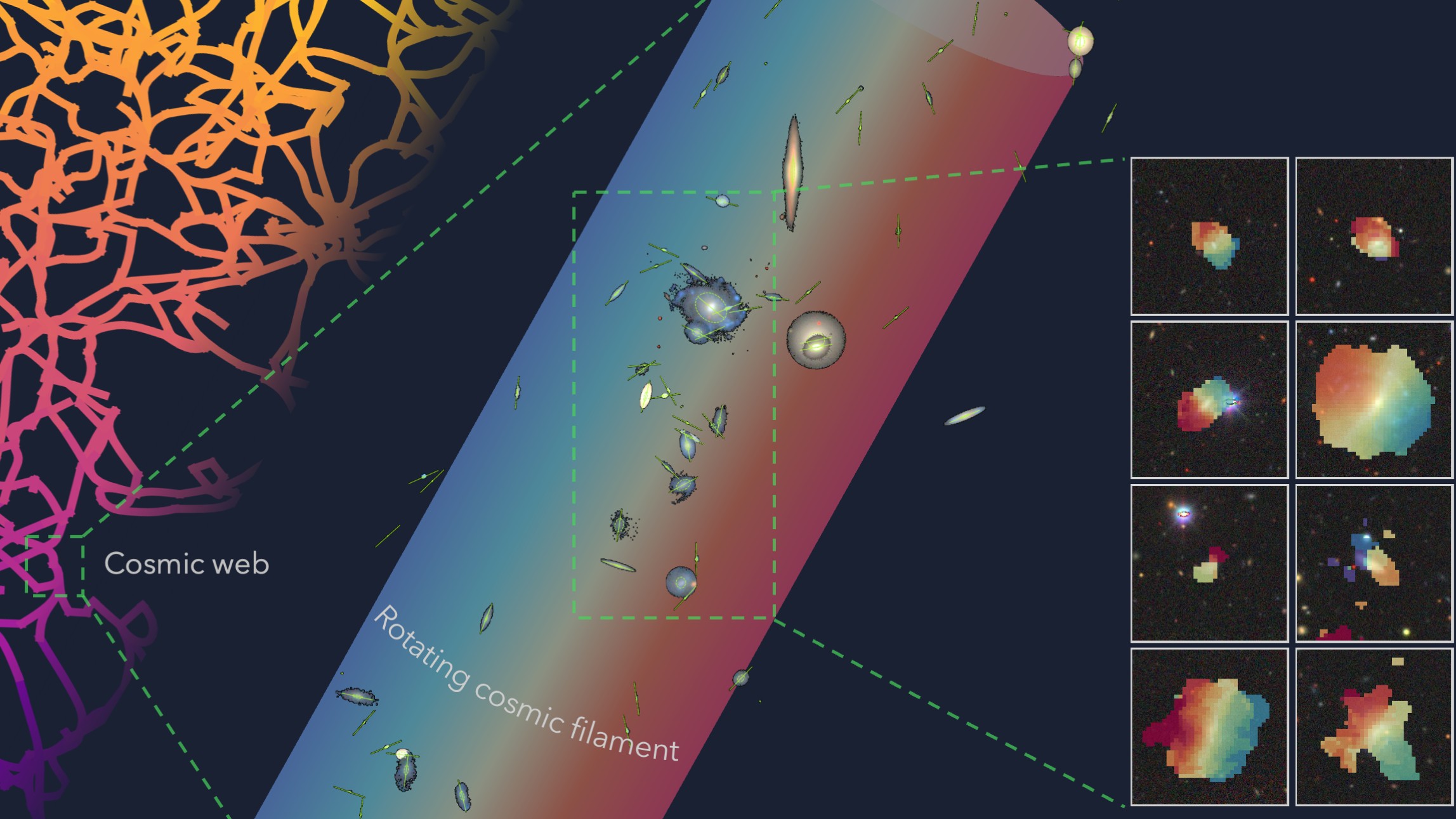
This immense celestial formation stretches approximately 5.5 million light-years in length and boasts a width of 117,000 light-years, making it significantly broader than our own Milky Way galaxy. Along its hydrogen-rich expanse, 14 galaxies are distinctly strung together, forming a cosmic chain reminiscent of charms on a bracelet.
Researchers explained that it was the unique configuration of these linked galaxies that ultimately betrayed the filament’s existence. These findings were detailed in a paper published today, December 3rd, in the journal *Monthly Notices of the Royal Astronomical Society*.
Astronomers made an unexpected discovery while utilizing the powerful MeerKAT radio telescope array in South Africa. Lyla Jung, an astronomer at the University of Oxford and co-lead author of the study, told Live Science that the initial finding was a “surprise” when she and her colleagues “noticed a striking alignment of galaxies glowing at the same distance.” The unusual cosmic configuration was observed using the 64-dish facility.
Measurements taken by researchers reveal a colossal cosmic filament rotating at an astonishing speed of approximately 68 miles per second (110 kilometers per second). Intriguingly, the galaxies surrounding this vast gaseous structure are also observed to be in rotational motion, with the majority spinning in the same direction as the filament itself.
This significant alignment suggests that such filamentary structures may play a pivotal role in the fundamental process of galaxy formation. Scientists propose these cosmic threads could be instrumental in influencing both the velocity and the orientation of a star cluster’s eventual rotational spin.
The recently identified filament stands as “probably the largest spinning object” astronomers have ever observed, according to Madalina Tudorache, an astronomer at the University of Oxford and a member of the research team, who shared this with Live Science. Tudorache explained that while the existence of such colossal structures has long been predicted in theoretical simulations, it is only with the advent of more sensitive telescopes in recent times that direct detection has become possible.

Anticipation is mounting among researchers that new, similar rotating filaments will soon be revealed, thanks to the unprecedented deep-space exploration facilitated by next-generation telescopes. These advanced instruments are pushing the boundaries of cosmic observation, allowing scientists to peer into previously unreachable regions of the universe.
Crucially, these celestial threads are not isolated phenomena; a multitude of them are interconnected, forming a monumental “cosmic web.” This intricate, universe-spanning network plays a pivotal role in channeling matter across the cosmos, thereby orchestrating the formation of the immense, interlinked clusters of galaxies that define the large-scale architecture of the universe.
The findings emerged from data collected during the ongoing MIGHTEE (MeerKAT International GHz Tiered Extragalactic Exploration) survey, an ambitious astronomical project spearheaded by Oxford physicist Matt Jarvis. Future MIGHTEE observations are expected to provide deeper insights into the filament’s unique behavior and could potentially lead to the discovery of other rotating cosmic threads. Furthermore, this significant find is poised to inform and guide upcoming surveys utilizing next-generation instruments, such as the Vera C. Rubin Observatory in Chile.
Tudorache emphasized its crucial role in advancing our comprehension of the universe.