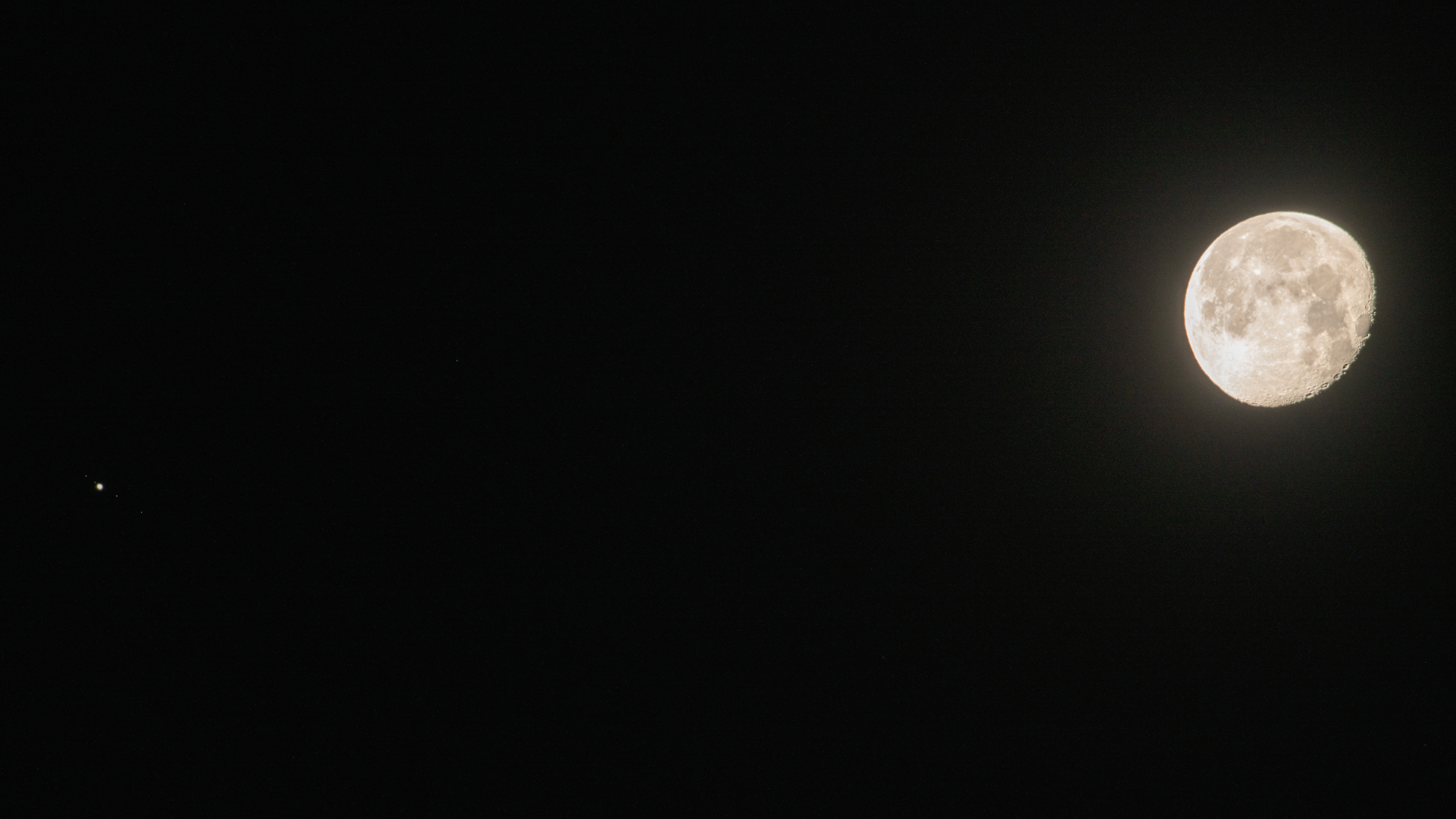
On the night of December 7, skygazers should look to the constellation Gemini for a notable celestial event. Jupiter, the solar system’s largest planet, will appear in a striking close conjunction with the waning gibbous moon, offering a prime viewing opportunity among the stars of the Twins.
On the evening of December 7, skywatchers are in for a treat as the strikingly luminous moon, 83% illuminated, ascends into the night sky. Making its appearance roughly three hours after sunset, our celestial neighbor will be closely accompanied by Jupiter. The gas giant will shine less than five degrees to the moon’s upper right – a proximity easily visualized as the width of your three middle fingers held at arm’s length.
Early risers on December 8th will be treated to a striking celestial display as Jupiter and the moon ascend to their highest point. In the pre-dawn hours, the luminous pair will dominate the southern sky, appearing almost directly overhead. Crowning this remarkable alignment, the brilliant twin stars Castor and Pollux, which famously represent the heads of the Gemini constellation, will gleam just above the moon and the gas giant.
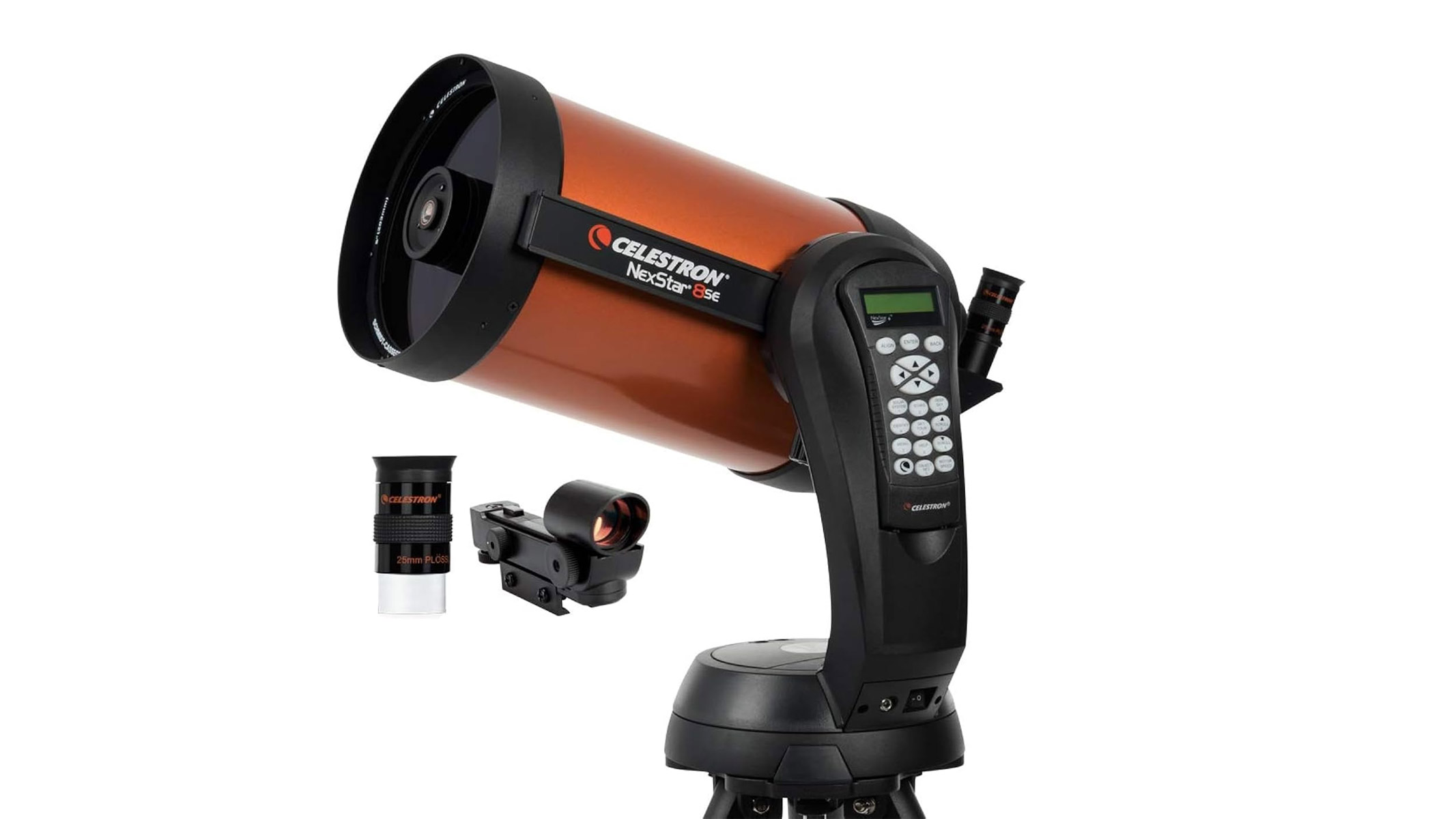
On the night of December 7-8, two prominent solar system objects are poised to offer a spectacular naked-eye viewing experience. For those seeking a more detailed perspective, a modest backyard telescope equipped with at least a 4-inch aperture can unveil Jupiter’s dynamic upper atmosphere, revealing its complex cloud bands and raging storms. This magnification may also allow observers to spot the gas giant’s four largest moons—Ganymede, Io, Europa, and Callisto—appearing as distinct points of light orbiting its colossal disk.
Shift your gaze from Jupiter’s majestic expanse to our nearest celestial neighbor, the Moon, to behold the impressive Tycho Crater. This prominent impact scar serves as a potent, visible reminder of the immense destructive power unleashed when asteroids collide with worlds throughout our solar system—a stark warning that includes Earth itself.
At an estimated 108 million years old, Tycho crater stands out as a remarkably young feature on the lunar surface. This makes it a mere infant when compared to some of the Moon’s most ancient and venerable formations, which can trace their origins back as far as 3.9 billion years.
**Elevate Your Celestial Observations: Top Gear for 2025 Unveiled**
For enthusiasts eager to explore the cosmos, definitive guides to the latest astronomical equipment are now accessible. Our comprehensive reviews showcase the leading telescopes and binoculars set to define optimal viewing experiences in 2025. Furthermore, aspiring astrophotographers can consult our expert recommendations for the finest cameras and lenses, perfectly suited for capturing the breathtaking expanse of the night sky.
Have you captured the recent captivating alignment of the moon and Jupiter? Space.com invites its readers to share their unique perspectives of this celestial event.
We are eager to showcase your stunning astrophotography. To submit your work for potential publication, please send your photograph(s), along with any accompanying comments or observations, and your full name and location to spacephotos@space.com.