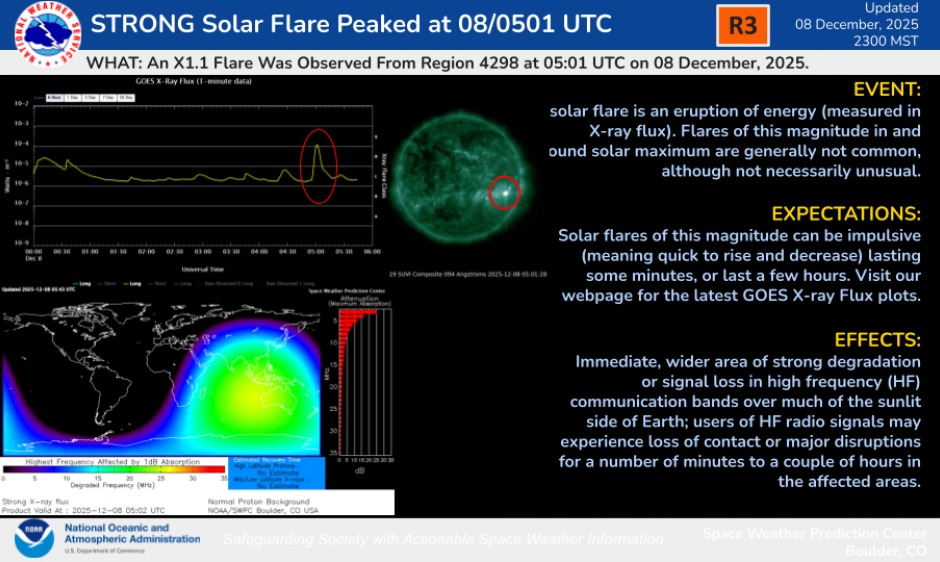
The sun unleashed a significant X1.1-class solar flare early Friday, December 8, leading to brief radio communication outages across Australia and portions of Southeast Asia.
An abrupt solar eruption, reaching its maximum intensity at 12:01 a.m. EST (0501 GMT), was observed emanating from sunspot region AR4298. This active solar feature is currently traversing towards the sun’s western limb and is anticipated to rotate out of Earth’s observational view within the next several days.
Accompanying a recent solar eruption, a coronal mass ejection (CME) — a vast cloud of plasma and magnetic fields — was hurled into space. Preliminary analyses of satellite coronagraph data, however, suggest that this specific CME is not on a collision course with Earth.
Earth is bracing for potential geomagnetic storms this weekend, December 8-9, as space weather forecasters predict the arrival of several coronal mass ejections (CMEs) from earlier solar flares. This anticipated impact comes amidst a highly active period for the sun, which recently saw another solar flare erupt.
Both NOAA’s Space Weather Prediction Center and the U.K. Met Office have issued geomagnetic storm watches, indicating a possibility of strong-moderate (G2-G3) level storming. Should these conditions develop, aurora displays, commonly known as the northern lights, could become visible to high and mid-latitude observers.
Solar flares erupt as powerful bursts of electromagnetic radiation from the sun’s atmosphere, triggered by the sudden, rapid discharge of pent-up magnetic energy.
Items are systematically sorted into distinct lettered groups, a classification driven primarily by their size, with each designation precisely reflecting a specific level of strength.

Solar flare classification involves a numerical scale within each category, precisely gauging the event’s strength. The Dec. 8 flare, recorded as an X.1.1, was thus designated as an X-class event.
When solar flares erupt, they unleash powerful radiation that, upon reaching Earth, electrifies the upper atmosphere. This sudden ionization can critically disrupt shortwave radio communications for areas across the planet’s sunlit hemisphere.
Under normal conditions, long-distance high-frequency (HF) radio communication depends on signals reflecting off the ionosphere’s upper, more tenuous layers. Yet, a strong solar flare profoundly disrupts this process.
During such an event, the sun’s intense radiation causes the lower, denser regions of the ionosphere to become intensely ionized. As radio waves attempt to traverse these newly overcharged layers, they experience a significant increase in particle collisions, leading to a rapid loss of energy.
Consequently, high-frequency radio signals can suffer severe fading, distortion, or even complete blackouts, according to the National Oceanic and Atmospheric Administration (NOAA).