
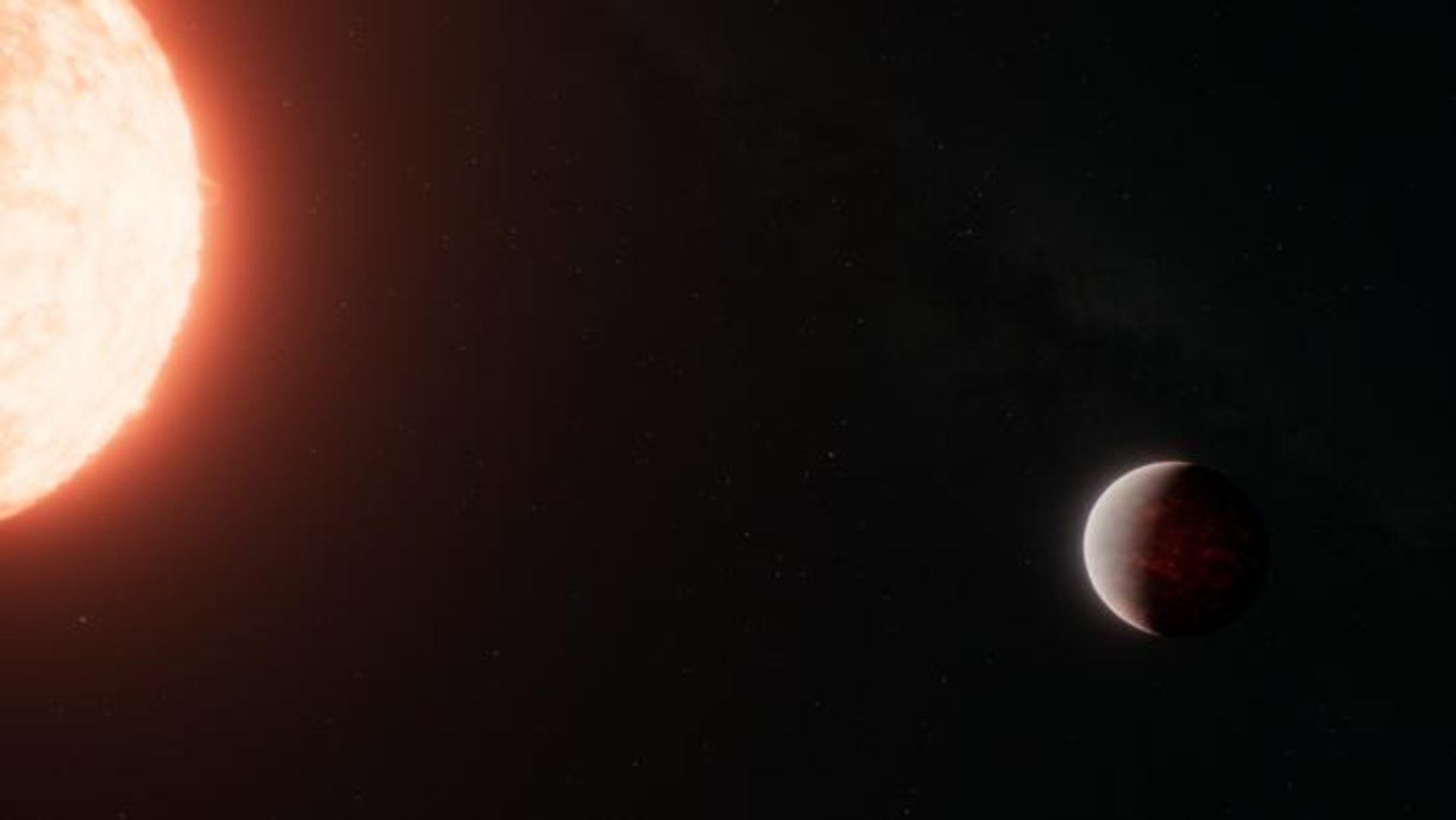
Harnessing the advanced capabilities of the James Webb Space Telescope, astronomers have reported uncovering the most compelling evidence to date for an atmosphere enveloping a rocky world situated beyond our solar system.
New findings are overturning the long-held belief that smaller planets positioned in searingly close orbits around their stars are inherently unable to retain atmospheres.
Astronomers have pinpointed TOI-561 b, an “ultra-hot super-Earth” that orbits remarkably close to its ancient host star. Situated about 280 light-years from Earth, this 10-billion-year-old star is orbited by TOI-561 b as the innermost of at least three known planets. The exoplanet’s extreme proximity to its sun is striking: it maintains an orbit just one-fortieth the distance separating Mercury from our own star, allowing it to complete a full revolution in a blazing less than 11 hours.

TOI-561 b is an ultra-short-period super-Earth that orbits its star so closely its surface is heated to temperatures capable of melting rock. Under such extreme conditions, scientists typically anticipate that intense stellar radiation would strip a planet of any atmosphere, leaving behind a barren, airless sphere. However, observations from NASA’s Transiting Exoplanet Survey Satellite (TESS) have unveiled a surprising anomaly: TOI-561 b exhibits an unusually low density for what is presumed to be a purely rocky world. This unexpected finding suggests that a more complex explanation may be required to understand the planet’s true nature.
The planet’s genesis must have unfolded within a chemical environment “very different” from those that shaped our own solar system, according to Johanna Teske. Teske, a staff scientist at the Carnegie Earth and Planets Lab in Washington D.C. and lead author of the new research paper, conveyed this striking observation in a recent statement.
To investigate the potential presence of an atmosphere around exoplanet TOI-561 b, a research team utilized the James Webb Space Telescope’s (JWST) NIRSpec instrument. Their primary method involved precisely measuring the temperature of the planet’s dayside.
In May 2024, the JWST conducted an uninterrupted observation campaign, monitoring the TOI-561 b system for over 37 hours and documenting four complete orbits. Scientists paid particular attention to “secondary eclipses”—moments when the exoplanet passed directly behind its host star, causing its own light to temporarily vanish.
By meticulously recording the subtle decrease in the system’s overall brightness during each of these eclipses, the team was able to isolate the unique infrared glow emanating from the planet. This critical measurement allowed them to directly determine TOI-561 b’s dayside temperature, providing essential data for their atmospheric assessment.
The James Webb Space Telescope (JWST) has uncovered a significant temperature discrepancy on exoplanet TOI-561 b, providing compelling evidence for the presence of an atmosphere. Scientists initially predicted that an airless TOI-561 b would reach a blistering 4,900 degrees Fahrenheit (2,700 degrees Celsius) on its dayside. However, the JWST’s measurements revealed a much cooler environment, registering around 3,100 degrees Fahrenheit (1,700 degrees Celsius). This substantial difference prompted researchers to investigate a variety of potential surface and atmospheric models, seeking to pinpoint the conditions that could account for the telescope’s unique thermal observations.
A substantial, volatile-rich atmosphere is deemed “indispensable for unraveling the full spectrum of observed phenomena,” according to Anjali Piette, a co-author of the study from the University of Birmingham. Piette further highlighted that powerful atmospheric currents within such an environment would play a crucial role in regulating daytime temperatures, effectively cooling the illuminated hemisphere by ferrying heat to the planet’s perpetually dark side.
A research team has put forth a compelling hypothesis: the planet likely maintains a critical equilibrium between its molten surface and its atmosphere. This proposed balance would enable a continuous cycle of gases, potentially allowing the atmosphere to be consistently replenished and sustained over long periods.
A team of researchers proposes that the planet may sustain a dynamic equilibrium between its molten surface and its atmosphere. This intricate balance could facilitate a continuous exchange of gases between these two extreme environments, potentially serving as a vital mechanism to replenish the planet’s atmospheric composition.
A planet’s atmosphere and its molten interior are engaged in a constant, dynamic interplay, according to Tim Lichtenberg, a study co-author from the University of Groningen in the Netherlands. Lichtenberg explained that as gases rise from the planet to feed its atmosphere, a vast magma ocean concurrently draws them back into the interior. This perpetual cycle, he observed, leads to a planet that is “really like a wet lava ball.”
These findings, researchers emphasize, offer an unprecedented opportunity to delve into the deep interiors and active geology of scorching rocky exoplanets by meticulously analyzing their atmospheric compositions.
The comprehensive findings of the study were officially unveiled on December 11, appearing in the prestigious pages of The Astrophysical Journal Letters.