
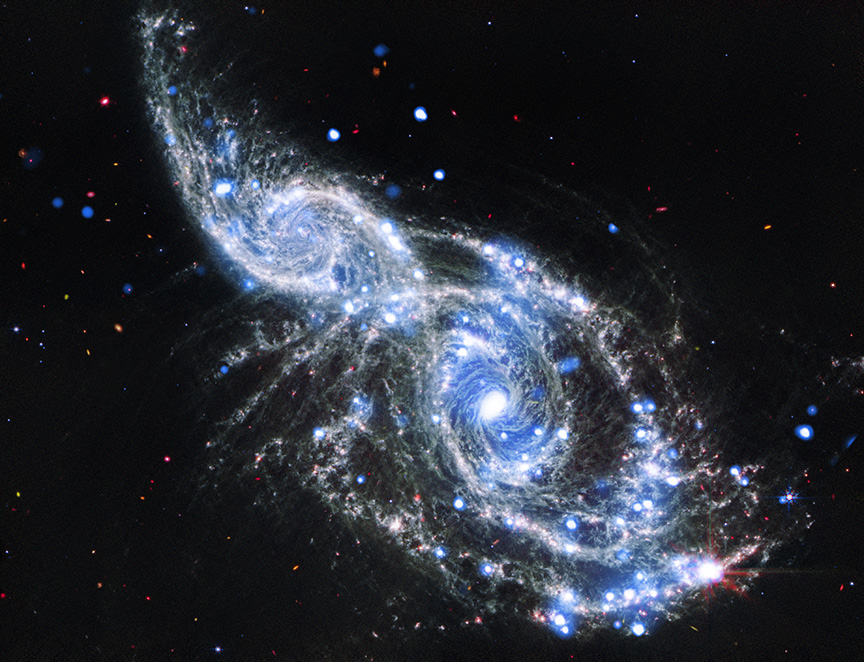
A stunning new composite image captures two spiral galaxies in a dramatic collision, their celestial forms and vibrant colors evoking the distinct moods of autumn. This captivating portrait highlights NGC 2207, situated in the lower right, and IC 2163, appearing prominently in the upper left. To achieve this unique visualization, scientists meticulously combined infrared observations from the advanced James Webb Space Telescope (JWST) with X-ray emissions detected by the Chandra X-ray Observatory.
In a stunning celestial display, the galaxies NGC 2207 and IC 2163 are caught in a protracted gravitational merger, offering a rare face-on view from Earth. The larger and more dominant NGC 2207 anchors the interaction, with its smaller companion, IC 2163, delicately overlapping its outer regions.
As these cosmic giants draw closer, their mutual gravitational pull intricately distorts each other’s elegant spiral arms. This powerful exchange stretches vast streams of stars and gas into elongated tendrils, while simultaneously compressing interstellar gas and dust. Such compression often triggers intense bursts of star formation, igniting new stellar nurseries across the merging duo. The cumulative effect is a dynamic, intricate tapestry of cosmic turbulence, continually reshaping these interacting galaxies.
NASA has assigned the James Webb Space Telescope (JWST) a pivotal mission: to provide scientists with an unprecedented, clear view into the tumultuous centers of merging galaxies. This crucial objective aims to fuel a new generation of sophisticated models, which will precisely detail how galaxies interact and ultimately coalesce. Consequently, the spectacular interacting duo of NGC 2207 and IC 2163 have been identified as ideal targets for these groundbreaking observations.
This captivating image merges observations from two powerful telescopes, painting a comprehensive portrait of galactic activity. Data from the James Webb Space Telescope (JWST), rendered in a striking palette of white, gray, and red, meticulously maps the cooler, dust-rich material inhabiting the galaxies’ dense cores and elegant spiral arms. In sharp contrast, the Chandra X-ray Observatory’s contributions, depicted in brilliant blue, pinpoint regions of intense high energy—revealing scorching binary star systems, the dense remnants of long-dead stars, and the dramatic sites where supernovas have recently erupted.
The Chandra X-ray Observatory recently unveiled a collection of four compelling composite images, spotlighting diverse cosmic phenomena. Leading this quartet is the spectacular, layered visualization of the colliding galaxies NGC 2207 and IC 2163.
Also among the newly released observations is NGC 6334, a dynamic star-forming region distinguished by its elegant arcs of incandescent gas and cosmic dust. Another featured object is the supernova remnant G272.2-0.3, where an expanding shell is densely filled with hot, X-ray-emitting gas. Rounding out the series is the fascinating binary star system R Aquarii, an astronomical drama where a compact white dwarf star actively siphons material from its expansive red giant companion.
Each captivating image offers a multi-wavelength view of the cosmos, meticulously woven from Chandra’s unique insights into the high-energy universe. This comprehensive perspective integrates data from the cutting-edge James Webb Space Telescope (launched in 2021), the long-serving Hubble Space Telescope (operational since 1990), and the Spitzer Space Telescope (active from 2003 to 2020), alongside crucial observations gathered by terrestrial observatories.
For more sublime space images, check out our Space Photo of the Week archives.





