In a groundbreaking astronomical achievement, scientists have for the first time definitively confirmed the existence of a ‘rogue planet’ – a solitary world untethered to any star, drifting through the vastness of space. These enigmatic celestial bodies have long baffled researchers, but new data has allowed astronomers to pinpoint the distance and mass of one such interstellar wanderer.
This newly confirmed rogue planet is a gas giant, estimated to be roughly the size of Saturn, and is located nearly 10,000 light-years from Earth. The precise characterization of this starless world represents a monumental leap in humanity’s understanding of the universe’s most mysterious inhabitants.
For millennia, our understanding of planets revolved around worlds bound to orbiting stars. However, this conventional view began to shift in 2000 when astronomers first detected signs of “rogue planets”—celestial bodies that drift unbound through the cosmos.
Fast forward to 2024, when a sophisticated new observation offered compelling evidence of another such free-floating world. Researchers, employing a powerful network of ground-based observatories in conjunction with data from the European Space Agency’s now-retired Gaia space telescope, simultaneously detected an object bending the light from a distant star. This synchronized detection from both Earth and space provided unprecedented accuracy.
These meticulous measurements allowed scientists to precisely estimate the characteristics of this newfound world. It is believed to be located approximately 9,950 light-years from Earth, deep within the bustling heart of the Milky Way. With an estimated mass roughly 70 times that of Earth, this colossal object challenges our traditional definitions of planetary systems, though it remains lighter than gas giants like Saturn, which has a mass about 95 times that of Earth.
Researchers behind a recent discovery are fundamentally reshaping our understanding of the Milky Way, positing that free-floating planets, unmoored from any star, are far more ubiquitous than once believed. These rogue worlds, it’s suggested, could dramatically outnumber the galaxy’s stellar population.
Andrzej Udalski, an astrophysicist at the University of Warsaw in Poland and a co-author of the study, explained to Space.com that theoretical models of planetary system formation indicate these planets could be “very numerous in the Milky Way,” potentially exceeding the number of stars by several times.
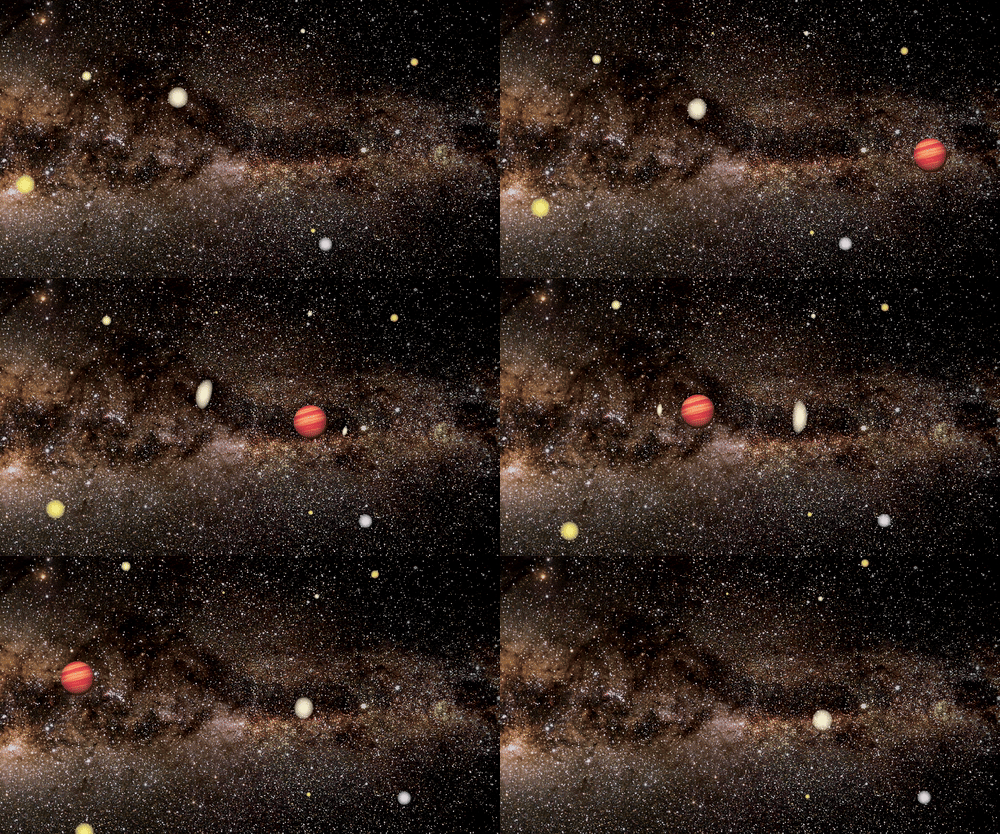
Investigating the elusive populations of rogue planets – worlds that drift unbound by any star’s gravitational pull – holds the key to unlocking mysteries surrounding planetary formation itself. Such research could also illuminate the specific mechanisms that cast planets adrift into interstellar space.
Prior studies indicate that violent gravitational skirmishes occurring early in a nascent planetary system’s life can violently eject planets from their stellar nurseries. Furthermore, close encounters with other stars passing through a system are theorized to destabilize orbits, potentially flinging worlds into the cold, dark expanse of interstellar space. Intriguingly, an alternative hypothesis proposes that some rogue planets may not be exiles at all, but instead coalesce independently from the very same primordial clouds of gas and dust that give rise to stars.
Identifying the enigmatic “rogue planets” poses a significant challenge for astronomers. These free-floating worlds do not generate enough light to be detected by our current generation of telescopes, effectively rendering them invisible to direct observation. Consequently, the only viable method for uncovering these elusive celestial bodies relies on detecting their profound gravitational influence, which subtly distorts the very fabric of spacetime around them.
Astronomers are leveraging a remarkable cosmic phenomenon to detect elusive rogue planets – those enigmatic worlds that drift through space untethered to any star.
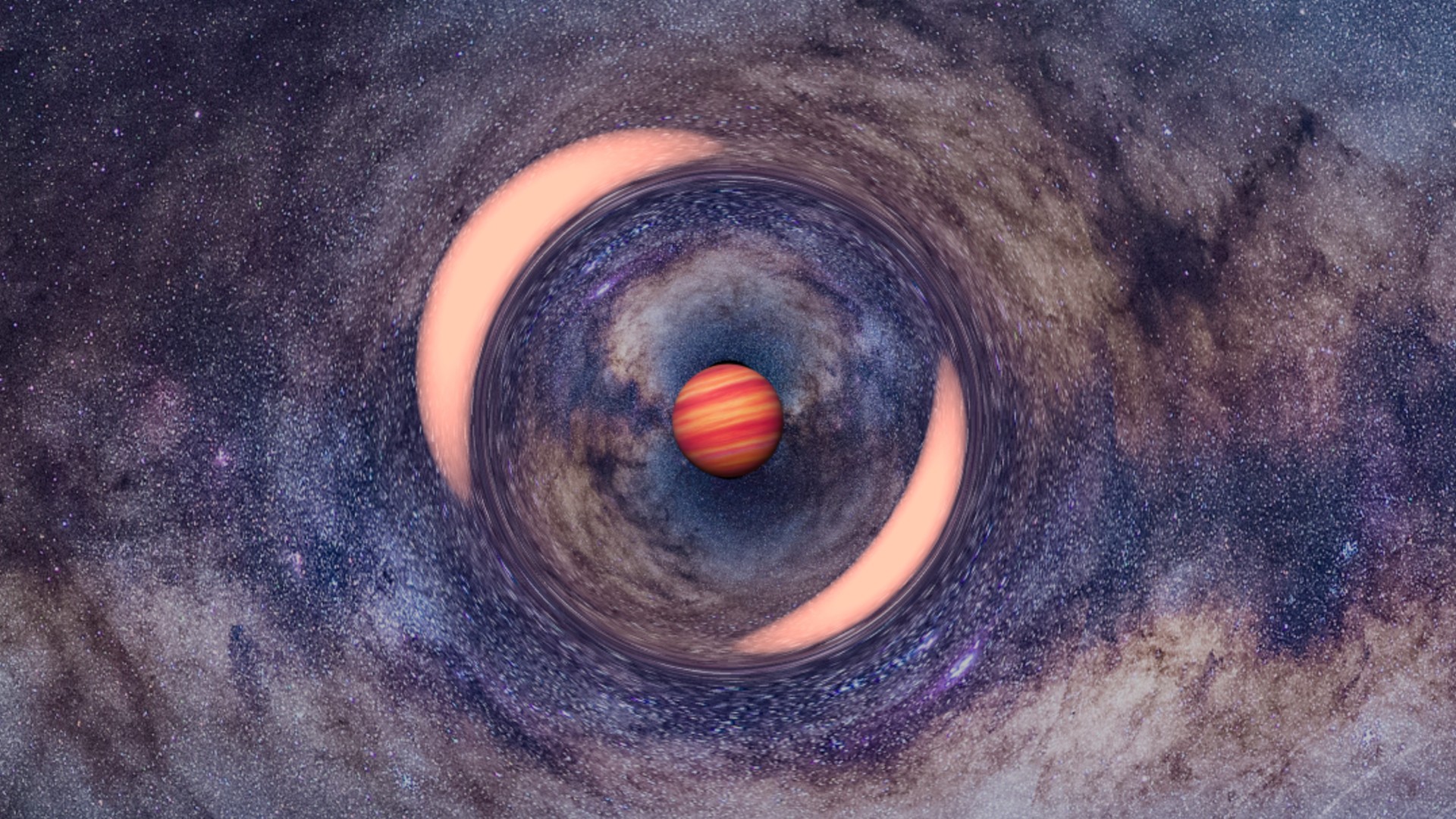
When one of these solitary planets passes in front of a distant background star, its powerful gravitational field warps spacetime, effectively acting as a natural magnifying lens. This gravitational lensing effect momentarily amplifies the star’s apparent brightness, creating a brief but discernible surge in luminosity.
This transient brightening provides crucial, indirect evidence, allowing scientists to infer the existence of an otherwise invisible rogue planet. Using this ingenious detection method, researchers have, to date, identified approximately a dozen potential rogue planets roaming the galaxy.
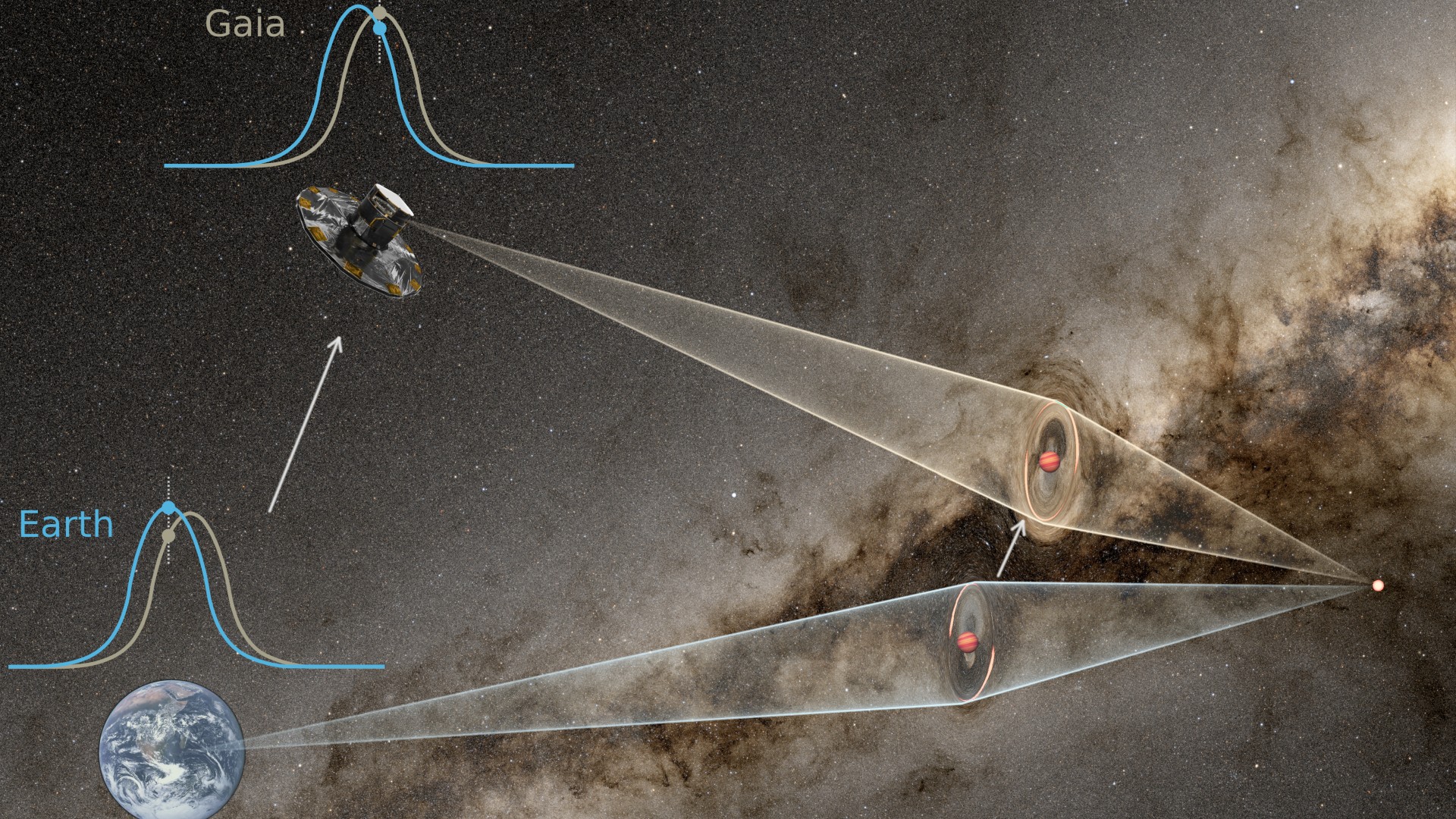
While gravitational microlensing offers a powerful method for detecting rogue planets, it possesses a significant limitation: the technique cannot independently ascertain the precise distance of these unbound worlds. This fundamental distance ambiguity inherently complicates the deduction of crucial planetary characteristics, such as their true mass. As a result, much about rogue planets has remained largely theoretical, preventing astronomers from conclusively confirming whether these detections truly represent planets or are, in fact, more massive objects like brown dwarfs – the so-called ‘failed stars’.
In a significant astronomical breakthrough, scientists have not only detected a free-floating rogue planet but have also achieved the unprecedented feat of precisely quantifying both its distance from Earth and its mass.
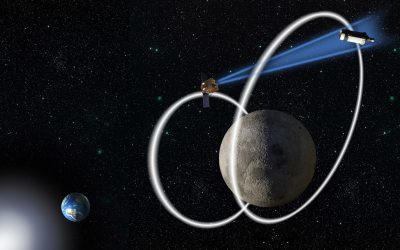
The celestial event, designated KMT-2024-BLG-0792 and OGLE-2024-BLG-0516, was observed simultaneously from two distinct vantage points. This dual perspective allowed researchers to employ a sophisticated triangulation technique, effectively measuring the planet’s vast separation from our home world.
With its precise distance established, astronomers were then able to deduce the isolated world’s mass. This was achieved by meticulously analyzing the duration and intensity of the gravitational field’s distortion on the light emanating from a background star, a phenomenon crucial for understanding its physical properties.
Here are a few options for paraphrasing the quote, each with a slightly different emphasis:
**Option 1 (Focus on the implication):**
> The astronomical community is abuzz with the potential implications of a new discovery, which a Peking University professor suggests could point to a universe “teeming with rogue planets.”
**Option 2 (More direct and concise):**
> “This finding provides compelling evidence that galaxies might be awash in wandering planets,” stated study co-author Subo Dong, an astronomer from Peking University.
**Option 3 (Highlighting the significance of the evidence):**
> According to Subo Dong, a professor of astronomy at Peking University, their recent discovery offers significant new support for the idea that galaxies are “teeming with rogue planets.”
**Option 4 (Emphasizing the “teeming” aspect):**
> A professor of astronomy at Peking University, Subo Dong, has declared that their latest findings serve as “further evidence that the galaxy may be teeming with rogue planets.”
**Key changes made and why:**
* **”Our discovery offers further evidence that…”** was rephrased to:
* “The astronomical community is abuzz with the potential implications of a new discovery, which suggests…” (More narrative, builds intrigue)
* “This finding provides compelling evidence that…” (Stronger, more active verb)
* “…offers significant new support for the idea that…” (Highlights the level of support)
* “…serve as ‘further evidence that…” (More formal phrasing)
* **”…the galaxy may be teeming with rogue planets,”** was kept largely the same but sometimes enclosed in quotes or slightly rephrased to fit the flow of the new sentence. “Teeming” is a strong word, so retaining it or a close synonym maintains the impact.
* **”study co-author Subo Dong, a professor of astronomy at Peking University in China, said in a statement.”** was reordered and sometimes integrated more smoothly into the sentence structure for better readability.
* **Journalistic Tone:** The phrasing aims for clarity, objectivity, and a sense of reporting on a scientific finding. Words like “potential implications,” “compelling evidence,” and “significant new support” contribute to this.
Choose the option that best fits the overall tone and context of your article.

Future space observatories are poised to significantly expand our understanding of rogue planets – those celestial bodies not gravitationally bound to any star. NASA’s upcoming Nancy Grace Roman Space Telescope, slated for a 2026 debut, promises a revolutionary leap in sky surveying. Its infrared capabilities will allow it to examine vast cosmic regions at speeds 1,000 times faster than the venerable Hubble Space Telescope. Complementing these efforts, China’s Earth 2.0 satellite, scheduled for a 2028 launch, will also join the quest to identify these elusive, free-floating worlds.
“The field of studying planets that drift through space untethered to any star is experiencing a period of significant growth and promise,” stated Udalski.
Here are a few options for paraphrasing “The scientists detailed their findings online Jan. 1 in the journal Science,” each with a slightly different emphasis:
**Option 1 (Focus on the publication):**
> Researchers unveiled their latest discoveries on January 1st, publishing the comprehensive details in the esteemed scientific journal, *Science*.
**Option 2 (More active voice):**
> The scientific community gained access to new findings on January 1st, as researchers published a detailed account of their work in the journal *Science*.
**Option 3 (Concise and direct):**
> A detailed report on the scientists’ findings was made public online on January 1st, appearing in the pages of the journal *Science*.
**Option 4 (Slightly more descriptive):**
> On January 1st, researchers shared the in-depth results of their study through an online publication in the prestigious journal *Science*.
**Option 5 (Emphasizing the immediacy):**
> The journal *Science* featured a comprehensive online release of the scientists’ latest findings on January 1st.
Choose the option that best fits the surrounding text and the overall tone you want to achieve.