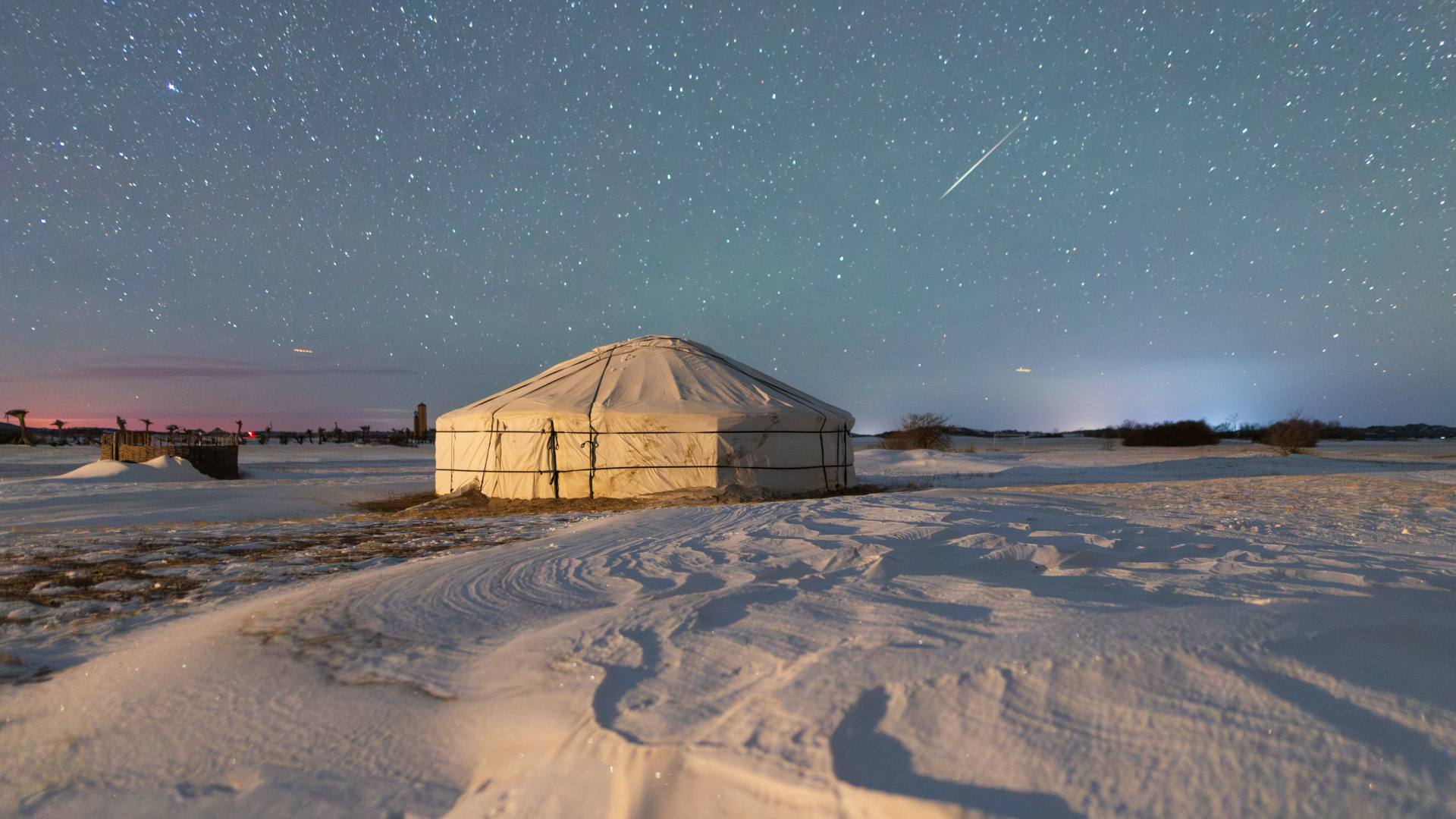
Tonight offers stargazers their first major celestial event of 2026 as the Quadrantid meteor shower reaches its peak. While the annual display promises shooting stars and the possibility of bright fireballs, observers should note that a full moon will also illuminate the night sky. Consequently, only the most luminous meteors are expected to cut through the significant lunar glare, making fainter sightings challenging.
Stargazers anticipating a celestial treat can look forward to the Quadrantid meteor shower, which will be active from December 26, 2025, through January 16, 2026. However, its most intense phase will be concentrated into a remarkably narrow window, lasting roughly six hours, expected to unfold in the pre-dawn hours of January 4, 2026, according to astronomical insights from EarthSky.org.
This unusually brief but brilliant peak is attributed to Earth’s swift, near-perpendicular traverse through the exceptionally thin debris stream left behind by asteroid 2003 EH1. The dazzling “shooting stars” themselves are born when these ancient fragments of comets and asteroids encounter our planet, igniting into brilliant streaks of light as they are consumed by the intense friction of Earth’s atmosphere.
Known for their potential to deliver spectacular celestial shows, the Quadrantid meteor showers typically boast rates of up to 200 shooting stars per hour under optimal dark sky conditions. However, skygazers hoping to witness the 2025-26 display face a significant challenge: the shower’s peak will unfortunately coincide with a full moon. The intense glare from this lunar phase is predicted to obscure all but the brightest meteors, severely diminishing visibility. Indeed, NASA’s projection for the peak night’s hourly rate is a modest 10 meteors, a stark contrast to its usual brilliance. This particular January full moon is traditionally known as the “Wolf Moon,” a name historically linked to the sound of wolves howling towards Earth’s satellite during the lean, food-scarce winter months.
The Quadrantid meteor shower’s celestial origins are traced to a specific region of the sky: a patch near the ‘handle’ of the iconic Big Dipper asterism. This prominent feature is part of Ursa Major, a constellation known for its circumpolar status—meaning it remains perpetually visible above the horizon for observers across the Northern Hemisphere. Consequently, the Quadrantids are optimally observed from higher northern latitudes, specifically from locations situated north of the 51st parallel.
The meteor shower owes its unique designation to an extinct constellation, Quadrans Muralis. This celestial pattern was charted in 1795 by French astronomer Jerome Lalande, locating it in the vicinity of the Big Dipper, as documented by NASA. Despite its historical significance, Quadrans Muralis was never formally adopted by the International Astronomical Union (IAU) and is not among the 88 constellations officially recognized today.
For skygazers, the apparent origin point of the Quadrantid meteors, known as the radiant, offers a dynamic display of positional change throughout the night. Early in the evening, after sunset, it will be observed hugging the northern horizon. However, as the night progresses towards the pre-dawn hours, the radiant ascends dramatically, reaching a prime, high-overhead position, ideal for peak viewing.
While these celestial streaks can ignite any part of the firmament, astronomers advise against focusing directly on the radiant itself. Stargazers seeking the most dramatic and extended trails are better off looking slightly away from this point, as focusing directly on it will result in observing only the briefest of streaks.
For those eager to capture the stunning Quadrantids meteor shower, our comprehensive guide offers essential techniques for photographing shooting stars. Additionally, if you’re looking to elevate your celestial photography, explore our expertly curated recommendations for the best cameras and lenses tailored for astrophotography.
**Share Your Quadrantid Meteor Shots!**
Did you capture a breathtaking image of a Quadrantid meteor? Space.com invites astrophotographers to share their stunning views of this celestial spectacle with our global audience.
We are actively seeking your unique perspectives from the recent meteor shower. To submit your photographs for potential publication, please send your high-resolution image(s), along with any accompanying comments about your capture, your full name, and your location, directly to spacephotos@space.com. We look forward to featuring your contributions!