
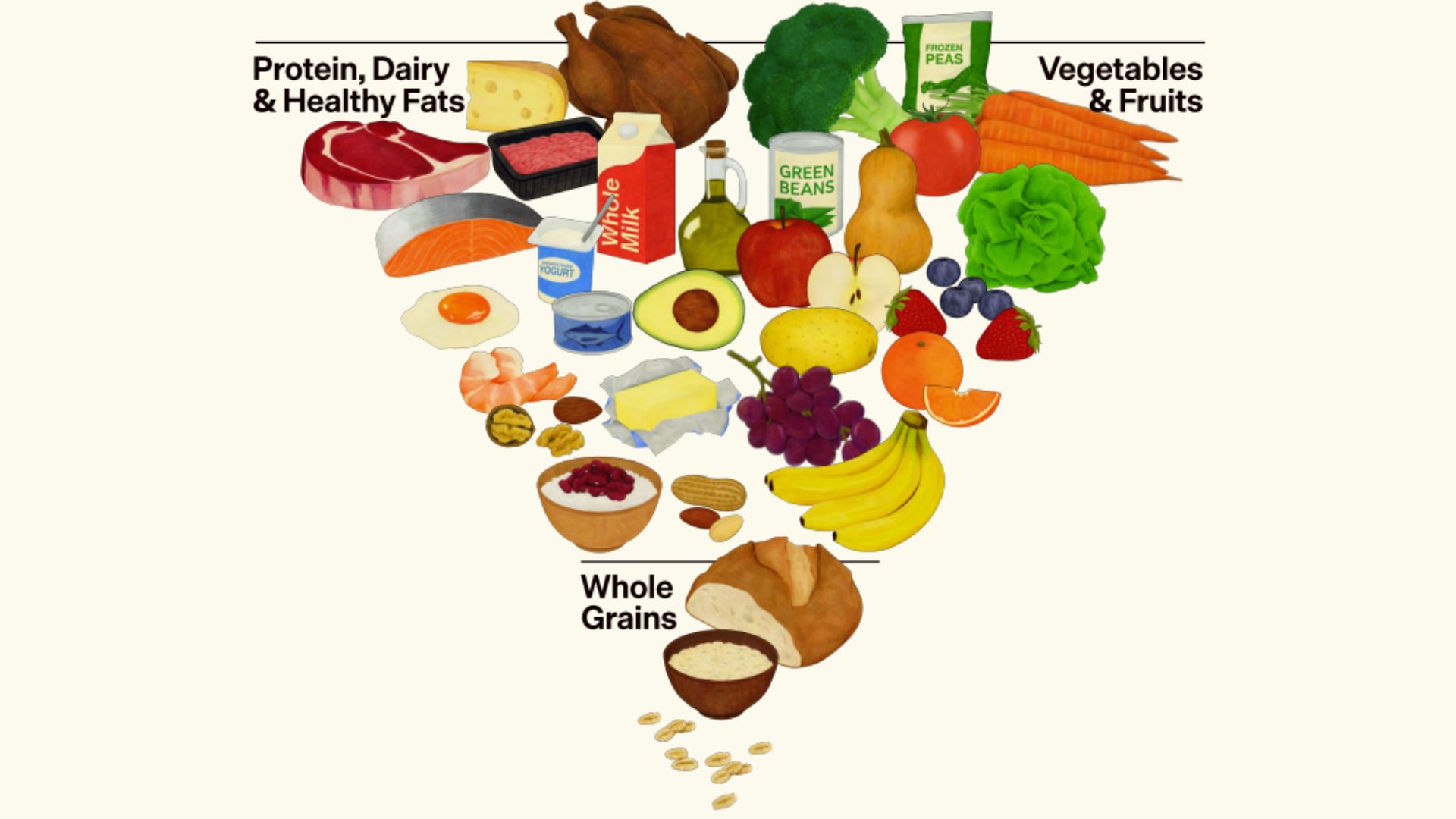
The United States government has unveiled a revamped food guidance system, significantly altering the traditional food pyramid’s structure.
A recently unveiled food chart is placing a significant emphasis on meats, dairy products, and what are categorized as “healthy fats,” alongside a strong focus on fruits and vegetables. This visual guide is being released in conjunction with updated nutritional advice that embraces some long-standing dietary principles while departing from others.
**New Dietary Guidelines Unveiled, Replacing MyPlate with a “New Pyramid” Concept**
On Wednesday, January 7th, the Departments of Agriculture and Health and Human Services introduced updated dietary guidelines, marking the discontinuation of MyPlate, the visual eating guide that had been in place since 2011. In its stead, the agencies have presented a concept they’re calling the “New Pyramid.” This innovative visual shifts from its predecessor by inverting the traditional triangular structure. At the apex of this new arrangement are protein, dairy, and “healthy fats,” positioned alongside fruits and vegetables. Occupying the base of this reimagined pyramid are whole grains.
The updated guidelines for the New Pyramid strongly advise against the consumption of heavily processed foods, refined carbohydrates, and added sugars. It’s important to note that naturally occurring sugars present in whole foods such as fruits and dairy products are not classified as “added sugars” under these recommendations.
New dietary recommendations clarify that healthy fats can be sourced from a variety of foods, including meats, poultry, eggs, and seafood rich in omega-3 fatty acids. Nuts, seeds, full-fat dairy products, olives, and avocados are also recognized as valuable sources of beneficial fats.
For cooking, both olive oil, predominantly unsaturated fat, and saturated fats like butter and beef tallow are deemed acceptable. However, the established advice to limit saturated fat intake remains in place, with recommendations advising that these fats constitute no more than 10% of a person’s total daily caloric consumption.
**New Protein Recommendations Mark a Substantial Shift in Dietary Advice**
Recent reporting from NBC indicates a significant upward revision in recommended daily protein intake. Previously, established guidelines suggested that sedentary adults required 0.8 grams of protein per 2.2 pounds (or 1 kilogram) of body weight to meet their nutritional needs. For those who are physically active, the recommended amount was higher, ranging from approximately 1.1 to 1.5 grams per kilogram. Older adults were also advised to consume more, with a recommendation of about 1 to 1.2 grams per kilogram. The newly released guidelines, however, represent a notable increase compared to these earlier benchmarks.
**Revised Protein Recommendations Signal Significant Increase for Many**
New dietary guidelines are suggesting a notable shift in daily protein consumption, recommending individuals aim for 1.2 to 1.6 grams of protein per kilogram of body weight. For a person weighing 150 pounds (approximately 68 kg), this translates to a substantial increase, potentially more than doubling their current intake. Under these new recommendations, this individual would need to consume between 81.6 and 108.8 grams of protein daily, a considerable jump from the previously suggested 54.4 grams.
Here are a few paraphrased options, each with a slightly different emphasis, maintaining a journalistic tone:
**Option 1 (Focus on delay and rejection):**
> Health Secretary Robert F. Kennedy Jr. has held up the release of new dietary guidelines for an extended period, a delay attributed to his rejection of the recommendations from a 20-member scientific advisory committee appointed under President Joe Biden, according to a report by STAT. The committee had been on the verge of advocating for diets that emphasize plant-based foods over those centered on meat. Furthermore, they determined that current research on ultraprocessed foods was insufficient to formulate definitive guidance.
**Option 2 (Focus on committee’s findings and Kennedy’s stance):**
> A scientific advisory committee, assembled during President Joe Biden’s administration, had prepared recommendations for plant-forward diets, a direction that Health Secretary Robert F. Kennedy Jr. has reportedly rejected, leading to months of delay in releasing new dietary guidelines. STAT reports that the 20-person panel also concluded that existing evidence on ultraprocessed foods did not provide a strong enough basis for specific recommendations.
**Option 3 (More concise and direct):**
> New dietary guidelines have been stalled for months, with Health Secretary Robert F. Kennedy Jr. reportedly sidelining the work of a 20-person scientific advisory committee formed under President Joe Biden, STAT has revealed. The committee was prepared to suggest a shift toward plant-centric eating patterns and determined that current research on ultraprocessed foods was not robust enough for concrete recommendations.
**Option 4 (Emphasizing the contrast in recommendations):**
> The rollout of updated dietary guidelines has been postponed for months, as Health Secretary Robert F. Kennedy Jr. has reportedly turned away the findings of a 20-member scientific advisory committee established under President Joe Biden. STAT reports that the panel was poised to endorse diets prioritizing plants over meat. Crucially, the committee also concluded that the existing body of research on ultraprocessed foods was inadequate for developing clear, actionable recommendations.
Here are a few options for paraphrasing the text, each with a slightly different emphasis:
**Option 1 (Focus on ambiguity and expert consensus):**
> While a definitive definition of “ultraprocessed” remains elusive, a consensus among many health experts suggests these foods are generally unhealthy when consumed frequently. However, pinpointing the precise health risks associated with every item categorized as ultraprocessed presents a significant challenge.
**Option 2 (More direct and action-oriented):**
> The classification of foods as “ultraprocessed” is complex, and though most experts concur that excessive consumption is detrimental to health, it’s unclear if all foods falling under this broad label pose identical health threats.
**Option 3 (Highlighting the nuance of risk):**
> Defining “ultraprocessed” foods can be a nuanced undertaking. While a broad agreement exists among experts that their overconsumption is unhealthy, the extent to which each individual ultraprocessed product carries the same level of health risk is not yet fully understood.
**Option 4 (Concise and journalistic):**
> Experts generally agree that ultraprocessed foods are best consumed in moderation, but the exact health implications of every food within this category remain a subject of debate due to the difficulty in precisely defining “ultraprocessed.”
These paraphrased versions aim to:
* **Be unique:** They use different sentence structures and vocabulary.
* **Be engaging:** They aim for a clear and direct style.
* **Maintain the core meaning:** They convey the difficulty in defining “ultraprocessed” and the uncertainty about uniform health risks.
* **Adopt a journalistic tone:** They are objective, informative, and avoid overly casual language.
New dietary recommendations are drawing attention for their strong focus on meat and dairy consumption, while simultaneously advising against “highly processed” foods. However, the guidelines fall short of providing a precise definition for this term. Instead, they offer a list of specific items to steer clear of, including:
* Packaged, prepared, and ready-to-eat meals.
* Foods characterized by excessive salt or sugar content.
* Beverages sweetened with sugar.
* Products containing artificial flavors, preservatives, or low-calorie, non-nutritive sweeteners.
Concerns have been raised by some health professionals that the recently issued guidelines may inadvertently encourage excessive consumption of red meat and dairy. Critics point to the visual representation within the guidelines, which prominently features items like steak, ground beef, and whole milk in its inverted pyramid illustration. Dr. Walter Willett, a distinguished professor of epidemiology and nutrition at the Harvard T.H. Chan School of Public Health, expressed his reservations to CNN, stating via email that such a focus “will not lead to optimally healthy diets or a healthy planet.”
Here are a few options, each maintaining the core meaning while offering a unique, engaging, and original journalistic tone:
**Option 1 (Direct and Analytical):**
> Nutritionist Marion Nestle, a professor emeritus at New York University, informed STAT via email that the guidelines explicitly promote diets heavily reliant on meat. She contended that, within these recommendations, “protein” serves as a mere euphemism for meat.
**Option 2 (Emphasizing the Euphemism):**
> In an email to STAT, Marion Nestle, a nutritionist and professor emeritus at New York University, criticized the guidelines, asserting they advocate for significantly meat-based diets. She highlighted that the term “protein” in this context effectively functions as a euphemism for meat.
**Option 3 (Concise and Impactful):**
> The guidelines advocate for heavily meat-based diets, according to nutritionist Marion Nestle, a professor emeritus at New York University. Nestle, who shared her view with STAT via email, stated that “protein” is simply a euphemism for meat in the document.
Under its previous framework, MyPlate organized foods into five core categories: fruits, vegetables, grains, protein, and dairy or fortified soy alternatives. It provided general portion recommendations, tailored to an individual’s age and sex. A key visual guideline advised that fruits and vegetables should constitute half the plate, with proteins and grains comprising the other half, alongside a modest serving of dairy. Healthy oils were specifically defined as those derived from vegetables, seafood, and nuts.
MyPlate offered a refined perspective on daily nutrition, emphasizing that individual needs extend far beyond age and sex. The guidelines clarified that a person’s dietary requirements are profoundly shaped by various additional factors, including height, weight, physical activity levels, and specific life stages like pregnancy or breastfeeding. These intricate details were meticulously outlined across approximately 150 pages of comprehensive recommendations, which also stipulated precise intake limits for added sugars, saturated fats, sodium, and alcohol.
The updated guidelines underscore the personalized nature of nutrition, recognizing that individual dietary requirements can fluctuate significantly based on various factors. Accordingly, they furnish concise, targeted recommendations specifically tailored for key demographic groups, including infants, expectant and nursing mothers, and older adults.
While no concrete daily alcohol limit was prescribed, the guidance strongly recommends a general reduction in consumption for improved public health. Critically, certain populations, most notably pregnant women, are explicitly advised to abstain from alcohol altogether.
Experts caution that individuals with a family history of alcoholism should closely monitor their alcohol consumption and any associated addictive behaviors. However, this guidance comes with a crucial clarification: while genetics undeniably play a role in an individual’s vulnerability to alcohol use disorder, they are not the sole determinant. The addiction can develop in anyone, even those without a familial predisposition.
National dietary recommendations serve as a cornerstone for shaping the menus of school cafeterias and military dining halls, as well as influencing the benefits provided through federal food assistance initiatives like SNAP, according to NBC. A representative from the White House confirmed that these updated guidelines will be progressively implemented across educational institutions and government food programs over the coming 24 months.