
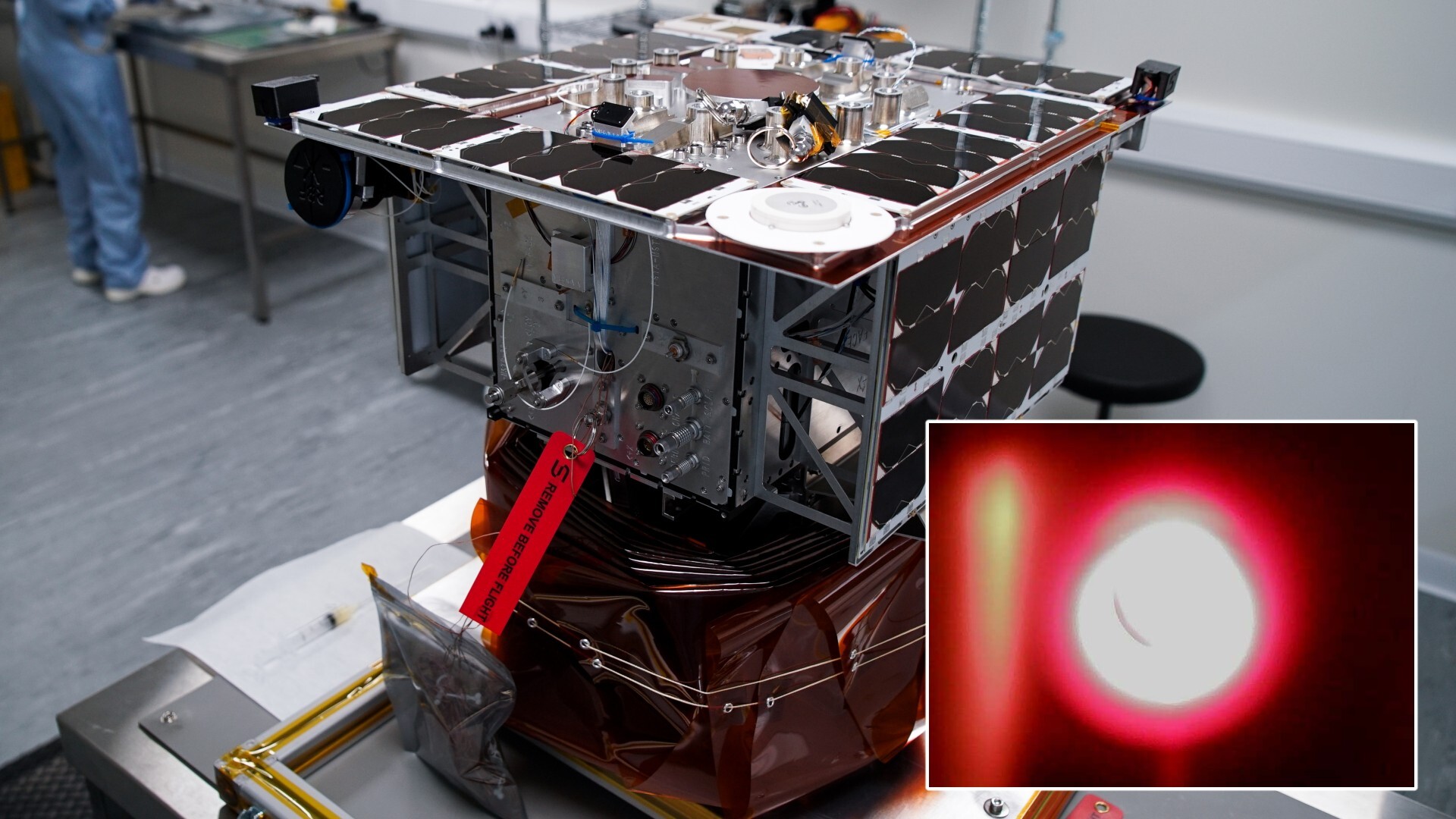
In a significant stride for space-based manufacturing, start-up Space Forge has successfully generated its first plasma in orbit aboard the ForgeStar-1 satellite. This unprecedented achievement marks a world first and is hailed as a pivotal step towards the company’s ambitious objective: developing novel semiconductors in the unique microgravity environment of space. Should this vision be realized, it holds the potential to profoundly transform future electronic technologies.
**London, UK** – British space startup Space Forge has marked a major step forward in its mission to revolutionize in-space manufacturing.
Since its launch in June 2025, the company’s pioneering ForgeStar-1 craft, a microwave oven-sized satellite, has been brought online and undergone rigorous activation. In a significant milestone achieved in December 2025, the satellite successfully ignited its miniature on-board furnace for the first time, generating a superheated plasma.
This fiery stream of gas reached extreme temperatures of 1,000 degrees Celsius (1,832 degrees Fahrenheit). This critical early success demonstrates the feasibility of Space Forge’s ambitious long-term goal: to harness the unique microgravity environment of space. In future missions, such plasma will be key to forging revolutionary, super-efficient materials in weightlessness, promising advanced capabilities far beyond those achievable through terrestrial manufacturing.
The ability to generate plasma in orbit represents a fundamental shift for space-based manufacturing, confirming that the crucial environment for advanced crystal growth can now be reliably achieved aboard dedicated commercial satellites. This breakthrough, according to Joshua Western, CEO and co-founder of Space Forge, “opens the door to a completely new manufacturing frontier,” heralding an unprecedented era of industrial production beyond Earth.
Established in 2018, SpaceForge is charting a course to revolutionize materials manufacturing by deploying a specialized furnace aboard an upcoming satellite. The ambitious goal is to fabricate a batch of novel semiconductors directly within the unique microgravity environment of space. This initiative marks a significant advancement, as prior experiments of this nature have historically been confined solely to the International Space Station.
In a significant announcement, the company has confirmed that a recent plasma demonstration successfully validated the capability to generate and precisely control the rigorous conditions essential for gas-phase crystal growth – a critical process fundamental to semiconductor manufacturing – on an autonomous platform in low Earth orbit (LEO).
According to the firm, this breakthrough firmly establishes ForgeStar-1 as the pioneering free-flying commercial facility for semiconductor production to operate independently in space.
Semiconductors manufactured in the microgravity environment of space are exhibiting remarkably precise atomic alignment, leading to enhanced performance capabilities. This advanced material, developed by Space Forge, holds the potential to significantly boost the energy efficiency of electronic devices, with estimates suggesting a reduction in energy consumption of up to 60 percent.
**Next-generation electronics, poised to revolutionize telecommunications and computing, may soon be powered by advanced semiconductors crafted from exotic materials like gallium nitride, silicon carbide, and diamond.**
This innovative technology leverages the unique properties of these rare elements to create chips capable of handling the demands of future communication networks, sophisticated electronic devices, and the powerful computing systems of tomorrow.
Here are a few paraphrased options, each with a slightly different emphasis, maintaining a journalistic tone:
**Option 1 (Focus on purpose and limitations):**
> The upcoming ForgeStar-1 mission is designed exclusively to validate the functionality of its orbital factory equipment. Upon completion of its objectives later this year, the satellite is slated for a controlled deorbit and atmospheric burn-up. Before its mission concludes, the craft will conduct further experiments, specifically analyzing the behavior of generated plasma in a microgravity environment. The data gathered will be crucial for the company’s engineers in refining future missions.
**Option 2 (More active and forward-looking):**
> Set to test its orbital factory hardware, the ForgeStar-1 will soon embark on its mission. This satellite’s journey will conclude later this year with a deorbit and atmospheric re-entry. Prior to its end-of-life, however, ForgeStar-1 will gather vital scientific intelligence. It will conduct additional experiments to meticulously observe how generated plasma reacts in the absence of significant gravity, providing essential data for engineers to optimize subsequent missions.
**Option 3 (Concise and direct):**
> ForgeStar-1’s primary objective is to rigorously test its orbital factory systems. The satellite will eventually deorbit and disintegrate in the Earth’s atmosphere before the year is out. However, its mission will not end without further scientific inquiry. The craft will execute additional experiments to study plasma behavior in microgravity, yielding critical data for engineers to enhance future operations.
**Key changes and why:**
* **”The current ForgeStar-1 will only test…”** changed to variations like “The upcoming ForgeStar-1 mission is designed exclusively to validate…”, “Set to test…”, and “ForgeStar-1’s primary objective is to rigorously test…”. This uses stronger verbs and more sophisticated vocabulary.
* **”orbital factory equipment”** paraphrased as “orbital factory equipment,” “orbital factory hardware,” or “orbital factory systems” for variety.
* **”The satellite will deorbit and burn up in the atmosphere later this year.”** rephrased to “is slated for a controlled deorbit and atmospheric burn-up,” “will conclude later this year with a deorbit and atmospheric re-entry,” or “will eventually deorbit and disintegrate in the Earth’s atmosphere before the year is out.” These options offer more descriptive language and vary the sentence structure.
* **”Before its mission ends, the craft will run more experiments…”** transformed into “Before its mission concludes, the craft will conduct further experiments…”, “Prior to its end-of-life, however, ForgeStar-1 will gather vital scientific intelligence. It will conduct additional experiments…”, or “However, its mission will not end without further scientific inquiry. The craft will execute additional experiments…”. These phrases aim for a more engaging and less repetitive flow.
* **”analyze how the generated plasma behaves in microgravity”** rephrased as “analyzing the behavior of generated plasma in a microgravity environment,” “meticulously observe how generated plasma reacts in the absence of significant gravity,” or “study plasma behavior in microgravity.” This adds descriptive elements and varies the verbs.
* **”collect data to help the company’s engineers fine-tune the future missions”** rephrased to “The data gathered will be crucial for the company’s engineers in refining future missions,” “providing essential data for engineers to optimize subsequent missions,” or “yielding critical data for engineers to enhance future operations.” These variations use stronger synonyms and a more formal construction.
These options aim to be more engaging and convey the information with greater impact, suitable for a professional content piece.
Here are a few options for paraphrasing the provided text, each with a slightly different journalistic emphasis:
**Option 1 (Focus on the Funding and Future):**
> Last year, Space Forge successfully secured a substantial Series A funding round, bringing in £22.6 million (approximately $30.5 million). This significant investment is earmarked for the development of ForgeStar-2, the company’s next-generation satellite. ForgeStar-2 is poised to become the first spacecraft to manufacture and return semiconductors from orbit, marking a new era for in-space production. A key feature of the satellite will be its innovative heat shield, engineered to withstand the intense conditions of atmospheric re-entry and ensure the safe delivery of its high-value payload to Earth.
**Option 2 (Highlighting the Technological Innovation):**
> With a substantial £22.6 million ($30.5 million) Series A funding infusion secured last year, Space Forge is set to revolutionize in-space manufacturing. The capital will fuel the creation of ForgeStar-2, a pioneering satellite designed to produce the company’s inaugural batch of space-made semiconductors. Crucially, ForgeStar-2 will incorporate a novel heat shield, a critical piece of technology designed to protect the spacecraft and its valuable cargo during its fiery return through Earth’s atmosphere.
**Option 3 (More Concise and Direct):**
> Space Forge is advancing its in-space manufacturing ambitions following a significant £22.6 million ($30.5 million) Series A funding round last year. The investment will facilitate the construction of ForgeStar-2, a satellite destined to produce the first semiconductors manufactured in space by the company. To ensure the safe retrieval of these components, ForgeStar-2 will be equipped with a cutting-edge heat shield capable of enduring atmospheric re-entry.
**Key changes made in these paraphrases:**
* **Varying Sentence Structure:** Sentences have been rearranged and combined to create a more dynamic flow.
* **Synonym Substitution:** Words like “generous,” “allow,” “build,” “make,” “fitted with,” “novel,” “survive,” and “deliver” have been replaced with more varied and precise vocabulary (e.g., “substantial,” “earmarked for,” “development,” “manufacture,” “incorporate,” “innovative,” “withstand,” “ensure safe delivery”).
* **Active vs. Passive Voice:** Some passive constructions have been shifted to active voice for greater impact.
* **Adding Context/Emphasis:** Phrases like “marking a new era” or “crucially” are added to enhance engagement.
* **Journalistic Tone:** The language is professional, informative, and avoids overly casual phrasing.
Choose the option that best suits the specific publication or context in which you intend to use the paraphrased text.