
Generative artificial intelligence has revolutionized digital content creation, making it challenging to imagine the internet without its influence. While these AI tools excel at producing creative digital assets like videos and photographs, their transformative power has yet to extend significantly into the physical realm.
The question arises: why haven’t we seen a surge of personalized, AI-generated physical objects, such as custom phone cases or plant pots, appearing in our homes, workplaces, and retail spaces? Researchers at MIT’s Computer Science and Artificial Intelligence Laboratory (CSAIL) point to a fundamental obstacle: the structural soundness of the 3D models that would underpin such creations.

## AI Learns to Design with Feel and Function
**Cambridge, MA** – Imagine 3D models generated by artificial intelligence that not only look good but also possess the physical resilience and tactile qualities you desire. This is the focus of groundbreaking work by Faraz Faruqi, a PhD student in MIT’s Department of Electrical Engineering and Computer Science and an engineer at the Computer Science and Artificial Intelligence Laboratory (CSAIL).
Current AI systems are adept at creating visually appealing, personalized 3D designs ready for fabrication. However, they often overlook crucial physical characteristics. Faruqi’s research tackles this limitation head-on by developing innovative AI-powered systems. One system is engineered to introduce aesthetic alterations to designs without compromising their functional integrity. Simultaneously, another system demonstrates the ability to modify structures, imbuing them with specific tactile properties that users can actively feel and experience. This research paves the way for 3D design that is not just visually compelling but also physically intelligent.
**AI Breakthrough Enables Creation of Personalized, Durable 3D-Printed Objects**
A groundbreaking collaboration between researchers at Google, Stability AI, and Northeastern University, alongside Faruqi, has unveiled an innovative AI system capable of transforming digital designs into tangible, long-lasting objects. Dubbed “MechStyle,” this powerful tool empowers users to personalize everyday items like vases and hooks with remarkable ease.
The process begins with users uploading a 3D model or choosing from a library of pre-existing assets. They then provide image or text prompts to guide the AI in customizing the object’s appearance and texture. A sophisticated generative AI model meticulously refines the 3D geometry, while MechStyle simultaneously simulates the impact of these modifications on the object’s structural integrity. This ensures that even the most delicate areas are reinforced, guaranteeing durability.
Once satisfied with the AI-generated blueprint, users can seamlessly 3D print their unique creations, ready for practical use in the real world. This advancement marks a significant leap forward in personalized manufacturing, bridging the gap between digital imagination and physical reality.
Here are a few options for paraphrasing the provided text, each with a slightly different emphasis, while maintaining a journalistic tone:
**Option 1 (Focus on Functionality):**
Imagine designing a custom wall hook, perhaps for your favorite jacket or a heavy backpack. A new system allows users to select a basic hook design and a printable material, such as polylactic acid plastic. Then, with a simple text prompt – for instance, “create a cactus-like hook” – the technology crafts a personalized object. This AI-driven process not only generates a visually distinct, cactus-inspired form but also ensures it retains the essential structural integrity of a functional hook. The result is a unique, perhaps green and ridged, accessory ready to hold your belongings. This innovative capability stems from a “stylization” process, where the AI interprets textual descriptions to alter the 3D model’s shape, guided by feedback from a simulation module that verifies its load-bearing capacity.
**Option 2 (Focus on AI Innovation):**
A breakthrough in 3D design is empowering users to move beyond pre-set models and create personalized objects with intelligent assistance. By choosing a foundational item, like a wall hook, and specifying a printable material such as polylactic acid, individuals can then guide an AI through descriptive commands. A prompt like “generate a cactus-like hook” triggers a sophisticated process. The AI, in collaboration with a simulation module, doesn’t just create a visual representation of a cactus; it engineers a 3D model that embodies both the aesthetic of a cactus and the robust functionality of a hook. This ability to translate textual whims into tangible, structurally sound objects is achieved through a “stylization” technique, where the AI modifies the model’s geometry based on its interpretation of the prompt and crucial feedback from the simulation’s structural analysis.
**Option 3 (More Concise and Direct):**
The creation of personalized 3D-printed items is becoming more accessible, allowing users to tailor designs with simple text instructions. For example, one could select a standard wall hook model and a material like polylactic acid, then ask the system to “generate a cactus-like hook.” An integrated AI and simulation system then produces a 3D model that not only resembles a cactus but also functions effectively as a hook, capable of holding items like coats or mugs. This fusion of form and function is facilitated by a “stylization” process, where the AI reshapes the model’s geometry according to the text prompt, validated by the simulation module’s assessment of its structural integrity.
A recent study by researchers at CSAIL has shed light on a significant limitation in existing 3D stylization technology. Their findings indicate that a substantial majority of 3D models lose their structural integrity when subjected to AI-driven stylization, with only about 26% remaining intact. This suggests a fundamental disconnect, as the AI systems currently lack an understanding of the underlying physics governing these digital models.
Here are a few paraphrased options, each with a slightly different emphasis, while maintaining a journalistic tone:
**Option 1 (Focus on Practicality and Personalization):**
> “Our aim is to leverage AI to develop models that are not just theoretical but can be tangibly manufactured and integrated into everyday life,” explained Faruqi, a lead author on the project’s published paper. “MechStyle offers a novel approach by simulating how generative AI-driven modifications affect a structure’s integrity. This system empowers users to customize the tactile feel of their possessions, infusing them with personal style while guaranteeing their durability for daily use.”
**Option 2 (Emphasis on Innovation and User Control):**
> A groundbreaking project, detailed in a new paper co-authored by Faruqi, seeks to bridge the gap between AI-generated designs and real-world application. “We’re focused on creating AI models that can be fabricated and used practically,” Faruqi stated. “MechStyle uniquely simulates the impact of AI-generated alterations on a structure’s physical properties, enabling users to personalize the sensory experience of an object and reflect their individual style, all while ensuring it can withstand the rigors of everyday life.”
**Option 3 (Concise and Direct):**
> “The goal is to develop AI-generated models that are truly manufacturable and usable in the real world,” said Faruqi, a lead author on the project’s accompanying paper. MechStyle, he explained, simulates how AI-driven modifications impact a structure’s physical characteristics. This allows for personalized tactile experiences and the integration of individual style, without compromising the object’s ability to endure regular use.
**Key changes and why they were made:**
* **”use AI to create models”**: Rephrased to “leverage AI to develop models,” “create AI models,” or “AI-generated designs” for variety and a more active voice.
* **”actually fabricate and use in the real world”**: Expanded to “tangibly manufactured and integrated into everyday life,” “truly manufacturable and usable in the real world,” or “real-world application” to sound more professional and impactful.
* **”lead author on a paper presenting the project”**: Simplified to “lead author on the project’s published paper,” “co-authored by Faruqi,” or “lead author on the project’s accompanying paper.”
* **”So MechStyle actually simulates how GenAI-based changes will impact a structure.”**: Changed to “MechStyle offers a novel approach by simulating how generative AI-driven modifications affect a structure’s integrity,” “MechStyle uniquely simulates the impact of AI-generated alterations on a structure’s physical properties,” or “MechStyle, he explained, simulates how AI-driven modifications impact a structure’s physical characteristics.” This adds descriptive language and clarifies the “how.”
* **”Our system allows you to personalize the tactile experience for your item, incorporating your personal style into it while ensuring the object can sustain everyday use.”**: Broken down and rephrased for better flow and impact.
* “allows you to personalize the tactile experience” became “empowers users to customize the tactile feel,” “enabling users to personalize the sensory experience,” or “allows for personalized tactile experiences.”
* “incorporating your personal style into it” became “infusing them with personal style,” “reflect their individual style,” or “integration of individual style.”
* “ensuring the object can sustain everyday use” became “guaranteeing their durability for daily use,” “withstand the rigors of everyday life,” or “without compromising the object’s ability to endure regular use.”
These options aim to be engaging by using stronger verbs and more descriptive language, while maintaining a clear and authoritative journalistic voice.
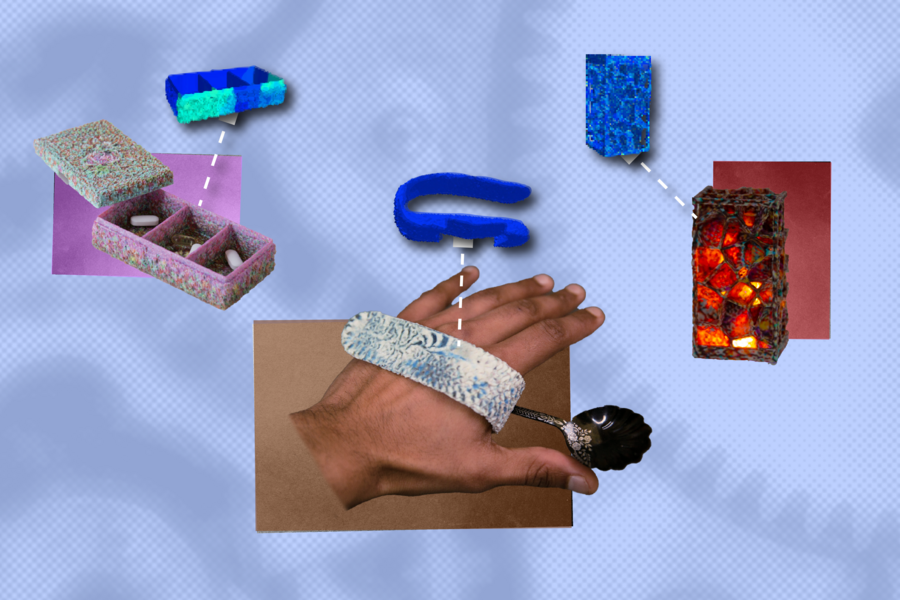
This advanced computational approach opens doors to highly personalized creations, allowing users to design one-of-a-kind items. Imagine crafting a pair of glasses with a unique speckled pattern of blue and beige dots, reminiscent of fish scales, or a pillbox featuring a rugged texture adorned with charming pink and aqua checks. The system’s capabilities also extend to producing distinctive home and office decor, such as a lampshade that mimics the fiery glow of red magma. Furthermore, it holds the potential to generate bespoke assistive devices, like custom-fitted finger splints designed to support recovery from dexterity injuries, or specialized utensil grips engineered to assist individuals with motor impairments.
**Future applications for MechStyle extend beyond the toy aisle and into a diverse retail landscape, including hardware stores and craft boutiques. Researchers at CSAIL envision the technology as a powerful tool for rapidly prototyping accessories and other handheld consumer products.**
The ultimate aim, according to CSAIL, is to empower both seasoned professionals and aspiring creators. By streamlining the assembly and customization process, MechStyle promises to free up valuable design time, allowing individuals to focus more on the crucial stages of brainstorming and iterating on innovative 3D concepts.
## Resilience: The Power Within
Life’s inevitable challenges often test our resolve, pushing us to our limits. Yet, within each of us lies an extraordinary capacity to endure, adapt, and emerge from adversity not just intact, but stronger than before. This inherent strength, often referred to as resilience, is the bedrock upon which we build our ability to navigate life’s storms and emerge with renewed purpose. It’s a testament to the human spirit’s remarkable ability to persevere, learn, and grow, even in the face of profound difficulty.
Here’s a paraphrased version of the text, aiming for a unique, engaging, and original journalistic tone:
MechStyle, a groundbreaking initiative by researchers, has incorporated advanced physics simulation – specifically, finite element analysis (FEA) – into its generative AI technology to guarantee the durability of its creations under everyday wear. Imagine a 3D blueprint of an item, like a pair of spectacles, overlaid with a visual guide that pinpoints areas strong enough to endure realistic pressure and those prone to weakness. As the AI refines the design, these physics simulations act as a crucial safeguard, flagging structurally compromised sections and halting any modifications that could lead to failure.
Dr. Faruqi, a key figure in the project, explains that the computational demands of running these simulations with every design iteration significantly impede the AI’s speed. To circumvent this, MechStyle employs a sophisticated adaptive scheduling strategy. This system meticulously monitors changes occurring at specific points within the 3D model. When the generative AI introduces modifications that jeopardize the integrity of particular areas, MechStyle’s intelligent system triggers a renewed physics simulation. This ensures that any subsequent design adjustments are precisely calibrated to prevent the fabricated product from breaking.
MechStyle has achieved a significant breakthrough in generative design, producing objects with up to 100 percent structural viability by seamlessly merging Finite Element Analysis (FEA) with an innovative adaptive scheduling system.
In extensive testing, the team evaluated 30 distinct 3D models, which featured diverse aesthetic styles resembling bricks, stones, and cacti. Their research revealed that the most efficient method for ensuring structural integrity involved dynamically pinpointing weak regions and subsequently making precise, real-time adjustments to the generative AI process to mitigate potential failures.
This adaptive strategy presented two primary methods for addressing vulnerabilities: either completely halting the stylization process when a specific stress threshold was detected, or implementing a series of gradual, smaller refinements designed to preemptively reinforce at-risk areas before they neared critical stress levels.
This advanced system is equipped with dual operational modes, designed to streamline both creative exploration and structural integrity analysis for 3D models. The ‘Freestyle’ feature empowers designers to rapidly visualize a wide array of aesthetic styles, leveraging AI to instantly apply diverse looks to their creations.
Complementing this artistic freedom is the ‘MechStyle’ mode, a precision tool that meticulously analyzes the engineering impacts of design adjustments. This innovative combination allows users to first unleash their creativity with various artistic flourishes, then seamlessly transition to ‘MechStyle’ to precisely determine how those design choices influence the durability and structural resilience of specific regions within the model.
While the CSAIL team’s innovative model excels at pre-validating the structural integrity of 3D designs before printing, researchers have highlighted a current limitation: it cannot inherently improve models that are fundamentally unviable from the outset. Users attempting to upload such a flawed file to MechStyle will, for now, receive an error message.
However, this is a temporary hurdle. Lead researcher Faruqi and his colleagues are already setting their sights on future enhancements, aiming to equip the platform with the capability to mend and bolster the durability of even initially problematic models.
The research team is also pursuing a more ambitious goal: leveraging generative AI to craft entirely new 3D models from scratch for users, moving beyond merely stylizing existing designs or user uploads. This advancement aims to significantly enhance user accessibility, allowing individuals—even those unfamiliar with 3D modeling or struggling to locate specific designs online—to effortlessly generate custom objects. For instance, if a user envisions a unique bowl design not available in any existing repository, AI could produce that precise 3D model on demand.
The transition of style-transfer techniques from 2D images to 3D objects presents significant challenges, as noted by Google Research Scientist Fabian Manhardt, who was not involved in the study. “While style-transfer for 2D images works incredibly well, not many works have explored how this transfer to 3D,” Manhardt explained. He elaborated that 3D modeling is “a much more difficult task,” primarily due to the scarcity of relevant training data and the risk that geometric alterations could compromise an object’s structural integrity, rendering it impractical for real-world use. This is precisely where the “MechStyle” approach proves transformative. By utilizing simulation, MechStyle facilitates 3D stylization without sacrificing an object’s structural soundness, empowering users with unprecedented creative freedom to design and express themselves through truly personalized products.
The groundbreaking paper was authored by Farqui, with senior contributions from Stefanie Mueller, an MIT associate professor and principal investigator at CSAIL. They collaborated with fellow CSAIL researchers Leandra Tejedor (SM ’24) and postdoc Jiaji Li. The extensive list of co-authors includes Amira Abdel-Rahman (PhD ’25), now an assistant professor at Cornell University; Martin Nisser (SM ’19, PhD ’24); Google researcher Vrushank Phadnis; Stability AI Vice President of Research Varun Jampani; Neil Gershenfeld, an MIT Professor and Director of the Center for Bits and Atoms; and Megan Hofmann, an assistant professor at Northeastern University.
This research received support from the MIT-Google Program for Computing Innovation. The findings were formally unveiled at the Association for Computing Machinery’s Symposium on Computational Fabrication in November.