
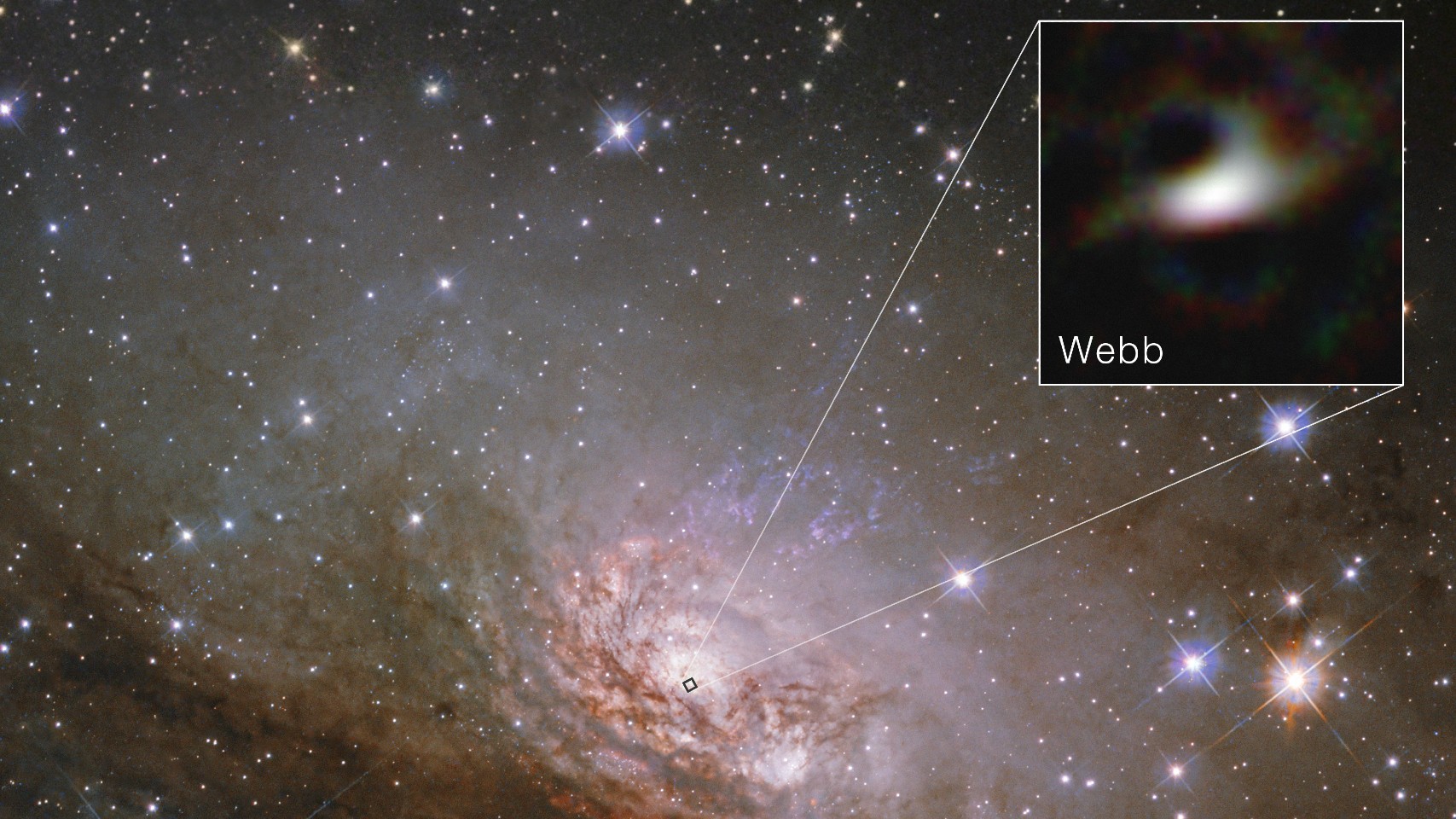
Astrophysicists have unveiled an image of unprecedented clarity, captured by the James Webb Space Telescope (JWST), showcasing the immediate vicinity of a black hole in astonishing detail. This breathtaking new view is more than just visually striking; it promises to unlock answers to a decades-long cosmic mystery and could potentially overturn a long-held scientific belief regarding the fundamental nature of these enigmatic celestial objects.
For decades, dating back to the 1990s, astronomers have observed a puzzling infrared glow surrounding the active supermassive black holes (SMBHs) at the centers of some galaxies. This curious luminosity was previously attributed to powerful outflows—superheated streams of matter violently ejected from the black holes themselves.
In a groundbreaking study published January 13th in the journal *Nature Communications*, an international team of researchers leveraged the advanced capabilities of the James Webb Space Telescope (JWST). Their target: the nearby Circinus galaxy, situated a mere 13 million light-years from Earth. By peering into its cosmic heart, the powerful observatory meticulously revealed the intricate environment directly surrounding the galaxy’s supermassive black hole (SMBH).
**Unraveling a Cosmic Mystery: Circinus Galaxy’s Infrared Glow Traced to Black Hole’s Feast**
A powerful synergy of data from the James Webb Space Telescope (JWST) and a wealth of ground-based observations has definitively pinpointed the source of the intense infrared emission emanating from the heart of the Circinus galaxy.
Contrary to earlier hypotheses, new analysis reveals that this prominent infrared “excess” is not generated by material being expelled from the galaxy’s central supermassive black hole. Instead, the combined astronomical insights confirm the glow originates from a turbulent disk of dusty material actively spiraling and feeding into the colossal black hole itself.
This unprecedented galactic discovery is set to provide astronomers with crucial insights into the enigmatic processes governing the growth and evolution of supermassive black holes. Crucially, it will also illuminate the profound influence these colossal cosmic titans wield over their host galaxies, shaping their very development.
Active black holes, like the colossal gravitational behemoths at the heart of galaxies, are perpetually fueled by a vast, doughnut-shaped cosmic reservoir of infalling gas and dust, aptly named a torus. As these hungry black holes siphon material from the torus’s inner rim, this matter undergoes a transformation, flattening and accelerating to form a distinct, rapidly swirling accretion disk. This disk then spirals inward with increasing velocity, inexorably drawn towards the black hole’s event horizon, much like water circling down a drain.
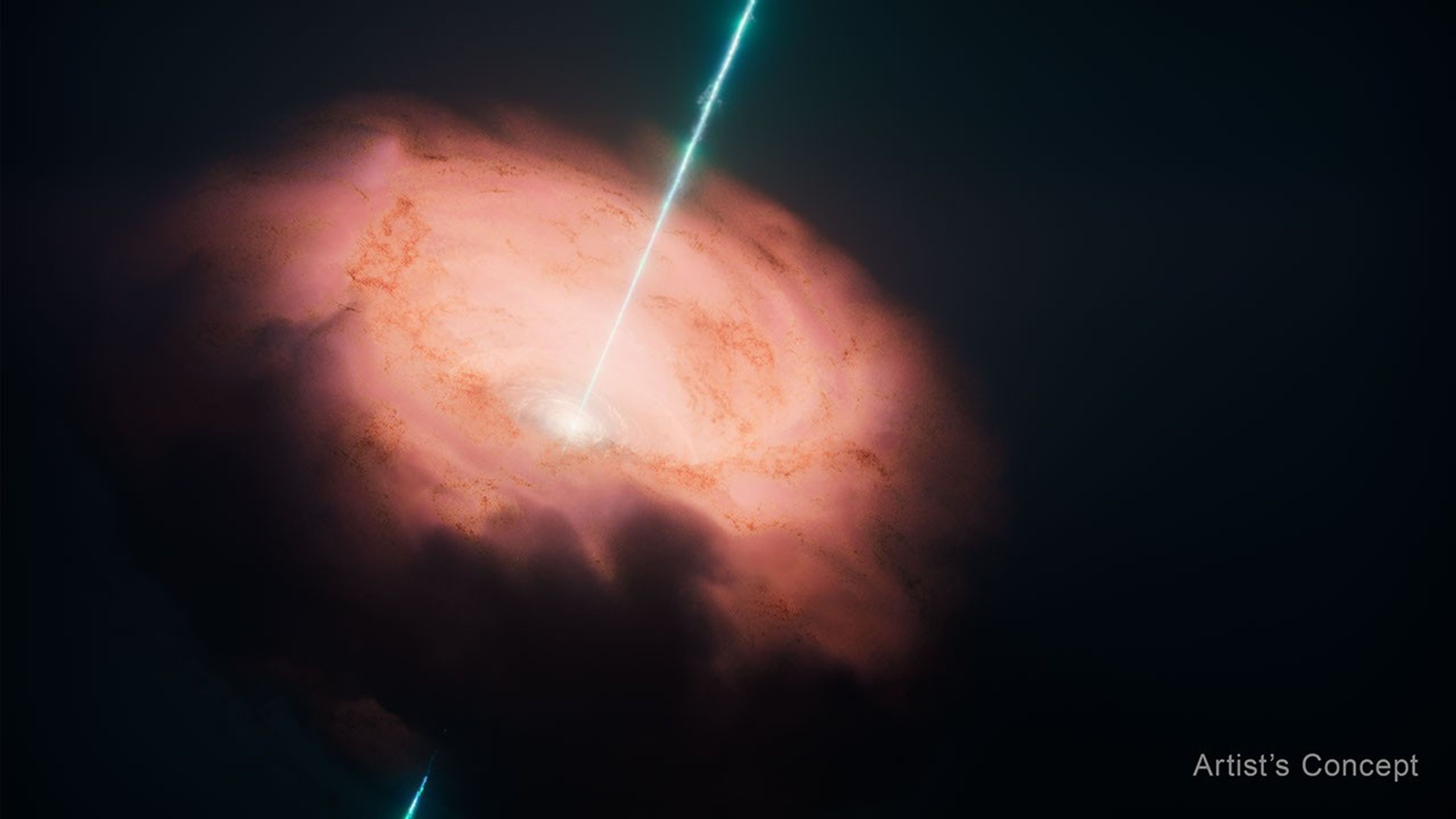
Driven by the black hole’s immense tidal forces, infalling matter is catapulted to astonishing velocities. This rapid, swirling motion within the accretion disk generates tremendous friction, igniting the material into a radiant glow. The resulting luminosity is so exceptionally bright that it paradoxically creates a blinding veil, effectively obscuring astronomers’ crucial view of the mysterious inner region immediately encircling the black hole.
Contrary to their popular image as insatiable cosmic vacuum cleaners, black holes operate with a discernible feeding limit. When overwhelmed by infalling material, they don’t consume it all; instead, they propel a significant portion back into space in the form of high-energy jets or powerful “winds.”
Therefore, a comprehensive understanding of the black hole’s immediate environment—its dense torus, its swirling accretion disk, and these energetic outflows—is crucial. This knowledge is key to deciphering precisely how black holes of varying sizes acquire and redistribute matter, a fundamental process that can profoundly influence the development of their host galaxies. By either suppressing or stimulating star formation across vast galactic scales, black holes play a pivotal role in shaping cosmic structures.
For an extended period, the intense stellar radiation and thick cosmic dust within the Circinus galaxy created an impenetrable veil, largely obscuring astronomers’ detailed view of its central region and the supermassive black hole residing at its core.
To unravel the mysteries of the supermassive black hole, scientists employed an indirect yet effective methodology, explained Enrique Lopez-Rodriguez, lead study author and a galaxy evolution researcher at the University of South Carolina, in a statement released by NASA.
“Despite the inability to directly resolve the black hole, the team’s approach involved meticulously gathering the total intensity from the galaxy’s innermost region across an extensive wavelength spectrum,” Lopez-Rodriguez detailed. “This crucial data was then fed into advanced computational models, enabling researchers to study the unobservable phenomenon.”
Here are a few paraphrased options, maintaining a clear, journalistic tone:
**Option 1 (Focus on the limitation):**
> Previous astronomical models struggled to fully explain the infrared light emissions observed around supermassive black holes. While these models could analyze individual components like the torus, accretion disk, and outflows, they lacked the resolution to examine the entire region comprehensively. This fragmentation prevented scientists from pinpointing the specific source of the excess infrared radiation.
**Option 2 (Focus on the unanswered question):**
> Astronomers previously faced a puzzle regarding the source of excess infrared light emanating from the vicinity of supermassive black holes. Despite separate analyses of key structures such as the torus, accretion disk, and outflows, existing models could not integrate these observations into a complete picture, leaving the origin of the infrared excess unexplained.
**Option 3 (More concise):**
> Earlier research attempted to model the infrared emissions from supermassive black hole environments by analyzing distinct components—the torus, accretion disk, and outflows. However, these models failed to provide a holistic view, leaving astronomers unable to definitively identify which part of the black hole’s surroundings was responsible for the elevated infrared light.
**Option 4 (Emphasizing the “why”):**
> The inability of earlier models to resolve the entire region surrounding supermassive black holes hindered astronomers’ understanding of their infrared emissions. By fitting observed spectra of the torus, accretion disk, and outflows in isolation, these models could not unify their findings, leaving the specific contributor to the excess infrared light a mystery.
**Astronomers leveraged the James Webb Space Telescope’s cutting-edge technology to achieve an unprecedented, high-resolution view of the environment surrounding the supermassive black hole (SMBH) in Circinus. By employing an advanced imaging method called interferometry, they were able to pierce through the obscuring dust and starlight that typically hinders such observations.**
Here are a few paraphrased options, each with a slightly different emphasis, while maintaining a journalistic tone:
**Option 1 (Focus on the “how”):**
> Astronomers employ ground-based interferometry, a sophisticated technique that harnesses the collective power of multiple telescopes or mirrors. By synchronizing these instruments to capture light from distant celestial bodies across a broad area, interferometry generates intricate interference patterns. Analyzing these patterns allows scientists to precisely determine crucial details about cosmic objects, including their dimensions and forms.
**Option 2 (Focus on the “why” and outcome):**
> To peer deeper into the cosmos, ground-based interferometry utilizes an interconnected network of telescopes or mirrors. This array functions as a larger light-gathering surface, combining electromagnetic waves from celestial sources. The resulting interference patterns are a treasure trove of information, enabling astronomers to accurately measure the size, shape, and other fundamental properties of the observed objects.
**Option 3 (More concise and active):**
> Ground-based interferometry achieves remarkable clarity by linking an array of telescopes or mirrors to act as a single, vast light collector. This collaborative approach merges light waves from celestial targets, producing interference patterns that reveal an object’s size, shape, and other defining characteristics to astronomers.
**Option 4 (Emphasizing the “pattern” aspect):**
> The power of ground-based interferometry lies in its ability to orchestrate an array of telescopes or mirrors to act in concert. This system gathers and integrates light from astronomical subjects over an expansive area. The subsequent interference patterns, formed by the combined electromagnetic waves, provide astronomers with the analytical tools to decipher the dimensions, configurations, and other vital attributes of these distant entities.
Here are a few paraphrased options, each with a slightly different emphasis, maintaining a journalistic tone:
**Option 1 (Focus on unique capability):**
> In a departure from Earth-bound observatories, the James Webb Space Telescope (JWST) possesses a unique capability: it can function as its own interferometer array. This advanced functionality is enabled by its aperture masking interferometer (AMI), a sophisticated component integrated within the telescope’s Near-Infrared Imager and Slitless Spectrograph (NIRISS) instrument. The AMI operates similarly to a camera aperture, utilizing an opaque physical mask. This mask features seven small, hexagonal apertures that precisely regulate both the quantity and trajectory of light reaching JWST’s sensitive detectors.
**Option 2 (More concise and direct):**
> The James Webb Space Telescope (JWST) distinguishes itself from terrestrial observatories by its capacity to operate as an interferometer array. This capability stems from its aperture masking interferometer (AMI), a key element of the NIRISS instrument. The AMI employs an opaque mask with seven hexagonal openings, akin to a camera aperture, to meticulously control the light that enters JWST’s detectors in both amount and direction.
**Option 3 (Highlighting the AMI’s mechanism):**
> Unlike ground-based facilities, the James Webb Space Telescope (JWST) can achieve interferometer array operations autonomously. This feat is accomplished through its aperture masking interferometer (AMI), a specialized part of the NIRISS instrument. The AMI functions as a physical mask, similar to a camera aperture, but with seven precisely placed hexagonal holes. These openings act as gateways, dictating the volume and path of light that ultimately strikes JWST’s detectors.
**Key changes and why they work:**
* **”Unlike these terrestrial facilities, however”**: Replaced with more active and varied phrasing like “In a departure from Earth-bound observatories,” “distinguishes itself from terrestrial observatories,” and “Unlike ground-based facilities.”
* **”space-based JWST”**: Shortened to “James Webb Space Telescope (JWST)” or “JWST” for conciseness and clarity.
* **”operate as its own interferometer array via its aperture masking interferometer (AMI)”**: Restructured to emphasize the JWST’s capability first, then explain how it’s achieved. Phrases like “possesses a unique capability: it can function as its own interferometer array,” “its capacity to operate as an interferometer array,” and “can achieve interferometer array operations autonomously” are used.
* **”a component of the telescope’s Near-Infrared Imager and Slitless Spectrograph (NIRISS) instrument”**: Integrated more smoothly into the sentences, often using phrases like “a sophisticated component integrated within,” “a key element of,” or “a specialized part of.”
* **”Like a camera aperture, AMI is an opaque physical mask with seven small, hexagonal holes that control the amount and direction of light entering JWST’s detectors.”**: This sentence was broken down or rephrased for better flow. The analogy to a camera aperture is maintained but described in different ways (“utilizing an opaque physical mask,” “employs an opaque mask,” “functions as a physical mask”). The function of the holes is also rephrased (“precisely regulate both the quantity and trajectory,” “meticulously control the light,” “dictating the volume and path”).
These options offer distinct yet accurate ways to convey the original information in a fresh and engaging manner.
The newly developed instrument, AMI, significantly enhances the James Webb Space Telescope’s imaging capabilities, effectively doubling its resolution. According to astrophysicist Joel Sanchez-Bermudez of the National University of Mexico and a co-author of the study, this advancement translates to “images twice as sharp.” He further explained that AMI’s contribution is akin to augmenting Webb’s existing 6.5-meter (21-foot) mirror to a hypothetical 13-meter diameter, thereby providing a substantially clearer view of celestial objects.
**James Webb Space Telescope Delivers Unprecedented Clarity to Galactic Core**
The James Webb Space Telescope (JWST) has achieved its most detailed observation to date of a 33-light-year-wide region at the heart of the Circinus galaxy, thanks to a doubling of its resolution. This groundbreaking image has enabled scientists to pinpoint the source of infrared emissions within the galactic center.
Analysis of the data reveals that approximately 87% of the excess infrared emissions originate from the dusty disk actively fueling the supermassive black hole at the galaxy’s core. Lead researcher, Dr. Lopez-Rodriguez, described this region as “the inner surface of the hole of the doughnut.”
This finding challenges prior theories that attributed these emissions to hot, dusty winds or the lingering starlight of the galaxy. The JWST’s sharp imagery has demonstrated that less than 1% of these excess infrared signals are generated by the powerful outflows emanating from the supermassive black hole.
While the intense accretion in Circinus’s core appears to be stifling new star birth, definitive confirmation will necessitate a different observational approach utilizing the James Webb Space Telescope, according to Lopez-Rodriguez.
This groundbreaking research not only sheds light on previously obscured mechanisms within supermassive black holes (SMBHs) but also underscores the powerful capabilities of James Webb Space Telescope (JWST)-based interferometry. This advanced technique offers exciting new avenues for investigating a range of cosmic phenomena, particularly other active SMBHs residing in the centers of neighboring galaxies. Scientists aim to expand their observations to a larger population of these galactic engines, seeking to resolve a key question: are the infrared signals emanating from these SMBHs originating from their surrounding dusty accretion disks or from their superheated outflows?
To secure valuable observation time on the James Webb Space Telescope (JWST), astronomers must focus on celestial targets that are beyond the reach of ground-based observatories or lie within wavelengths obscured by Earth’s atmosphere. This strategic approach ensures that the powerful capabilities of JWST are utilized for research that truly cannot be accomplished from our planet. Julien Girard, a senior research scientist at the Space Telescope Science Institute and co-author of the study, explained this necessity in an email to Live Science.
Here are a few paraphrased options, maintaining a journalistic tone and unique phrasing:
**Option 1 (Focus on recent achievement and future potential):**
> Advanced Meteroid Imager (AMI) observations are proving invaluable for understanding our cosmic neighborhood, recently providing unprecedented detail of the volcanic activity on Jupiter’s intensely hot moon, Io. This capability allows AMI to scrutinize a wide array of celestial bodies, from molten moons to dust-shrouded black holes, regardless of their dimensions. Looking ahead, Girard noted that AMI could be instrumental in discovering moons orbiting significant asteroids and in precisely mapping the orbits and masses of complex multi-star systems.
**Option 2 (More direct and concise):**
> As highlighted by Girard, observations from AMI are shedding new light on our solar system, with recent insights into the volcanic landscapes of Jupiter’s infernal moon, Io. The instrument’s versatility enables it to capture diverse cosmic phenomena, from lava-spewing moons to elusive, dust-obscured black holes. Future applications, Girard added, include identifying moons around key asteroids and characterizing the orbital dynamics and masses within multi-star systems.
**Option 3 (Emphasizing the breadth of AMI’s capabilities):**
> Girard explained that AMI-based observations are enhancing our understanding of our own solar system, most recently delivering a detailed view of the volcanic processes on Jupiter’s extreme moon, Io. The instrument’s power lies in its ability to observe a broad spectrum of cosmic objects, spanning from actively erupting moons to the enigmatic interiors of black holes. Furthermore, Girard anticipates AMI’s future role in helping astronomers pinpoint moons around prominent asteroids and in determining the orbital paths and masses of complex stellar arrangements.





