Stunning new photographs have captured an enigmatic volcanic comet as it morphed into a colossal, “fossil-like” spiral of light, following one of its most powerful eruptions in years. This breathtaking celestial spectacle not only highlights the comet’s unpredictable nature but also deepens the mystery surrounding this unusual planetary remnant.
An extraordinary celestial object known as 29P/Schwassmann-Wachmann (29P) is a colossal ice ball, measuring an impressive 37 miles (60 kilometers) across—a size roughly three times the length of Manhattan. This enigmatic comet belongs to a select group of approximately 500 “centaurs,” celestial wanderers that spend their entire lifecycles confined to the inner solar system. However, 29P’s distinctiveness doesn’t end there; it’s also a member of an even more exclusive club: cryovolcanic comets. These frosty giants are celebrated for their occasional, dramatic eruptions, during which they violently eject gas and ice across the surrounding cosmic expanse.
Cryovolcanic comets periodically erupt in spectacular fashion, a phenomenon triggered when their icy nucleus absorbs an abundance of solar radiation. This intense energy rapidly superheats the comet’s internal reservoir of frozen gases and dust—its cryomagma—propelling it into a gaseous state through sublimation. The resulting immense pressure builds within the comet’s core, eventually forcing a fracture in its icy crust and expelling a geyser of material into the vacuum of space. As this ejected ice and dust expands, the comet’s ethereal coma—the diffuse cloud surrounding it—swells dramatically, reflecting significantly more sunlight and causing the celestial body to shine with exceptional brilliance in the night sky.
On February 10, Comet 29P underwent a dramatic and sudden surge in brightness, with its luminosity increasing by approximately 100 times. This powerful flare-up, as reported by Spaceweather.com, signaled a major eruptive event for the comet.
This current flare-up marks one of the comet’s five most significant eruptions in the past two and a half decades, according to experts quoted by Spaceweather.com. It stands as the most potent event since October 2024, when a quadruple eruption caused Comet 29P to blaze an astonishing 300 times brighter than its usual luminosity.
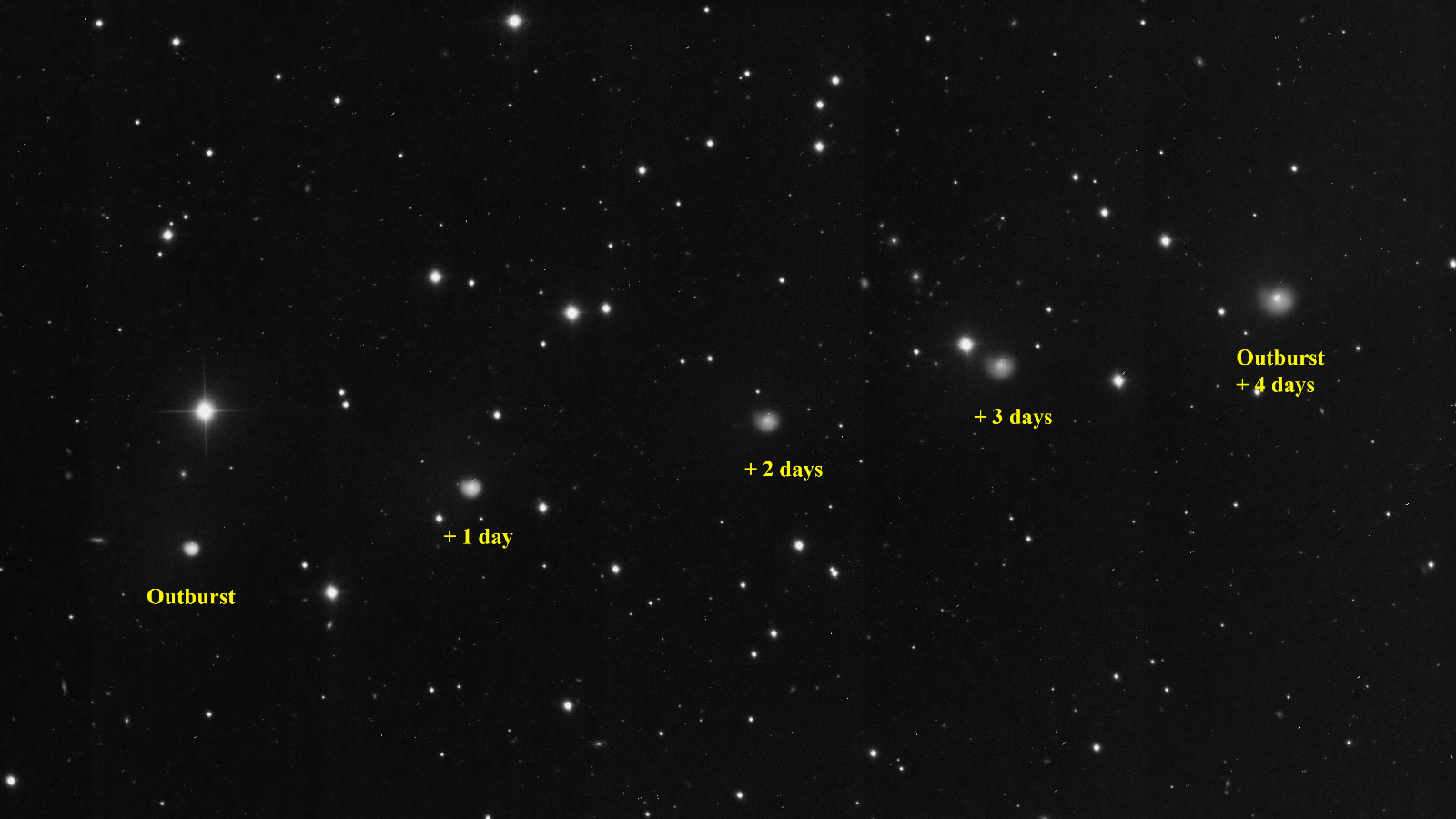
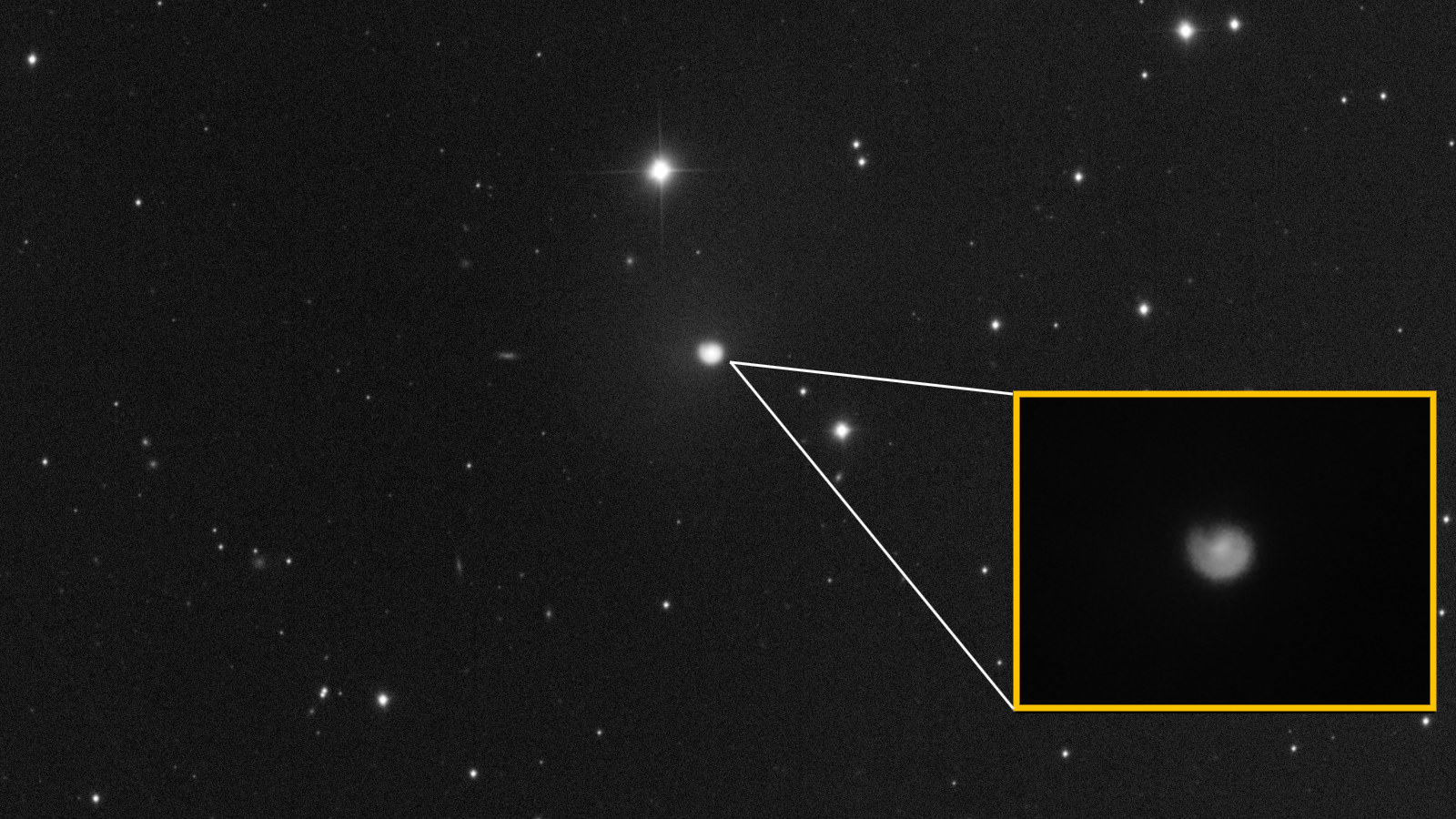
In the aftermath of the comet’s violent eruption, researchers observed an unprecedented phenomenon regarding 29P’s expanding coma. The reflective cloud, which typically dissipates symmetrically, instead displayed a highly unusual characteristic: it had elongated into a rare, distinct spiral formation, diverging sharply from expected cometary behavior.
Astrophotographer Eliot Herman, observing from Chile’s Rio Hurtado valley, captured a striking image of the comet’s distinctively asymmetrical coma. He noted its uncanny resemblance to a fossilized ammonoid, an ancient shelled cephalopod. Concurrently, fellow photographer Anthony Kroes, who also documented a remarkable view of the comet’s spiral from Wisconsin, independently commented on its characteristic “snail-shell appearance.”
According to Spaceweather.com, the comet’s bizarre geometry is likely forged by the uneven expulsion of cryomagma. This cryogenic material is believed to erupt from a nascent vent on its icy crust, a phenomenon spurred by the comet’s interior rotating independently from its nucleus.
This development echoes the dramatic spectacle of comet 12P/Pons-Brooks, famously dubbed the “devil comet.” In late 2023, during its initial eruptions as it approached the sun, that comet appeared to sprout “demonic horns.” Experts at the time theorized this distinctive shape was likely caused by a surface notch that partially obstructed the powerful outflow of cryomagma, or icy volatiles.
Here are a few options for paraphrasing the sentence, each with a slightly different emphasis:
**Option 1 (Focus on discovery and activity):**
> Last year, the interstellar comet 3I/ATLAS, a celestial visitor that captured global attention as it traversed our inner solar system, revealed compelling signs of cryovolcanism. Scientists believe this activity likely resulted in cryomagma erupting from multiple fissures.
**Option 2 (More concise and direct):**
> The interstellar comet 3I/ATLAS, a notable visitor to our inner solar system last year, exhibited evidence of cryovolcanism. Observations suggest that cryomagma was expelled through a series of jets.
**Option 3 (Emphasizing the “leaking” aspect):**
> Interstellar comet 3I/ATLAS, which garnered significant media attention as it passed through the inner solar system in the past year, provided evidence of cryovolcanic activity. It appears the comet likely leaked cryomagma from multiple vents.
**Option 4 (Highlighting the comet’s unique nature):**
> Beyond its status as an interstellar traveler, comet 3I/ATLAS, observed within our inner solar system last year, has shown itself to be volcanically active. The presence of cryovolcanism indicates that the comet likely spewed cryomagma through several distinct jets.
**Key changes made in these paraphrases:**
* **Vocabulary:** Replaced “made headlines” with “captured global attention,” “garnered significant media attention,” or “notable visitor.” Changed “zoomed through” to “traversed,” “passed through,” or “observed within.” Replaced “displayed evidence of” with “revealed compelling signs of,” “exhibited evidence of,” or “provided evidence of.” Used “fissures,” “vents,” or “distinct jets” instead of just “multiple jets.”
* **Sentence Structure:** Varied the order of clauses and phrases to create a different flow.
* **Tone:** Maintained a professional, journalistic tone.
* **Engagement:** Used stronger verbs and more descriptive language to make the information more engaging.
* **Originality:** Ensured the phrasing is unique while retaining the core factual information about cryovolcanism and cryomagma jets on comet 3I/ATLAS.
Here are a few paraphrased options, each with a slightly different emphasis, maintaining a clear, journalistic tone:
**Option 1 (Focus on their journey and behavior):**
> Comets like 12P/Pons-Brooks and the recently identified Comet SWAN belong to a category of “cryovolcanic” celestial bodies. These are typically long-period comets originating from the frigid outer solar system, embarking on a centuries- or millennia-long journey back toward the Sun. Their dramatic eruptive activity is triggered only as they approach our star and absorb increased solar radiation. Once this energetic phase concludes, they quiet down and retreat to the distant reaches of our solar system.
**Option 2 (More concise and direct):**
> Long-period comets, such as 12P/Pons-Brooks and the newly discovered Comet SWAN, are characterized by cryovolcanic activity. These icy wanderers reside in the outer solar system, making their way toward the Sun on orbits spanning hundreds or thousands of years. Their eruptions are a direct response to the intensified radiation encountered near our star, a phenomenon that ceases as they ultimately return to the solar system’s fringe.
**Option 3 (Highlighting the “cryovolcanic” aspect):**
> The icy phenomena known as cryovolcanic comets, exemplified by 12P/Pons-Brooks and the recently cataloged Comet SWAN, are predominantly long-period visitors. These celestial objects spend most of their existence in the distant outer solar system, gradually drifting sunward over periods of centuries or millennia. Their explosive eruptions are reserved for the final stages of their solar approach, fueled by increasing solar radiation. Following this burst of activity, they become dormant and recede back into the quiet expanse of our cosmic neighborhood.
**Key changes made across these options:**
* **Synonyms:** “dwell” changed to “reside” or “originate from,” “drift toward” to “journey back toward” or “gradually drifting sunward,” “soak up” to “absorb,” “ceasing activity” to “concludes” or “becomes dormant,” “quietly returning” to “retreat” or “recede.”
* **Sentence Structure:** Varied the order of clauses and introduced different connecting phrases to create new sentence flow.
* **Word Choice:** Used more active and descriptive verbs.
* **Emphasis:** Slightly shifted the focus in each option while preserving the core information.
* **Tone:** Maintained a professional, informative, and journalistic style.
Here are a few options for paraphrasing the text, each with a slightly different emphasis:
**Option 1 (Focus on consistent distance and dim light):**
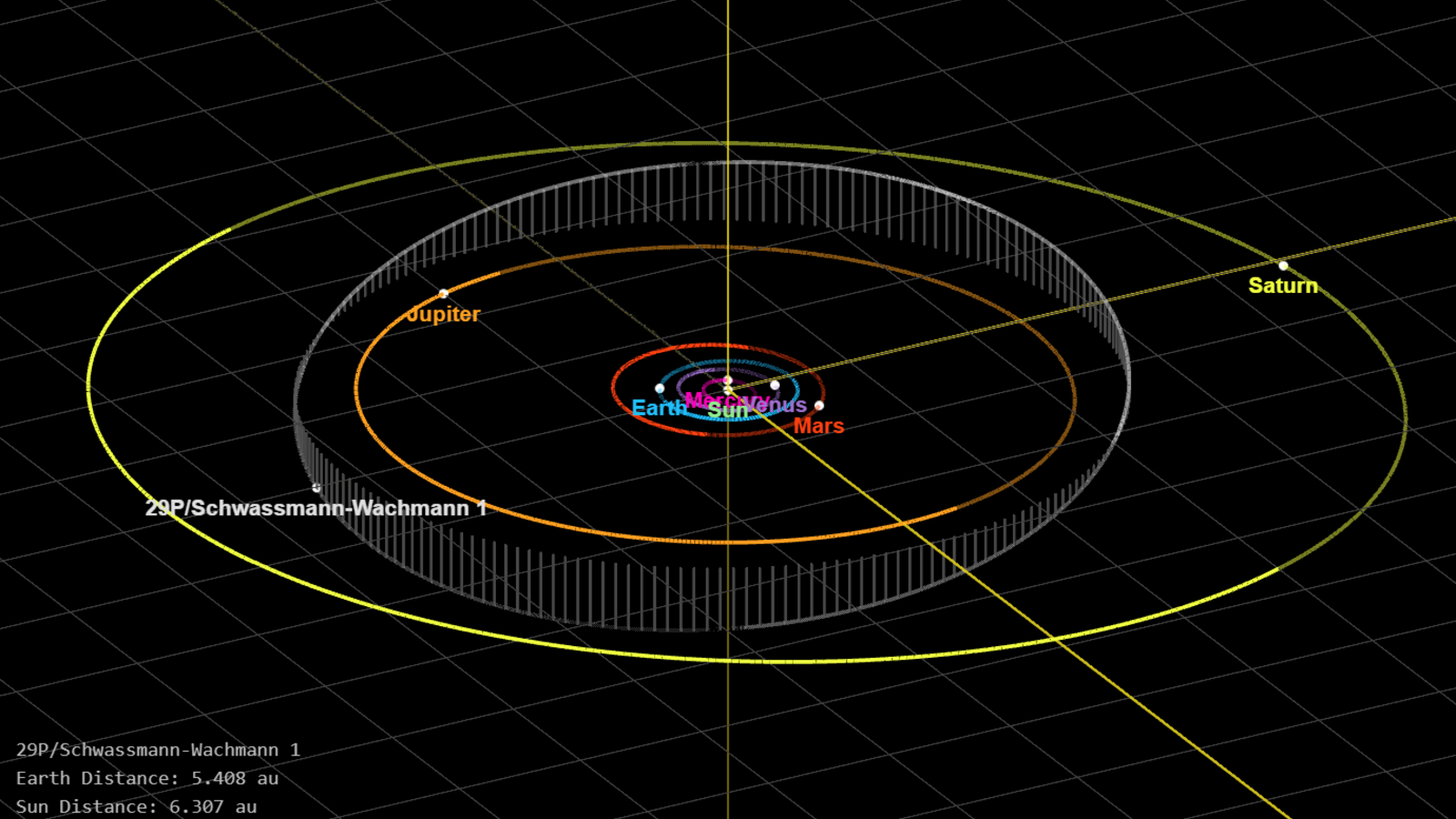
> Comet 29P maintains a consistent, near-circular orbit around the Sun, keeping its distance remarkably stable. Positioned between Jupiter and Saturn, it resides approximately six times farther from our star than Earth, resulting in a consistently dim environment with limited solar illumination.
**Option 2 (More direct and active voice):**
> Unlike comets with more eccentric paths, Comet 29P follows a nearly circular orbit, ensuring it remains at a largely unchanging distance from the Sun. This celestial body is situated in the vast expanse between Jupiter and Saturn, receiving only a fraction of the sunlight Earth experiences due to its position roughly six times farther away.
**Option 3 (Emphasizing the implications of its orbit):**
> Comet 29P’s orbit around the Sun is characterized by its near-circular shape, a feature that dictates its relatively constant distance from our star. Located in the region between Jupiter and Saturn, this comet is a significant distance from the Sun – approximately six times farther than Earth – meaning it experiences a perpetual twilight, bathed in very little sunlight.
**Option 4 (Slightly more descriptive):**
> With a roughly circular trajectory, Comet 29P maintains a stable, predictable distance from the Sun throughout its journey. This comet makes its home in the interplanetary gulf between Jupiter and Saturn, a location that places it about six times the Earth-Sun distance from our star, and consequently, it receives minimal solar warmth and light.
Choose the option that best fits the overall tone and context of your writing.
This comet, known as 29P, is a remarkably active celestial body, with an average of 20 eruptive events annually. While the majority of these are minor, the comet can also produce colossal outbursts, such as the recent one observed, which expelled an astonishing one million tons of icy material into the vacuum of space.
Researchers have been grappling with a persistent puzzle: the exact triggers for significant outbursts from comets remain elusive, even when the celestial bodies themselves appear to be in a state of relative stability. This lack of clarity has left scientists searching for definitive answers regarding the catalysts behind these dramatic events.
In April 2023, scientists successfully anticipated a significant cometary eruption, a feat made possible by detecting a subtle dimming preceding the event. Despite this foresight, the underlying cause of the phenomenon remained a mystery.
**Comet 29P Rekindles Glow After Mid-February Outburst**
Comet 29P, a celestial visitor, has experienced a resurgence in brightness following a recent outburst. While it had already passed its peak luminosity, a secondary event on Sunday, February 15th, injected a new supply of icy material into its surrounding coma, according to reports from Spaceweather.com. This injection has unexpectedly sustained the comet’s unusually high level of illumination. It remains uncertain at this time whether this revitalized coma will develop into a spiral formation.
Stargazers equipped with a respectable telescope or binoculars can still catch a glimpse of the comet. As of now, it resides within the constellation Leo, as reported by TheSkyLive.com.
Following such a significant outburst, astronomers anticipate a series of smaller events, akin to seismic aftershocks, which could lead to further activity from Comet 29P over the next several days or weeks. This forecast comes from Richard Miles, an astronomer specializing in Comet 29P and affiliated with the British Astronomical Association, as reported by Spaceweather.com.
Stargazers have a celestial visitor to admire as Comet C/2024 E1 (Wierzchoś) graces the night sky, following its closest approach to Earth on Tuesday, February 17th. Experts suggest this icy wanderer might be on a one-way trip out of our solar system, a fate also anticipated for Comet 3I/ATLAS. This means the current viewing opportunity could be a once-in-a-lifetime chance to witness this spectacular comet.
April is set to deliver a celestial spectacle with the appearance of two noteworthy comets.
First, the recently discovered “sungrazer” comet C/2026 A1 (MAPS) holds the extraordinary potential to become brilliant enough for naked-eye observation even during daylight hours. Joining this rare event, the long-period comet C/2025 R3 (PanSTARRS) is also projected to achieve visibility without the aid of a telescope, offering skywatchers a potential nighttime spectacle.