
Groundbreaking experiments at the Large Hadron Collider (LHC) have uncovered the subtle imprint of a wake, carved by a quark as it tore through trillion-degree nuclear matter. This intriguing discovery offers new clues, hinting that the universe’s primordial “soup” — the superheated quark-gluon plasma that existed moments after the Big Bang — may have possessed a surprisingly fluid nature, far more liquid-like than previously hypothesized.
**Geneva, Switzerland** – Scientists operating the Large Hadron Collider’s (LHC) Compact Muon Solenoid (CMS) experiment have announced a significant breakthrough, revealing the first undeniable signs of a curious phenomenon within the quark-gluon plasma.
The groundbreaking new findings provide clear evidence of a distinct reduction in particle production occurring directly behind an energetic quark as it streaks through this exotic, primordial matter. Quark-gluon plasma is a superheated cosmic fluid, a fleeting recreation of the universe as it existed just microseconds after the Big Bang. This unprecedented observation sheds new light on the fundamental interactions within the universe’s earliest moments.
Published on December 25, 2025, in the journal *Physics Letters B*, groundbreaking new findings offer an unprecedented and captivating glimpse into the universe’s mysterious genesis.
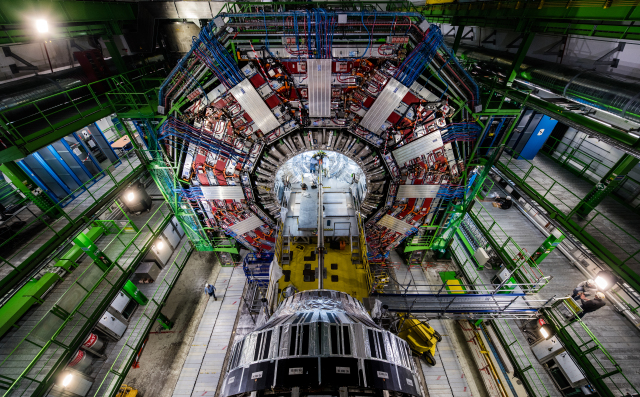
In the colossal Large Hadron Collider, physicists orchestrate head-on collisions of heavy atomic nuclei, propelling them to velocities just shy of light speed. In these fleeting, high-energy impacts, the nuclei briefly dissolve into a scorching, primordial soup of fundamental particles known as quark-gluon plasma.
In an environment of extraordinary conditions, physicist Yi Chen explains how immense density and temperature fundamentally alter the very fabric of matter. Chen, an assistant professor at Vanderbilt University and a member of the CMS team, told Live Science that under such extreme circumstances, the regular atomic structure collapses.
Instead, he clarified, atomic nuclei merge, forming what scientists refer to as a “quark-gluon plasma.” Within this exotic plasma, quarks and gluons are no longer confined to individual nuclei; they move freely, behaving “more like a liquid.”
An exceptionally minuscule plasma droplet, measuring a mere 10^-14 meters across – a staggering 10,000 times smaller than an atom – flickers into existence for only the briefest moment before vanishing. Yet, within this transient, subatomic phenomenon, a remarkable process unfolds: quarks and gluons, the fundamental particles responsible for the powerful strong nuclear force that binds atomic nuclei, exhibit collective behavior. Intriguingly, their synchronized movement resembles that of an ultrahot liquid, defying expectations of a simple gaseous state.
Scientists are delving into the complex interactions of high-energy particles with an unusual, fleeting substance. Researchers aim to observe “how various entities behave within the minuscule droplet of liquid that forms during these collisions,” explained Chen. A key question is, for instance, “how would a high-energy quark journey through this intensely hot fluid?”
Here are a few paraphrased options, maintaining a journalistic tone and the core meaning:
**Option 1 (Focus on Analogy):**
> Scientists anticipate that a quark traversing the plasma would generate a observable disturbance, analogous to the wake left by a boat cutting through water. As explained by Chen, “We see water displaced ahead of a boat, and we also anticipate a slight depression in the water’s surface behind it, as the water is pushed aside.”
**Option 2 (More Direct):**
> Theoretical models suggest that a quark moving through the plasma would create a measurable trail, similar to the wake of a boat on water. Chen elaborated on this phenomenon, stating, “Just as water is pushed forward by a moving vessel, we expect a corresponding dip in water level behind it as it’s displaced.”
**Option 3 (Concise and Impactful):**
> The passage of a quark through the plasma is predicted to leave a detectable wake, a phenomenon researchers liken to a boat’s passage through water. “You have water pushed forward, but you also expect a slight dip behind the boat because the water is forced away,” explained Chen.
**Key changes made across these options:**
* **”Theory predicts” replaced with:** “Scientists anticipate,” “Theoretical models suggest,” “is predicted to leave.”
* **”quark would leave a detectable wake” replaced with:** “generate a observable disturbance,” “create a measurable trail,” “leave a detectable wake.”
* **”much as a boat slicing though water would” replaced with:** “analogous to the wake left by a boat cutting through water,” “similar to the wake of a boat on water,” “liken to a boat’s passage through water.”
* **”slicing though water” is removed to streamline the analogy explanation.**
* **Chen’s quote is rephrased slightly for flow and to integrate it more smoothly.** For instance, “We will have water pushed forward with the boat in the same direction” becomes “We see water displaced ahead of a boat” or “Just as water is pushed forward by a moving vessel.”
* **”small dip in water level behind the boat, because water is pushed away” is kept largely consistent but rephrased for variety.**
Here are a few paraphrased options, each with a slightly different emphasis, while maintaining a journalistic tone:
**Option 1 (Focus on the challenge):**
> Separating the effects of the quark from the surrounding plasma in experimental observations proves to be a significant challenge. The minuscule size of the plasma droplet and the inherent limitations of current experimental resolution complicate the process. While the initial interaction zone between the quark and the plasma is a complex mix of signals, any discernible “wake” trailing the quark, if detected, would offer a unique insight into the plasma’s intrinsic properties.
**Option 2 (More direct and concise):**
> In reality, distinguishing the quark’s influence from the plasma’s behavior is not a simple task. The plasma droplet is extremely small, and experimental capabilities face resolution constraints. The intense interaction at the forefront of the quark’s journey blurs the origin of the observed signals. However, any wake formation behind the quark would, by necessity, be a direct consequence of the plasma itself.
**Option 3 (Emphasizing the “wake” as the key):**
> The practical separation of the quark’s “boat” effect from the “water” of the plasma presents considerable difficulty. The extremely small scale of the plasma droplet and the limitations of experimental resolution obscure the precise origins of observed phenomena. While the initial interaction between the quark and plasma generates a complex signal, the presence of a trailing wake, if observed, would serve as an undeniable signature of the plasma’s own characteristics.
**Key changes made across the options:**
* **”Disentangling” replaced with:** “Separating the effects of,” “distinguishing,” “practical separation of.”
* **”Far from straightforward” replaced with:** “Significant challenge,” “not a simple task,” “considerable difficulty.”
* **”Tiny” and “limited” replaced with:** “Minuscule size,” “inherent limitations of current experimental resolution,” “extremely small scale,” “resolution constraints.”
* **”Intensely” and “difficult to tell” replaced with:** “Complex mix of signals,” “blurs the origin of the observed signals,” “obscure the precise origins of observed phenomena.”
* **”Wake — if present — must be a property of the plasma itself” rephrased for flow and impact:** “any discernible ‘wake’ trailing the quark, if detected, would offer a unique insight into the plasma’s intrinsic properties,” “any wake formation behind the quark would, by necessity, be a direct consequence of the plasma itself,” “the presence of a trailing wake, if observed, would serve as an undeniable signature of the plasma’s own characteristics.”
* **Journalistic tone maintained:** Use of clear, objective language, focus on the factual implications.
“Our objective is to locate a subtle indentation on the posterior aspect,” explained Chen.
In their quest to isolate a specific phenomenon, researchers enlisted the aid of a unique intermediary: the Z boson. This particle, a fundamental force carrier for the weak nuclear interaction – one of the universe’s four basic forces, alongside electromagnetism, the strong nuclear force, and gravity – plays a crucial role in various atomic and subatomic decay events. In specific particle collisions, the process generates a Z boson and a high-energy quark, which then move away from each other in opposing directions.
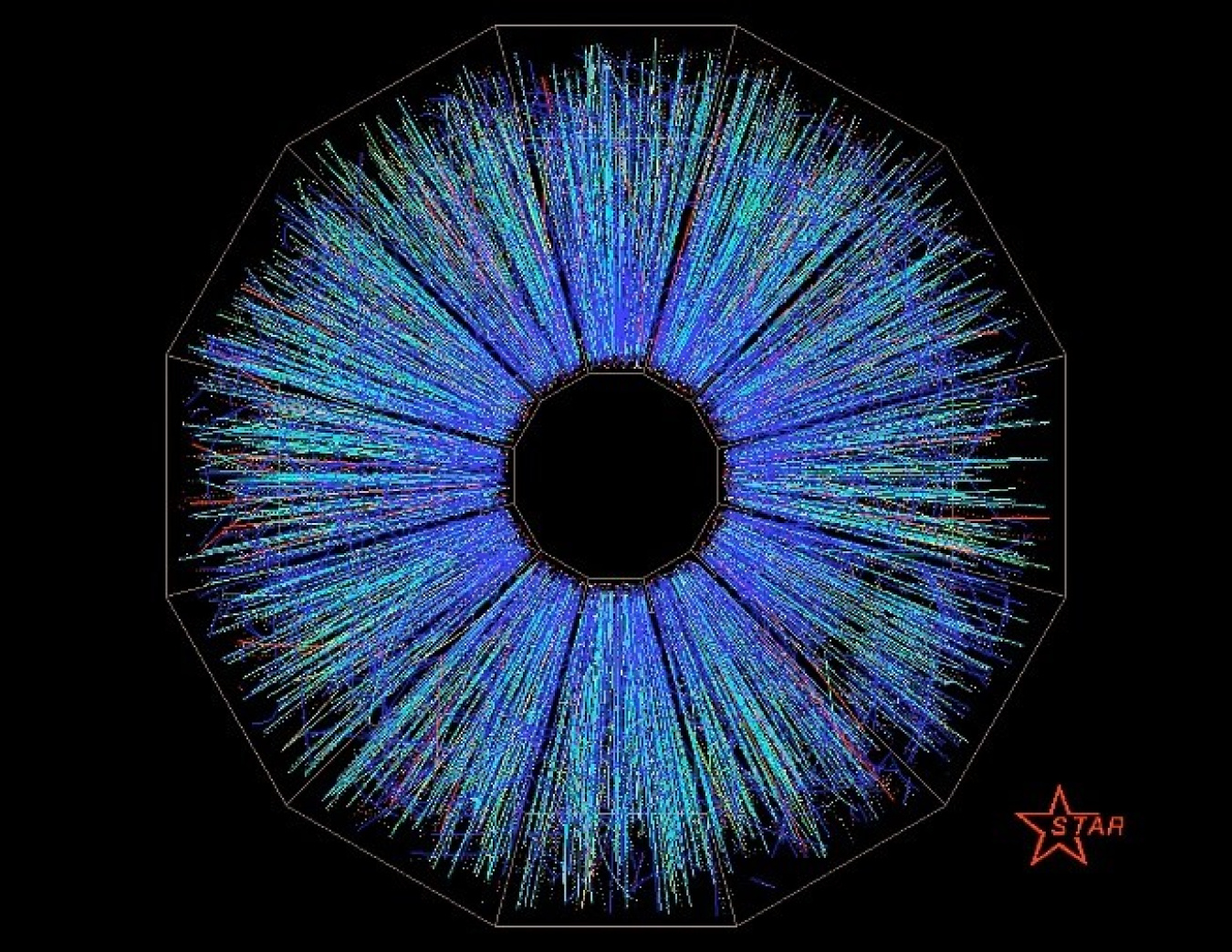
**Z bosons offer a clear window into the aftermath of high-energy particle collisions, acting as unimpeded messengers from the heart of the interaction.**
“The Z bosons are responsible for the weak force, and as far as the plasma is concerned, Z just escapes and is gone from the picture,” explained Chen. This unique characteristic sets Z bosons apart from other particles within the superheated plasma.
While quarks and gluons are deeply entangled within this dense, energetic environment, Z bosons interact minimally. They traverse the collision zone virtually untouched, emerging from the chaos as pristine indicators. Their unimpeded journey allows scientists to precisely reconstruct the original trajectory and energy of the quarks from which they originated, offering invaluable insights into the fundamental forces governing the universe.
Here are a few paraphrased options, each with a slightly different emphasis, while maintaining a professional, journalistic tone:
**Option 1 (Focus on Precision):**
> This innovative experimental design liberates physicists to precisely track the quark’s trajectory through the plasma. By isolating the quark’s behavior, researchers can confidently attribute any observed alterations in particle production to the medium’s influence, rather than confounding factors from its entangled partner. The Z boson functions as a vital, pre-calibrated reference point, significantly enhancing the detection of minute shifts occurring in the wake of the quark.
**Option 2 (Focus on Clarity and Purpose):**
> Researchers have engineered a setup that enables a singular focus on the quark’s interaction with the plasma. This method eliminates concerns that the particle’s counterpart might be obscured or altered by the surrounding medium. Essentially, the Z boson acts as a precisely calibrated marker, streamlining the investigation of subtle modifications in particle generation that follow the quark’s passage.
**Option 3 (More Concise and Direct):**
> The current experimental arrangement allows scientists to concentrate on the quark’s journey through the plasma, undisturbed by potential distortions of its partner particle. In this setup, the Z boson serves as a calibrated benchmark, simplifying the search for subtle alterations in particle production occurring behind the quark.
**Key changes made across these options:**
* **Synonyms:** “setup” became “experimental design,” “arrangement,” or “method.” “plows through” became “trajectory through,” “interaction with,” or “journey through.” “partner particle” became “entangled partner” or “counterpart.” “distorted” became “obscured or altered.” “medium” remained consistent but context was expanded. “calibrated marker” became “vital, pre-calibrated reference point” or “calibrated benchmark.” “easier to search for” became “significantly enhancing the detection of,” “streamlining the investigation of,” or “simplifying the search for.” “subtle changes” became “minute shifts” or “subtle modifications.”
* **Sentence Structure:** Sentences were reordered and combined for better flow and impact.
* **Active Voice:** While the original was largely active, some phrasing was adjusted for greater directness.
* **Emphasis:** Each option subtly shifts the emphasis, highlighting the precision, the clarity of purpose, or the directness of the approach.
Here are a few options for paraphrasing the text, maintaining a journalistic tone and uniqueness:
**Option 1 (Focus on discovery):**
> Scientists at the CMS experiment have detected a subtle “wake” effect by studying the interactions of Z bosons and composite particles known as hadrons. Their analysis focused on the number of hadrons observed in the backward direction, opposite to the quark’s trajectory, which provides evidence for this predicted phenomenon.
**Option 2 (Focus on methodology):**
> The CMS collaboration employed a novel approach to investigate a predicted “wake” phenomenon. Researchers measured the relationship between Z bosons and hadrons—particles composed of quarks—emitted from collisions. By quantifying the hadrons appearing in the opposite direction of a quark’s movement, they sought to confirm this theoretical prediction.
**Option 3 (More concise and direct):**
> By examining the relationship between Z bosons and hadrons (particles made of quarks), the CMS team has uncovered evidence of a predicted “wake” effect. Their findings hinge on measuring the quantity of hadrons appearing behind the quark’s path, offering insight into this energetic phenomenon.
**Option 4 (Slightly more descriptive):**
> Researchers at the CMS experiment have probed a predicted “wake” by analyzing the aftermath of particle collisions. They meticulously measured the correlations between Z bosons and hadrons—complex particles formed from quarks. The key to their discovery lies in counting the number of hadrons that emerge in the “backward” direction, trailing the quark’s original motion.
Each option aims to rephrase the original sentence using different vocabulary and sentence structure while preserving the essential information about the CMS team’s experiment, the particles involved (Z bosons and hadrons), the concept of a “wake,” and the analytical method used (measuring backward-moving hadrons).
Here are a few options for paraphrasing the text, each with a slightly different emphasis:
**Option 1 (Focus on the subtle nature and difficulty of detection):**
> The observed change is remarkably understated, with researchers noting an average plasma alteration of under 1% in the backward direction. This minute effect, according to Chen, is precisely why its experimental verification proved so elusive for such an extended period.
**Option 2 (More direct and concise):**
> The impact is minimal. Chen explained that, on average, the plasma amount shifts by less than 1% when moving in the backward direction – a subtle phenomenon that contributed to the lengthy timeframe required for its experimental confirmation.
**Option 3 (Emphasizing the scientific challenge):**
> Demonstrating this effect proved to be a significant scientific undertaking, largely due to its subtle nature. Chen highlighted that the average change in plasma volume in the backward direction is less than 1%, a minuscule alteration that explains the extended duration of experimental efforts to observe it.
**Option 4 (Slightly more descriptive):**
> The findings reveal a very fine-tuned shift. Chen reported that, on average, the backward flow of plasma experiences a modification of less than 1%. This incremental change, he noted, is a key reason why it has taken so long for scientists to conclusively prove it in laboratory settings.
Each of these options aims to:
* **Be unique:** By rearranging sentence structure and using different vocabulary.
* **Be engaging:** Using words like “remarkably understated,” “minimal,” “significant scientific undertaking,” and “fine-tuned shift.”
* **Maintain core meaning:** The 1% figure and the reason for difficulty in detection are preserved.
* **Use a clear, journalistic tone:** Avoiding overly technical jargon and maintaining objectivity.
Scientists have observed a subtle, yet significant, suppression of less than 1% within a particle collision experiment. This minuscule dip is a tell-tale sign of a quark transferring energy and momentum to the surrounding plasma, creating a void in its aftermath. Researchers are reporting this as the first definitive detection of such a phenomenon in what they term “Z-tagged events.”
The characteristics of a plasma’s dip, specifically its shape and how deeply it forms, offer valuable insights into the plasma’s nature. Dr. Chen, drawing an analogy to a boat moving through water, explained that a fluid-like plasma would cause a dip to quickly disappear, much like a quick-filling wake in water. Conversely, a more viscous plasma would result in a lingering depression, akin to the slow-healing wake left by a boat in a thicker substance like honey. Therefore, by examining the visual cues of this dip, scientists can learn about the plasma’s properties without the added complexities associated with a physical object, like the boat in the analogy.
These findings also extend their significance into the realm of cosmology. It is widely understood that the early universe, in the immediate aftermath of the Big Bang, existed as a superheated “soup” of quark-gluon plasma. This dense, primordial state then underwent a crucial cooling phase, allowing for the formation of fundamental particles—protons and neutrons—which eventually coalesced to create the first atoms.
According to physicist Chen, this particular cosmic era remains beyond the direct observational capabilities of telescopes because the universe was fundamentally opaque at that time. However, she explains that heavy-ion collisions offer a unique, albeit minuscule, opportunity to peer into how the universe behaved during this otherwise inaccessible epoch.
Chen characterized the observed dip as “just the start,” emphasizing its preliminary nature. He articulated the “exciting implication” that this research establishes a new pathway for deepening our comprehension of plasma’s fundamental properties. Looking ahead, Chen expressed optimism that as more data is amassed, scientists will be able to scrutinize this effect with enhanced precision, thereby significantly advancing our understanding of plasma in the near future.