
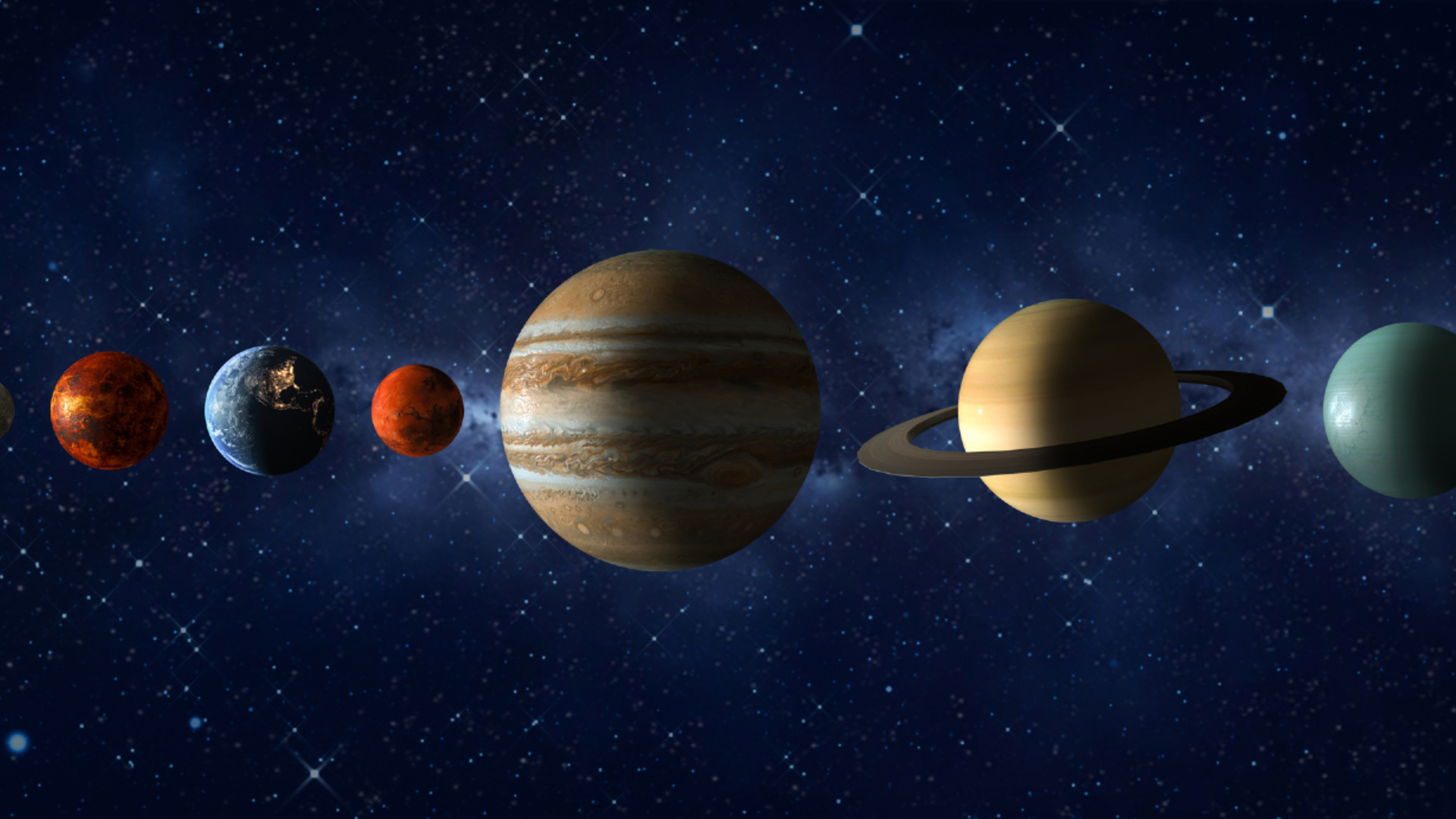
Get ready for a celestial spectacle: six of our solar system’s planets are poised to form a rare “planetary parade” across the night sky. However, catching a glimpse of this cosmic gathering won’t be an easy feat for observers.
**Rare Planetary Alignment Visible This Saturday, Feb. 28**
Skywatchers are in for a celestial treat this Saturday, February 28, with a rare planetary gathering gracing the night sky. According to NASA, those with clear skies and an unobstructed view directly to the west will have the opportunity to spot the inner planets, Venus and Mercury, appearing in close proximity to Saturn.
Adding to the spectacle, the gas giants Neptune, Uranus, and Jupiter will also be visible elsewhere in the night sky, offering a widespread astronomical display for diligent observers.
Stargazers will have a narrow window to glimpse a celestial lineup featuring Venus, Mercury, Saturn, and Neptune, all making fleeting appearances shortly after sunset. While Venus, Mercury, and Saturn should be discernible to the unaided eye, a pair of stargazing binoculars is recommended to enhance the view. During the twilight hours, observers will find Venus and Mercury positioned closest to the western horizon, with the ringed planet, Saturn, visible slightly higher above them.
Skywatchers are in for a celestial treat as Neptune positions itself remarkably close to Saturn. However, don’t expect a naked-eye marvel; capturing a decent glimpse of the distant ice giant will demand a powerful 6-inch (15 cm) skywatching telescope. Even then, attempts to view Neptune during the fleeting twilight period are likely to be frustrated by its elusive nature.
This brief, albeit grand, planetary quartet will emerge into the night sky roughly half an hour after sunset, gracing observers with its presence for approximately 45 minutes.
After successfully observing Venus, Mercury, Saturn, and Neptune, stargazers can pinpoint Jupiter high in the southern sky, positioned within the constellation Gemini. Its exceptional brilliance makes it an unmistakable target.
As a helpful celestial landmark, the distinctive three stars forming Orion’s Belt will appear approximately midway between your previously observed planets and Jupiter.
Distinguishing Jupiter from the surrounding stars is straightforward: the gas giant will present itself as a steady, whitish light, notably lacking the characteristic twinkle of stellar objects.
While the seventh planet, Uranus, will also be visible in the night sky, observers will require binoculars or a small telescope to best discern it. To locate this distant world, begin by identifying Orion’s distinctive Belt, formed by the three bright stars Alnitak, Alnilam, and Mintaka. Trace an imaginary line upwards from these stars until you encounter the shimmering Pleiades open cluster, also known as “The Seven Sisters” or M45. Uranus will then be found positioned just below this iconic cluster, nestled within the constellation Taurus.
Stargazers are in for a celestial bonus on February 28, when the moon will grace the night sky alongside a well-known star cluster. On this date, a luminous, 92%-illuminated waxing gibbous moon is slated to make a close pass by the Beehive Cluster. Scientifically designated as M44 and NGC 2632, this impressive grouping consists of approximately 1,000 bright stars and is located about 577 light-years from our solar system.
Following recent celestial alignments, an even more captivating astronomical event is on the horizon: a total lunar eclipse set for March 3. On this date, the full “Worm Moon” is poised for a dramatic transformation as it plunges into Earth’s deepest shadow.
During this spectacle, often referred to as a “blood moon,” the lunar surface will take on a striking reddish-copper hue. This breathtaking totality is expected to last for a significant 58 minutes, offering sky-watchers a prolonged display.
Prime viewing opportunities for the entire eclipse sequence are anticipated across the western United States, including Alaska and Hawaii, as well as the Pacific islands, New Zealand, Australia, and East Asia. Stargazers in these regions should prepare for a truly unforgettable celestial show.





