Astronomers may soon witness an extraordinary cosmic event: a pair of supermassive black holes locked in a breathtaking, cataclysmic death spiral. Researchers have made a significant breakthrough, revealing how these colossal, unseen entities, as they orbit one another, could gravitationally warp and magnify the light from background stars. This newfound understanding offers a unique method to potentially detect these dark behemoths, making their intense gravitational dance observable for the first time.
At the core of nearly every major galaxy lies a supermassive black hole, a cosmic behemoth whose mass can range from millions of times that of our sun—like the Milky Way’s own Sagittarius A*—to an astonishing billions of solar masses. Ordinarily, a galaxy is anchored by a singular supermassive black hole.
However, this cosmic solitude dramatically changes during galactic mergers. When two galaxies collide, their respective central black holes are drawn inexorably towards each other. Following an extended gravitational dance where they spiral into a binary orbit, these colossal entities ultimately coalesce, unleashing a powerful burst of gravitational waves that ripples across the fabric of spacetime.
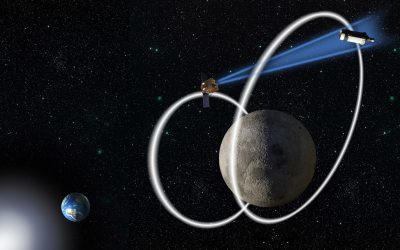
Astronomical observations to date have pinpointed binary supermassive black holes exclusively when they are at immense distances, often hundreds or thousands of light-years apart. To bridge this observational gap, the European Space Agency (ESA) is developing its ambitious space-based gravitational-wave observatory, LISA (Laser Interferometer Space Antenna). This groundbreaking mission is designed to capture the subtle, low-frequency gravitational ripples produced as supermassive black holes spiral inwards towards a colossal merger.
Concurrently, Chinese scientists have put forth a comparable proposal, dubbed TianQin, aiming for similar cosmic insights. For years, these ambitious projects represented humanity’s only prospective pathways for directly observing the final stages of such elusive cosmic behemoths. However, that understanding may now be poised for a significant shift.
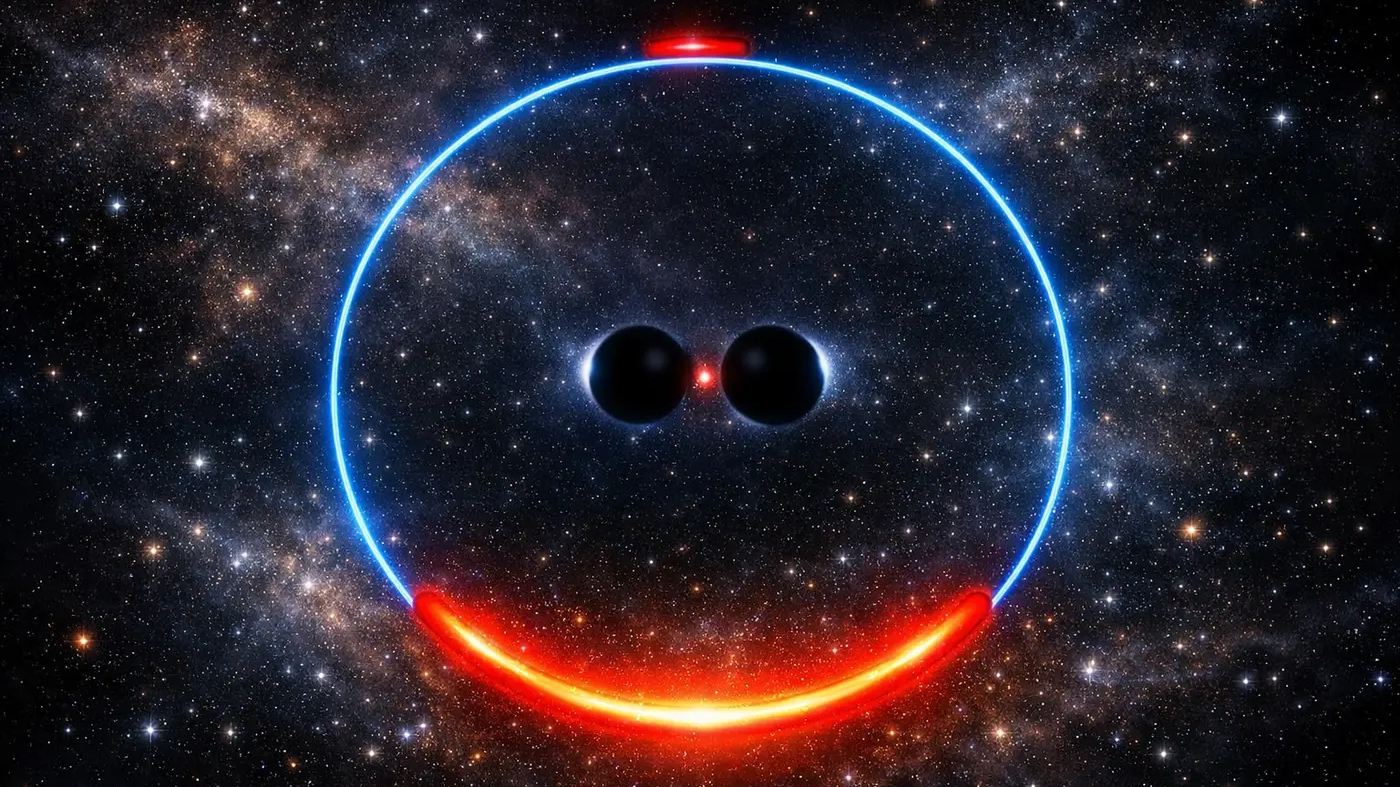
Bence Kocsis, a researcher at the University of Oxford, has underscored the profound significance of potentially identifying in-spiraling supermassive black hole binaries years before next-generation space-based gravitational-wave detectors are even operational. He highlighted that this early detection capability would usher in genuine multi-messenger studies of black holes. This integrated approach, combining diverse cosmic signals, would provide unprecedented opportunities to rigorously test gravitational theories and the fundamental physics of black holes in entirely novel ways.
Astronomer Kocsis, a key member of a collaborative research team spanning Oxford University and Germany’s Max Planck Institute for Gravitational Physics, has contributed to a significant breakthrough. Their work details a novel method demonstrating how the distinctive gravitational lensing caused by binary black holes can be harnessed to pinpoint these colossal cosmic pairs in remote galaxies.
Gravitational lensing, a remarkable astronomical effect, arises when massive celestial objects, due to their immense gravitational pull, distort the very fabric of space-time around them. This profound warping then bends the path of light traveling through these cosmic distortions. Consequently, background objects viewed through such a “gravitational lens” can appear significantly magnified, or occasionally even split into several distinct images.

Detecting gravitational lensing by a solitary black hole necessitates flawless alignment with a background star. Crucially, this exacting requirement fundamentally alters in the presence of a binary black hole system.
According to Kocsis, the likelihood of starlight undergoing dramatic amplification escalates significantly within a binary black hole system, presenting a far greater probability than when only a single black hole is involved.
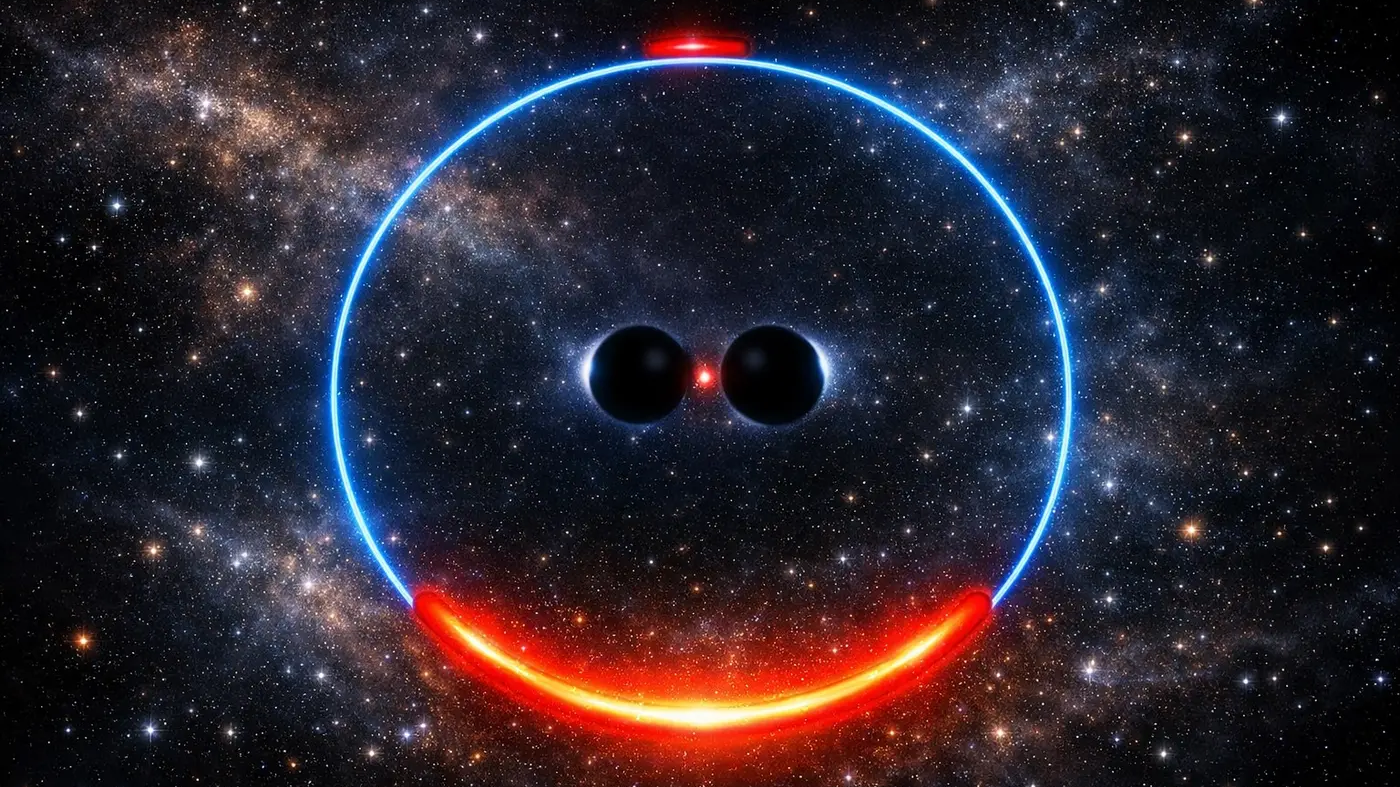
In a fascinating cosmic phenomenon, a binary black hole system operates much like a pair of immense, rotating gravitational lenses. As these two colossal black holes orbit their common center of mass, their combined gravitational pull sculpts a distinctive, diamond-shaped zone within spacetime.
This unique region is the site of quasi-periodic lensing events and is scientifically known as the ‘caustic curve’. A critical characteristic of this curve is that the gravitational lensing effect is dramatically amplified along its path, causing light passing through it to be significantly intensified.
The alignment of distant background stars with a gravitational caustic curve triggers a remarkable phenomenon: these celestial bodies will periodically ignite, their light dramatically amplified. This luminous event occurs on timescales of several years, precisely synchronized with the orbital dance of the binary supermassive black holes. Importantly, these incredibly distant stars are expected to remain entirely invisible at all other times, a stark reminder of the vast cosmic distances to their host galaxies.
Here are a few paraphrased options, maintaining a journalistic tone and the core meaning:
**Option 1 (Focus on the visual):**
> “Imagine a cosmic dance: as the pair of supermassive black holes orbit each other, a warped, caustic ‘shadow’ or ‘lens’ effect rotates and contorts, sweeping through a vast stellar field,” explained Hanxi Wang, a doctoral candidate at Oxford. “Should a particularly luminous star cross paths with this dynamic region, it can erupt in an exceptionally bright flash with every pass. These recurring bursts of starlight act as a definitive beacon, signaling the presence of a binary supermassive black hole system.”
**Option 2 (More direct and concise):**
> According to Hanxi Wang, a Ph.D. student at Oxford, the gravitational interplay of a supermassive black hole binary creates a unique visual phenomenon. “As the binary system moves, the resulting caustic distortion rotates and shifts its form, effectively ‘sweeping’ across a wide expanse of stars,” Wang stated. “When a brilliant star enters this zone, it’s illuminated intensely each time the caustic passes, generating repeating flashes of starlight that serve as a clear and unmistakable fingerprint for such celestial binaries.”
**Option 3 (Emphasizing the discovery aspect):**
> A team at Oxford has identified a key indicator for locating binary supermassive black holes, based on the dramatic light effects they produce. Hanxi Wang, a Ph.D. student involved in the research, described the process: “The orbiting black holes cause a caustic curve that constantly changes shape and orientation, sweeping through a significant volume of stars. If a bright star happens to be in the path of this sweeping curve, it will emit a remarkably powerful flash every time the caustic moves over it. These repeated bursts of starlight offer a distinct and unmistakable signature for these massive binary systems.”
**Key changes made in these paraphrases:**
* **Vocabulary:** Replaced words like “caustic curve,” “rotates,” “changes shape,” “sweeping,” “extraordinarily bright flash,” and “distinctive signature” with synonyms or more descriptive phrases (e.g., “warped, caustic ‘shadow’ or ‘lens’ effect,” “contorts,” “dynamic region,” “erupt in an exceptionally bright flash,” “definitive beacon,” “gravitational interplay,” “unique visual phenomenon,” “clear and unmistakable fingerprint,” “dramatic light effects,” “remarkably powerful flash”).
* **Sentence Structure:** Varied sentence beginnings and combined or split clauses to create a more natural flow and engaging rhythm.
* **Figurative Language:** Introduced analogies like “cosmic dance” or “lens effect” to make the concept more accessible.
* **Tone:** Maintained a professional, informative, and slightly awe-inspired tone suitable for scientific reporting.
* **Attribution:** Clearly attributed the quote and explanation to Hanxi Wang.
The dynamic nature of the cosmos ensures this standoff is temporary, as the black holes’ orbital paths are progressively narrowing.
Here are a few paraphrased versions, each with a slightly different emphasis:
**Option 1 (Focus on the observable effects):**
> As two black holes spiral closer, they shed orbital energy in the form of gravitational waves. This loss of energy accelerates their dance, causing them to orbit each other at ever-increasing speeds. While the process of losing enough energy to merge can span millions of years, the shrinking of their orbits may manifest as detectable changes in the caustic curve. These alterations would, in turn, influence the frequency modulation of light-bending events and their peak brightness. Furthermore, the unique masses of the black hole pair could be imprinted onto the very shape of this caustic curve.
**Option 2 (More direct and concise):**
> Gravitational waves carry away orbital energy as two black holes draw nearer to each other, causing their orbital speed to escalate dramatically. Although the journey to a merger can take eons, the progressive tightening of their orbits could be revealed through shifts in the caustic curve. Such modifications would affect the regularity of light-bending events and their associated brightness peaks. The caustic curve also holds the potential to reveal the specific masses of the black hole duo.
**Option 3 (Emphasizing the cosmic timescale and detection):**
> The cosmic ballet of two black holes involves a continuous loss of orbital energy, radiated away as gravitational waves. This energetic exchange forces them into increasingly rapid orbits. While the gradual spiraling toward a merger unfolds over millions of years, the contraction of their orbital path could become evident through subtle yet significant alterations in the caustic curve. These changes would ripple through the modulation of light-bending events, impacting their frequency and peak luminosity. Intriguingly, the masses of these celestial behemoths could also be encoded within the intricate patterns of the caustic curve.
Here are a few options for paraphrasing the provided text, maintaining a journalistic tone and focusing on uniqueness and engagement:
**Option 1 (Focus on the timescale and observational challenge):**
> Changes in the frequency and intensity of light from gravitational lensing events caused by supermassive black holes unfold over immense timescales, stretching into the thousands or even millions of years. This means astronomers are limited to capturing fleeting glimpses, or snapshots, of any individual binary supermassive black hole system. Nevertheless, by meticulously observing a diverse range of similar systems at various points in their orbital journeys, these individual snapshots can be pieced together to construct a comprehensive narrative of their evolution.
**Option 2 (Emphasizing the “cosmic puzzle” aspect):**
> The subtle shifts in frequency and peak brightness during gravitational lensing events, a phenomenon influenced by binary supermassive black holes, are imperceptible to us within human lifespans, taking millennia or longer to manifest. Consequently, astronomers can only ever capture a static image of a single binary black hole system. However, the universe offers a vast gallery of these celestial dancers. By studying enough comparable systems at different stages of their orbital ballet, scientists can assemble these individual snapshots into a grand, overarching story of cosmic evolution.
**Option 3 (More concise and direct):**
> For binary supermassive black hole systems, the alterations to gravitational lensing events – specifically in frequency and peak brightness – are so gradual that they require thousands to millions of years to become apparent. This glacial pace confines astronomers to observing just a single moment, a snapshot, of any given system. Yet, by compiling observations from numerous similar systems at distinct phases of their orbital development, these discrete images can be synthesized to reveal the broader evolutionary trajectory.
**Key changes and why they work:**
* **”Modulation to the frequency and peak brightness”** is rephrased with more descriptive language like “Changes in the frequency and intensity of light,” “subtle shifts in frequency and peak brightness,” or “alterations to gravitational lensing events – specifically in frequency and peak brightness.”
* **”lensing events”** is clarified as “gravitational lensing events caused by supermassive black holes” or similar, adding context.
* **”take thousands or millions of years to become noticeable”** is made more evocative with phrases like “unfold over immense timescales, stretching into the thousands or even millions of years,” “imperceptible to us within human lifespans, taking millennia or longer to manifest,” or “require thousands to millions of years to become apparent.”
* **”At best, astronomers can only take a snapshot of any given binary supermassive black hole system”** is varied to “This means astronomers are limited to capturing fleeting glimpses, or snapshots, of any individual binary supermassive black hole system,” “Consequently, astronomers can only ever capture a static image of a single binary supermassive black hole system,” or “This glacial pace confines astronomers to observing just a single moment, a snapshot, of any given system.”
* **”However, observe enough similar systems at different stages in their orbital evolution and the snapshots could be put together to tell a larger story”** is transformed into more engaging narratives like “Nevertheless, by meticulously observing a diverse range of similar systems at various points in their orbital journeys, these individual snapshots can be pieced together to construct a comprehensive narrative of their evolution,” “However, the universe offers a vast gallery of these celestial dancers. By studying enough comparable systems at different stages of their orbital ballet, scientists can assemble these individual snapshots into a grand, overarching story of cosmic evolution,” or “Yet, by compiling observations from numerous similar systems at distinct phases of their orbital development, these discrete images can be synthesized to reveal the broader evolutionary trajectory.”
These options aim to be unique by using different vocabulary and sentence structures while ensuring the core scientific information remains accurate and presented in a clear, journalistic style.
The upcoming comprehensive sky surveys from the Vera C. Rubin Observatory in Chile and the Nancy Grace Roman Space Telescope, slated for its 2027 launch, are expected to be instrumental in detecting numerous gravitational lensing events caused by binary supermassive black holes in distant galaxies. Furthermore, once the LISA mission becomes operational, anticipated in the 2030s, it is poised to collaborate with these survey telescopes. This partnership will enable an in-depth, multi-messenger approach—combining observations of electromagnetic and gravitational waves—to catalog black holes across the universe, particularly those on a collision course towards a merger.
A new study, detailed in the February 12th issue of the scientific journal *Physical Review Letters*, presents groundbreaking findings.