**New NASA DART Images Reveal Asteroids Slowly Reshaping Themselves Through Rock and Dust Exchange**
Analysis of images captured by NASA’s Double Asteroid Redirection Test (DART) mission has provided the first visual confirmation that small asteroids engage in a gradual process of exchanging rocks and dust, a phenomenon that slowly reshapes their surfaces over vast geological timescales.
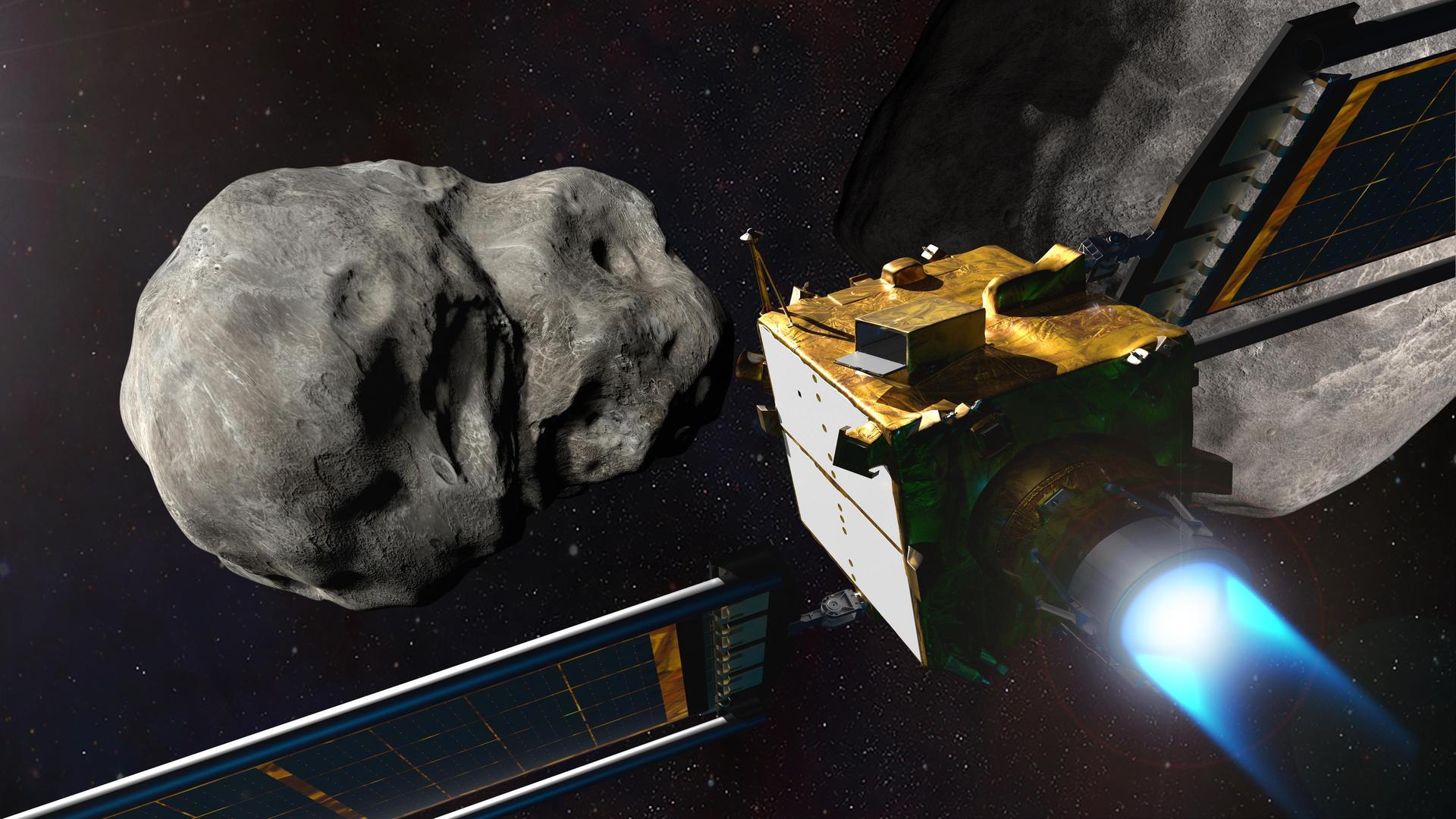
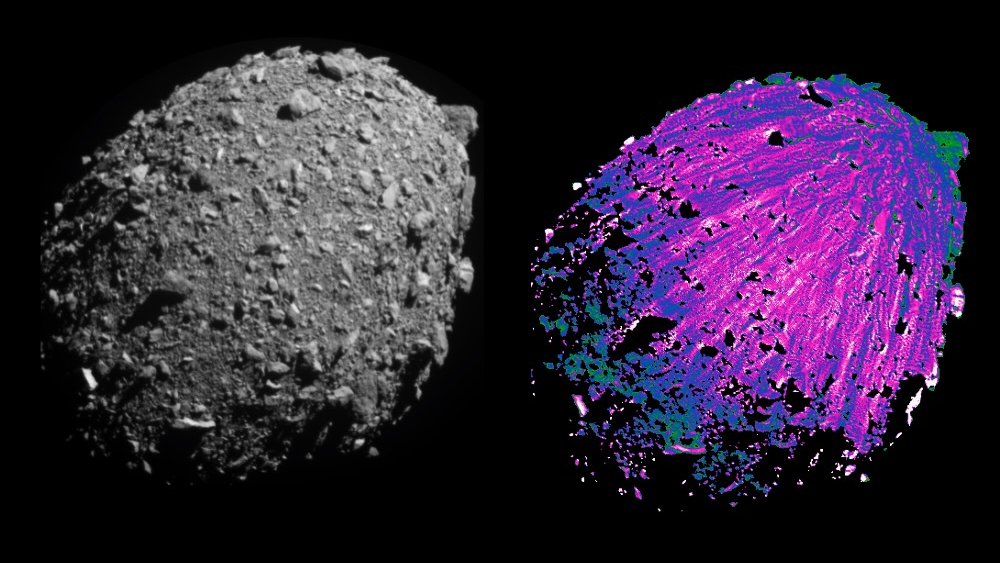
New analysis of images from NASA’s DART mission, which tested asteroid-deflection technology in late 2022, has uncovered subtle, fan-shaped markings on the surface of the asteroid moon Dimorphos. These striking patterns were visible just moments before the spacecraft intentionally impacted its target.
Scientists now believe that peculiar streaks observed on Dimorphos were most likely created by fragments ejected from its larger partner, Didymos. These pieces of space debris are thought to have traveled between the two celestial bodies before settling onto Dimorphos through a series of low-speed collisions.
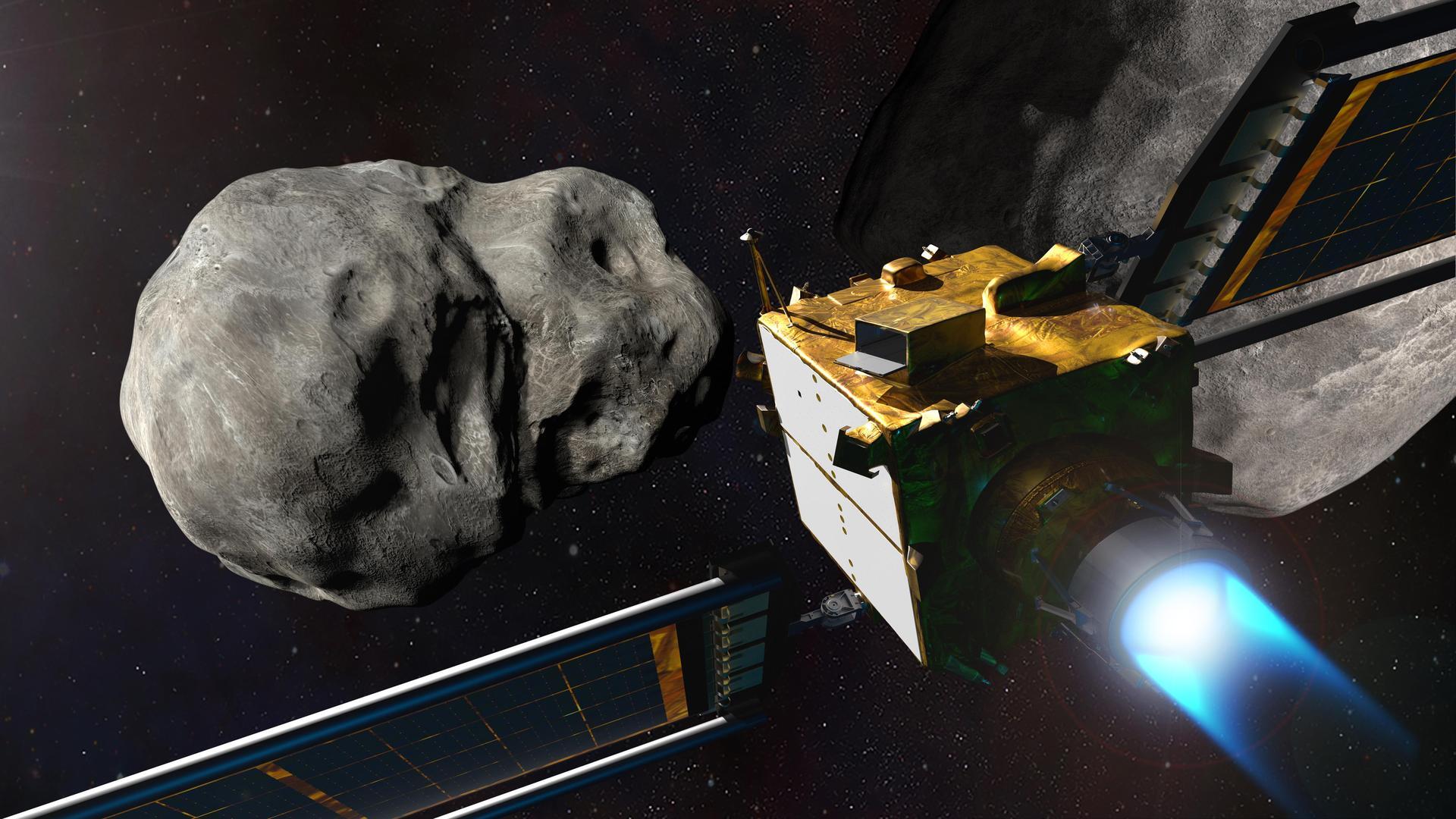
“Initially, we suspected a malfunction with the camera itself, followed by a concern that our image processing techniques might be flawed,” stated Jessica Sunshine, lead author of the study from the University of Maryland.
**Further investigation revealed that the observed streaks were consistent with faint, slow-moving impacts from particles encountered in space, akin to “cosmic snowballs” colliding with the object, according to Sunshine.**
Scientists have uncovered the first direct evidence of recent material movement within a pair of asteroids orbiting each other.
**New Research Unveils Broader Impact of NASA’s DART Mission**
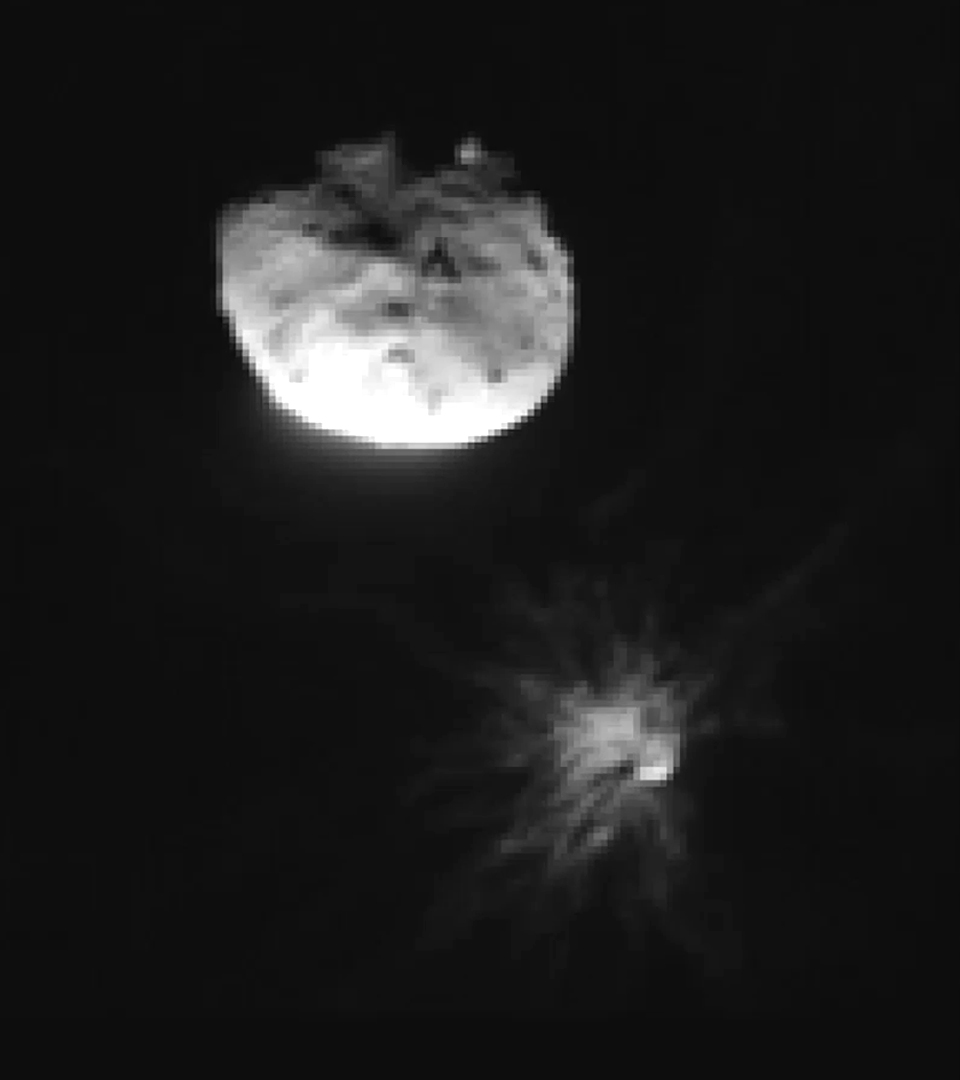
A groundbreaking study, published on March 6 in The Planetary Science Journal, reveals that NASA’s Double Asteroid Redirection Test (DART) had a more far-reaching effect than initially understood. The mission not only successfully altered the orbit of Dimorphos around its larger asteroid partner, Didymos, but also subtly shifted the entire binary asteroid system’s trajectory around the sun. This confirmation comes from an independent team of scientists, adding significant weight to the findings of the DART mission’s success in planetary defense.
Researchers revealed a subtle yet significant change in the system’s orbital speed, a mere 11.7 microns per second. This translates to approximately 1.7 inches every hour, according to their findings detailed in a separate study published on March 6 in the journal *Science Advances*.
Here are a few paraphrased options, maintaining a journalistic tone and original phrasing:
**Option 1 (Focus on impact):**
> “Even a minute alteration in an asteroid’s trajectory can be the critical factor determining whether it poses a threat to Earth or safely bypasses our planet,” explained Rahil Makadia, a planetary defense specialist at the University of Illinois Urbana-Champaign and lead author of the study published in *Science Advances*.
**Option 2 (Focus on the research):**
> According to Rahil Makadia, the lead researcher on a *Science Advances* paper and a planetary defense expert at the University of Illinois Urbana-Champaign, subtle shifts in an asteroid’s movement over time can ultimately decide its fate relative to Earth, dictating whether it becomes a dangerous impactor or a harmless passerby.
**Option 3 (More concise):**
> “A tiny change in an asteroid’s path can ultimately determine if it strikes Earth or misses us entirely,” stated Rahil Makadia, a planetary defense researcher at the University of Illinois Urbana-Champaign who spearheaded the *Science Advances* publication.
**Option 4 (Emphasizing the “difference”):**
> The cumulative effect of even a small alteration in an asteroid’s course can prove decisive, determining whether it becomes a hazard to our planet or remains a distant object, noted Rahil Makadia, a planetary defense researcher at the University of Illinois Urbana-Champaign and the lead author of the *Science Advances* paper.
Here are a few options for paraphrasing the text, each with a slightly different emphasis:
**Option 1 (Concise and direct):**
> A significant portion, approximately 15%, of asteroids located near Earth are not single celestial bodies but rather binary systems. These pairings, where a smaller asteroid circles a larger one, are capable of supporting unexpectedly intricate phenomena. A key driver of this complexity is the sun’s persistent energy, which can slowly accelerate the spin of smaller asteroids, eventually leading to the shedding of surface material.
**Option 2 (More descriptive):**
> Astronomers estimate that around one in seven near-Earth asteroids exist as binary systems, a cosmic dance where a diminutive asteroid orbits its larger counterpart. These dual-asteroid arrangements can harbor surprisingly sophisticated dynamics. One significant factor contributing to this complexity is the continuous influence of sunlight, which can gradually increase the rotational speed of smaller asteroids, causing loose debris to detach from their surfaces.
**Option 3 (Focus on the “why”):**
> The intricate processes occurring within near-Earth asteroid binary systems are more common than one might expect, with roughly 15% of these celestial duos exhibiting such complexity. These systems, composed of a smaller asteroid tethered to a larger one, are shaped by the subtle but powerful force of sunlight. Over time, this solar radiation can incrementally boost the rotation of smaller asteroids, reaching a critical point where loose surface materials are ejected.
**Option 4 (Slightly more active voice):**
> Within the near-Earth asteroid population, an estimated 15% form binary systems, featuring a smaller asteroid in orbit around a larger companion. These systems are capable of fostering surprisingly complex activities, partly due to the sun’s influence. Sunlight gradually accelerates the rotation of smaller asteroids, a process that can eventually cause loose material to break free from their surfaces.
Each option aims to convey the same core information: the prevalence of near-Earth asteroid binaries, the nature of these binaries, and the mechanism by which sunlight drives complex processes. The choice between them would depend on the specific context and desired tone of the larger piece.
The YORP effect, a subtle yet persistent force, influences asteroids by harnessing solar energy. When an asteroid absorbs sunlight, it subsequently radiates this energy back into space as heat. This thermal radiation, though minute, generates a continuous, gentle push, gradually accelerating the asteroid’s rotation over time.
Here are a few paraphrased options, maintaining a journalistic tone and original phrasing:
**Option 1 (Focus on the discovery):**
> This phenomenon, where celestial bodies spin so rapidly that material shifts and gathers, is not unique to this specific location. NASA’s Lucy spacecraft has previously observed striking evidence of this process on other worlds. Around the equators of the asteroid Dinkinesh and its orbiting moon, Selam, researchers identified ridges. These formations are thought to be the result of material migrating and accumulating as the asteroids spun up. Similar equatorial ridges have also been noted on Dimorphos and Didymos, suggesting a common mechanism where material shed from these rapidly rotating asteroids eventually settled back onto their surfaces.
**Option 2 (More concise and direct):**
> The solar system offers further proof of this rotational material redistribution. NASA’s Lucy spacecraft, for instance, documented ridges encircling the equators of asteroid Dinkinesh and its moon, Selam. Scientists interpret these features as the product of material movement and consolidation during periods of accelerated rotation. Corresponding equatorial ridges on Dimorphos and Didymos point to a similar origin, likely material ejected by the spinning asteroids that subsequently re-accumulated on their surfaces.
**Option 3 (Emphasizing the “spin-up” concept):**
> The effects of rapid asteroid spin-ups, leading to material migration and accumulation, have been observed throughout our solar system. Notably, NASA’s Lucy spacecraft discovered ridges ringing the equators of asteroid Dinkinesh and its satellite, Selam, features scientists attribute to this very process. The discovery echoes similar observations of equatorial ridges on asteroids Dimorphos and Didymos, believed to have formed from material shed by these spinning bodies and then redeposited.

Researchers, led by Sunshine, have unveiled a novel method for identifying distinctive fan-shaped streaks. Their breakthrough involved the creation of advanced image-processing tools, capable of meticulously eliminating shadow interference from boulders and rectifying variations in surface illumination, according to a recent statement.
“As our three-dimensional lunar model evolved, we observed that the fan-shaped streaks grew more distinct, rather than fading, which solidified our belief that we were encountering a genuine phenomenon,” stated Tony Farnham, a research scientist at the University of Maryland and co-author of the study.
Scientists observed that ejected material from Didymos dispersed at a leisurely pace, approximately 30.7 centimeters per second (12.1 inches per second). This slow velocity suggests the impacts likely formed accumulations rather than distinct craters. Furthermore, the resulting streaks are concentrated near the moon’s equator, aligning with theoretical predictions about where material shed from Didymos would naturally settle.
Here are a few options for paraphrasing the text, each with a slightly different emphasis, maintaining a journalistic tone:
**Option 1 (Focus on anticipation and the upcoming mission):**
> The scientific community is abuzz with anticipation to witness the transformed appearance of Dimorphos firsthand. This close-up examination could become a reality as early as December, with the arrival of the European Space Agency’s Hera spacecraft at the Dimorphos-Didymos celestial pairing.
**Option 2 (More direct and concise):**
> Scientists are keenly awaiting the opportunity to study Dimorphos in its altered state. This chance may present itself as soon as this December, when the European Space Agency’s Hera mission is scheduled to reach the Dimorphos-Didymos system.
**Option 3 (Emphasizing the “how” and “when”):**
> A detailed, up-close look at the transformed Dimorphos is eagerly anticipated by researchers. The European Space Agency’s Hera spacecraft is poised to provide this view, with its arrival at the Dimorphos-Didymos system slated for December.
**Option 4 (Slightly more descriptive):**
> The profound changes to Dimorphos are of immense interest to scientists, who are eager to observe them directly. Their opportunity to do so could arrive as early as December, marking the arrival of the European Space Agency’s Hera spacecraft at the binary asteroid system of Dimorphos and Didymos.
Here are a few paraphrased options, each with a slightly different emphasis, maintaining a journalistic tone:
**Option 1 (Focus on Discovery):**
> The forthcoming Hera mission, valued at $398 million, is poised to undertake a comprehensive post-impact examination of the asteroid Dimorphos. Scientists anticipate this survey could determine if the distinctive fan-shaped debris streaks from the earlier collision have endured. Furthermore, the mission might identify novel, ray-like formations, evidence of boulders dislodged by the impact, providing invaluable insights into asteroid evolution and potential terrestrial threats.
**Option 2 (Focus on Scientific Goals):**
> Researchers are looking to the $398 million Hera mission to deliver a crucial post-collision analysis of Dimorphos. A key objective is to ascertain the survival of fan-shaped ejecta patterns, while the mission may also uncover new ray-like features originating from impact-loosened boulders. These findings are expected to illuminate the processes that shape asteroids and help identify those that could pose a risk to Earth.
**Option 3 (More Concise):**
> The $398 million Hera mission aims to scrutinize the aftermath of an asteroid collision on Dimorphos. Scientists hope to see if the characteristic fan-shaped streaks remain and to potentially detect new boulder-driven ray patterns. This detailed survey promises to deepen our understanding of asteroid development and identify potential Earth-bound hazards.
**Key changes made in these paraphrases:**
* **Stronger Verbs:** “conduct a detailed post-impact survey” becomes “undertake a comprehensive post-impact examination,” “deliver a crucial post-collision analysis,” or “scrutinize the aftermath.”
* **Varied Sentence Structure:** Sentences are reordered and combined differently.
* **Synonym Substitution:** “reveal” becomes “determine” or “ascertain,” “survived” becomes “endured,” “knocked loose” becomes “dislodged” or “loosened,” “clues” becomes “insights.”
* **Active Voice Emphasis:** Where appropriate, the subject performing the action is made more prominent.
* **Flow and Engagement:** The language is crafted to be more dynamic and engaging for a reader.
* **Maintaining Core Meaning:** All essential facts about the mission’s cost, target, purpose, and potential discoveries are preserved.
Recent research has unveiled crucial new insights into the evolution of near-Earth asteroids, according to lead researcher Sunshine. In a statement, Sunshine emphasized that these celestial bodies are “far more dynamic than previously believed,” a pivotal discovery that will significantly enhance both predictive modeling and planetary defense strategies.