
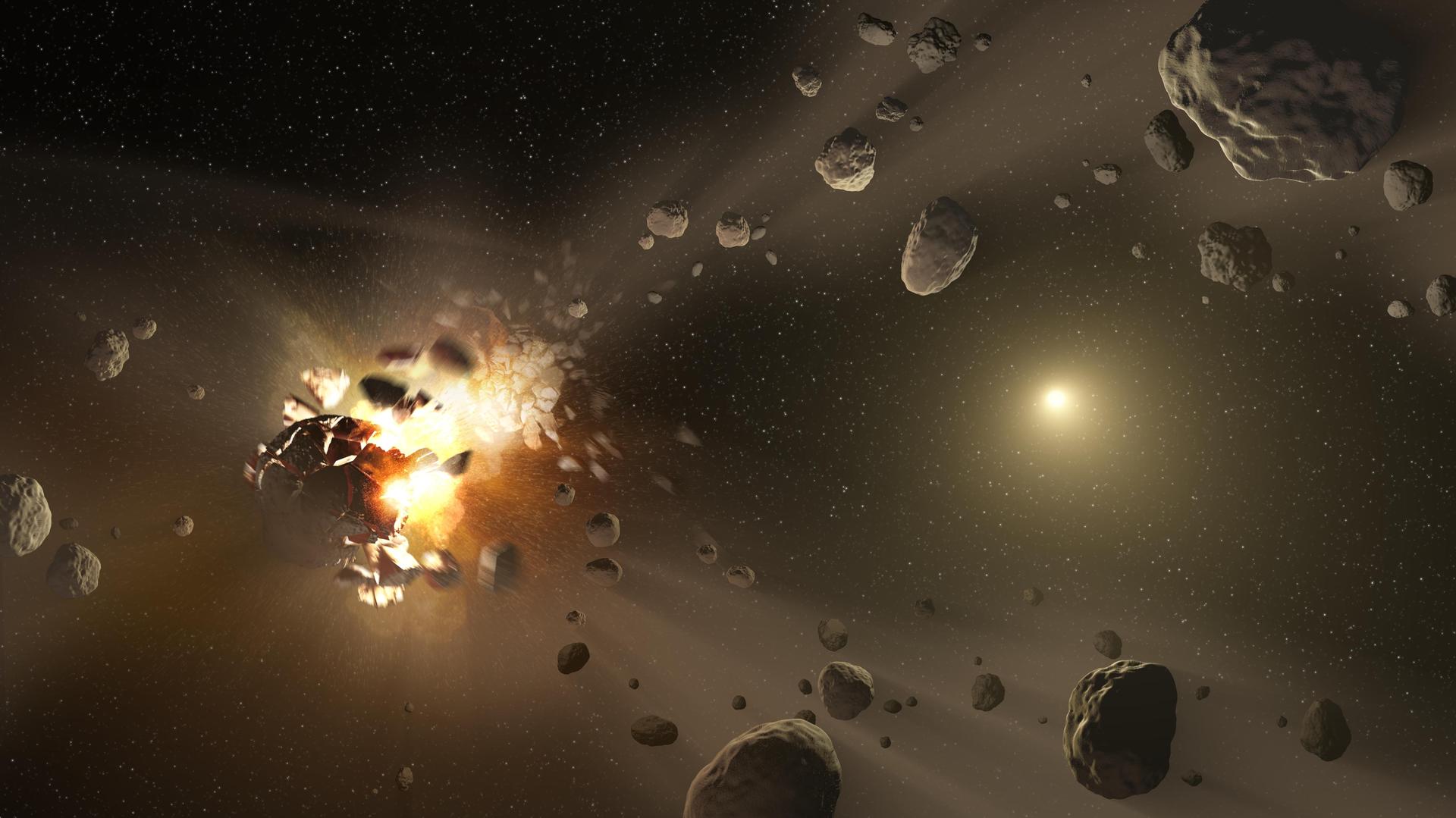
A recent laboratory experiment reveals that so-called “extremophile” bacteria possess the remarkable ability to survive asteroid impacts forceful enough to propel them into space. This finding lends significant weight to the intriguing hypothesis that such cosmic collisions could act as a natural vehicle, facilitating the dissemination of potential alien life between planetary bodies.
In a groundbreaking study published March 3 in the journal *PNAS Nexus*, researchers delved into the extreme resilience of *Deinococcus radiodurans*, a bacterium notorious for its ability to survive for years in the harsh vacuum of space.
To replicate the immense forces of asteroids slamming into a planet, scientists engineered a unique experiment. They meticulously placed samples of the space-hardy microbe between two steel plates. This “bacterial sandwich” was then subjected to incredibly hard and fast compression, designed to simulate high-velocity cosmic impacts. The primary objective was to quantify the survival rate of these microorganisms under conditions mimicking a planetary collision.
In a series of experiments designed to model the harsh conditions of interplanetary travel, scientists subjected microbes to extreme pressures mirroring those generated by asteroid impacts on Mars. These intense forces, specifically chosen to simulate the launch of planetary material and potential microbial life into space, ranged from a staggering 1.4 to 2.9 gigapascals (GPa). To put this into perspective, these pressures are equivalent to 14,000 to 29,000 times the atmospheric pressure found at Earth’s sea level.
The findings revealed a surprising resilience among the microorganisms: approximately 60% of the microbes endured impacts at 2.4 GPa. Even more remarkably, when the pressure was reduced to 1.4 GPa, an astonishing 95% managed to survive.
In a stark departure from previous research, where microbial survival rates in similar scenarios were orders of magnitude lower, this new study has uncovered an intriguing difference. The authors theorize that this remarkable resilience is a hallmark of the specific microbes examined, suggesting they are inherently stronger and more adept at enduring extreme conditions. These microorganisms demonstrated an extraordinary capacity to withstand intense radiation exposure, severe desiccation (extreme drying out), and scorching temperatures.
Researchers specifically targeted *D. radiodurans* for their experiments due to its exceptional ability to withstand the extreme conditions of space. This remarkable resilience was powerfully demonstrated in a 2020 study, which confirmed the bacterium’s survival after a three-year exposure period on the unforgiving exterior of the International Space Station—an environment notoriously hostile to most forms of life.
Researchers further scrutinized the recovery mechanisms of these microbes post-impact. By incubating the cells at a constant 98.6 degrees Fahrenheit (37 degrees Celsius) for several hours and meticulously analyzing their gene expression, a critical survival strategy emerged.
It was discovered that following high-pressure impacts—severe enough to compromise cell membranes—the microbes significantly shifted their priorities. Instead of focusing on generating new cells, their genetic activity predominantly favored repairing existing cellular damage. This intensive recovery effort also included an increased consumption of iron and robust DNA repair processes.

A fundamental understanding of how life could potentially travel between planetary bodies is crucial for future sample-return missions, the study’s authors underscored.
For example, specimens brought back from Mars already undergo rigorous protocols designed to meticulously prevent any potential Martian microbes from inadvertently hitching a ride to Earth and contaminating our planet. Should scientific evidence confirm that asteroid impacts are indeed capable of transporting microbes across the solar system, it would necessitate similar, if not enhanced, biosecurity measures for samples returned from any other celestial destination.
Here are a few options, each with a slightly different nuance, while maintaining the core meaning and journalistic tone:
**Option 1 (Direct and impactful):**
“Crucially, the study further reveals that certain life forms possess the remarkable resilience to survive the extreme violence of being ejected into space. This profound discovery could fundamentally reshape our astrobiological search strategies, influencing both where and how we look for life across the solar system.”
**Option 2 (Emphasizing the ‘rewriting’ of understanding):**
“More profoundly, the research establishes that some organisms can endure the intense forces of being violently propelled into the cosmos. This revelation significantly alters our understanding of habitability, potentially redefining both the methods and locations of our quest for life elsewhere in the solar system.”
**Option 3 (Concise and engaging):**
“Beyond its immediate findings, the study strikingly illustrates that specific life forms can withstand the trauma of being blasted into interplanetary space. This has critical implications, prompting a reevaluation of where and how scientists target their search for extraterrestrial life within our solar system.”





