
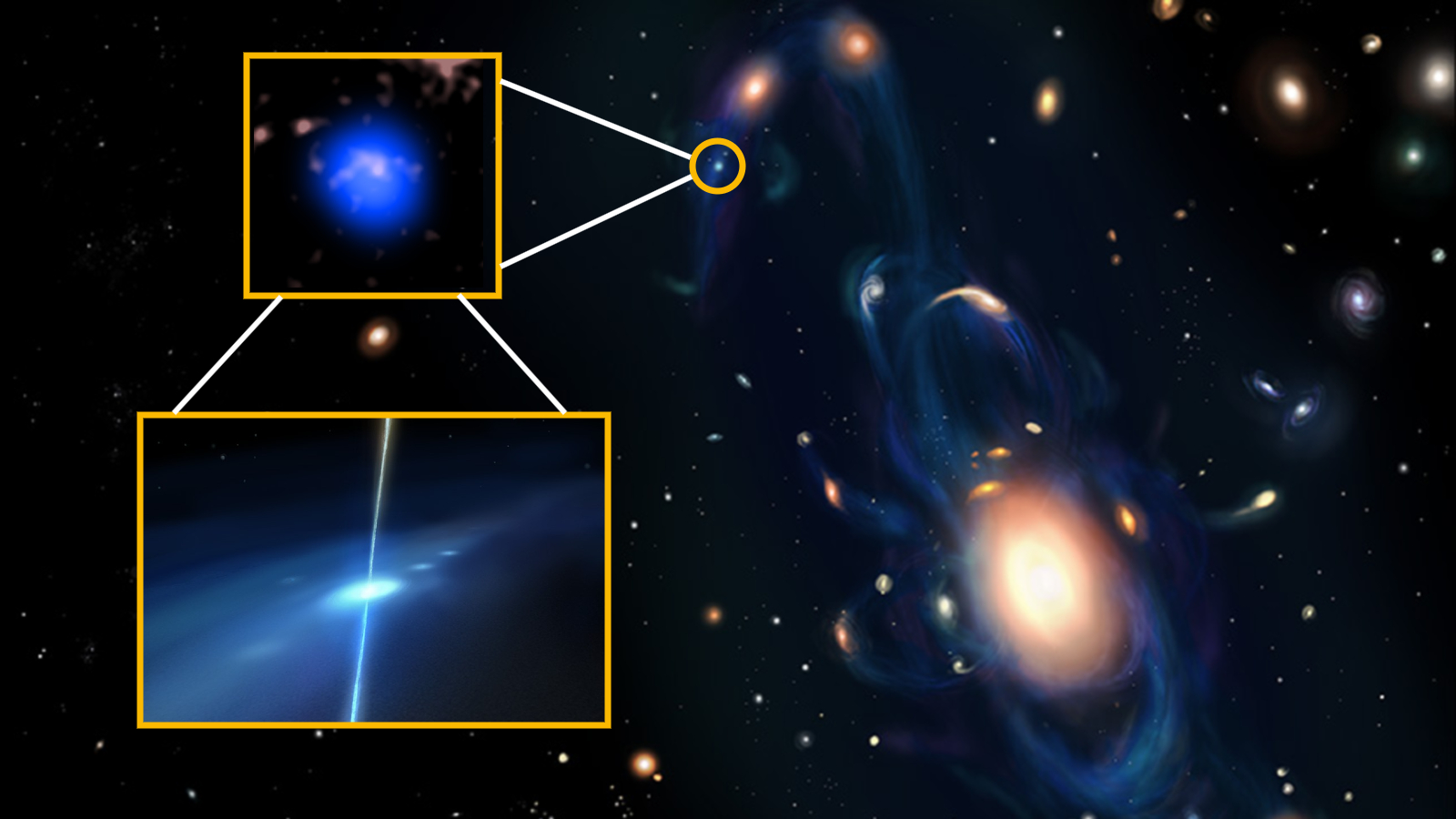
Astronomers have pinpointed a monumental cosmic explosion, born from the violent embrace of two merging neutron stars. This cataclysmic event unfolded deep within the fossilized wreckage of an ancient galactic merger, creating what scientists are calling an astonishing “collision within a collision.” Researchers claim this singular, unexpected phenomenon could provide crucial insights, potentially answering not one, but two long-standing mysteries in astrophysics.
Reporting in the March 10 issue of *The Astrophysical Journal Letters*, an international team of scientists has announced the discovery of a new gamma-ray burst (GRB) – one of the universe’s most luminous and energetic explosions. This colossal event fired a concentrated beam of radiation directly at Earth from a distance of approximately 4.7 billion light-years.
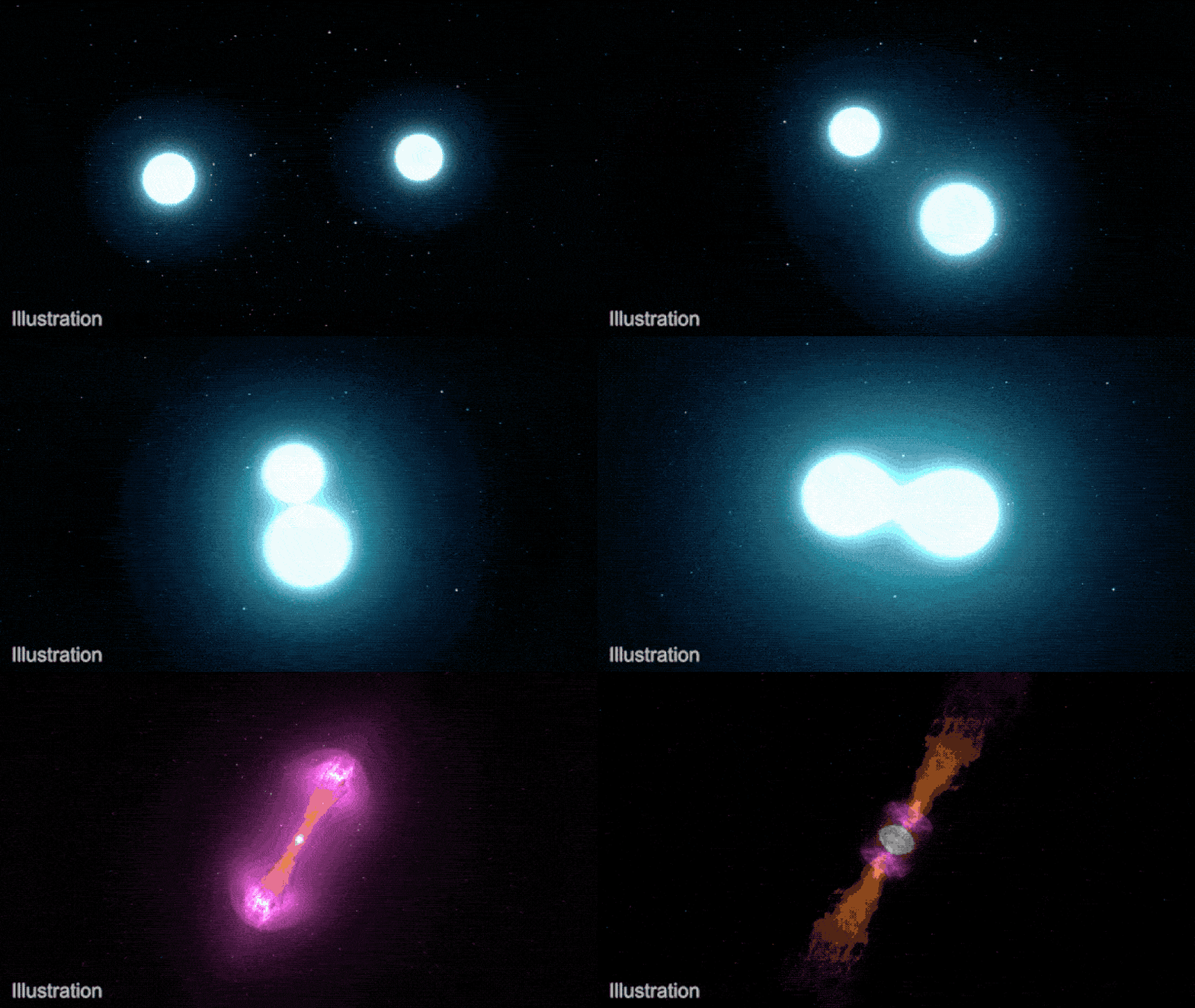
In 2023, the Earth-orbiting Fermi Gamma-ray Space Telescope identified a powerful shock wave, dubbed GRB 230906A. This cosmic blast is thought to originate from the cataclysmic merger of two neutron stars – ultradense stellar remnants that compact the mass of a sun-like star into an object merely a few miles across. Such an extraordinary collision not only forges a single, more massive celestial body but also unleashes ripples in the fabric of space-time, known as gravitational waves. Furthermore, these violent cosmic events are crucial for seeding their environments with valuable heavy elements, including gold and platinum.
Astronomers were left astonished by the detection of a powerful Gamma-Ray Burst (GRB) emanating from what appeared to be the desolate void of intergalactic space. Adding to the cosmic mystery, the burst’s origin remained stubbornly invisible across both the optical and radio spectrums. This observation significantly challenged established astronomical models, as these high-energy signals are conventionally believed to originate from the bustling, star-rich centers of massive galaxies, much like our own Milky Way.
A dedicated research team, utilizing an array of powerful Earth-orbiting observatories—including the venerable Hubble Space Telescope, the Chandra X-ray Observatory, and the Neil Gehrels Swift Observatory—successfully pinpointed the elusive source of an intriguing energy pulse. Their meticulous investigation revealed a surprising origin: the powerful emission emanated from a tiny, previously uncharted galaxy, a celestial body never before documented.
A newly identified ‘mini-galaxy’ has been pinpointed within a colossal cosmic river of gas and dust. This immense structure spans an estimated 600,000 light-years, a breathtaking distance approximately six times greater than the diameter of our own Milky Way galaxy. While researchers have not yet precisely quantified the new galaxy’s dimensions, its recent emergence from obscurity strongly suggests it is a remarkably compact stellar cluster.
Scientists propose that the colossal gas stream is a relic from a turbulent period in the early universe, when numerous galaxies collided and were subsequently torn asunder. Within this cosmic aftermath, a newly discovered mini-galaxy is nestled in a remarkably dense cloud of gas – an environment perfectly primed for the birth of new stars following such an epic celestial impact. Researchers further estimate that the progenitor stars, which ultimately gave rise to the merging neutron stars, likely ignited approximately 700 million years ago.
Astronomers have uncovered a rare and dramatic cosmic phenomenon they’ve described as a “collision within a collision.”
Eleonora Troja, an astrophysicist at the University of Rome and co-author of the groundbreaking study, elaborated on this complex event in a statement. She explained that the initial monumental impact between galaxies acted as a powerful catalyst, igniting a widespread wave of star formation. This intense period of stellar genesis, unfolding over hundreds of millions of years, ultimately culminated in the birth and eventual violent merger of neutron stars.
The recent detection of a gamma-ray burst (GRB), particularly its surprising location within a miniature galaxy, is now providing crucial new insights that could resolve long-standing astronomical anomalies.
The precise detection of a neutron star collision at its specific location marks a “game-changing” moment for astrophysics, according to Simone Dichiara, the study’s lead author and an assistant research professor in Penn State’s Department of Astronomy and Astrophysics. Dichiara emphasized that this transformative discovery holds the potential to unlock solutions to not one, but two crucial questions that have long challenged the field.

Among the most persistent mysteries in astrophysics is the occasional detection of powerful gamma-ray bursts (GRBs) originating not within the bustling star-forming regions of large galaxies, but in seemingly desolate cosmic expanses. These rare occurrences have long confounded astrophysicists, as such environments are typically not conducive to the birth of the massive stars believed to produce GRBs. However, groundbreaking new research now proposes an elegant solution: these enigmatic bursts could be emanating from previously unseen, diminutive ‘dwarf’ galaxies – faint cosmic structures that have, until now, largely eluded our telescopic gaze.
Here are a few options, maintaining the core meaning with a unique, engaging, and journalistic tone:
**Option 1 (Focus on Expanding Understanding):**
“Writing in The Conversation, Dichiara and Troja explained that the discovery unveils previously unconsidered locations for powerful cosmic events, demonstrating these collisions are not exclusively confined to massive galaxies.”
**Option 2 (Highlighting the Challenge to Previous Beliefs):**
“The discovery challenges the prevailing notion that powerful cosmic collisions are limited to large galaxies, extending their known habitats to a wider range of galactic environments, Dichiara and Troja noted in an article for The Conversation.”
**Option 3 (Direct and Impactful):**
“This breakthrough discovery revolutionizes our understanding of where cosmic collisions take place, proving they are no longer considered exclusive to large galaxies, according to Dichiara and Troja, who detailed their findings in The Conversation.”
**Option 4 (Emphasizing the ‘New Homes’):**
“Cosmic collisions have found ‘new homes’ beyond the confines of massive galaxies, a significant finding that broadens our understanding of these powerful events, Dichiara and Troja co-authored in The Conversation.”
This phenomenon could also help resolve a long-standing astronomical puzzle: the infrequent detection of heavy elements like gold and platinum, along with other dense metals, in the vast expanses of space outside large galaxies. Although researchers were unable to pinpoint the specific metals released by this particular gamma-ray burst, the explosion nonetheless offers compelling evidence that these precious elements *can* originate and disperse far beyond the primary star-forming regions typically found within major galactic structures.
Here are a few paraphrased options, maintaining a journalistic tone and conveying the core meaning:
**Option 1 (Focus on surprise/unexpectedness):**
> According to Dichiara and Troja, this discovery reveals an unforeseen pathway for the dispersal of heavy metals, a route we might not typically consider.
**Option 2 (More active voice):**
> Dichiara and Troja’s findings indicate a novel mechanism for spreading heavy metals into unexpected environments.
**Option 3 (Emphasizing the “new path”):**
> The researchers, Dichiara and Troja, have identified a new, unanticipated avenue through which heavy metals can travel.
**Option 4 (Slightly more concise):**
> This suggests a novel and unexpected route for heavy metal dissemination, as noted by Dichiara and Troja.
Each option aims to rephrase the original statement using different vocabulary and sentence structure while preserving the essential information that a new, unexpected pathway for heavy metal spread has been identified.





