One of the most profound and enduring mysteries in the universe centers on the very fact of existence itself. Cosmological theory suggests that the Big Bang, the cataclysmic event that birthed our cosmos, should have created perfectly equal quantities of matter and its intriguing counterpart, antimatter. Antimatter, essentially the “opposite” of regular matter, consists of particles like antiprotons and antielectrons. The paradox arises because these opposing forms of matter cannot coexist; whenever matter and antimatter particles collide, they instantly and completely annihilate each other, vanishing in a burst of energy.
The fundamental existence of vast cosmic structures—galaxies, stars, planets, moons, and even biological life—is predicated on a singular condition: a universe overwhelmingly dominated by matter. Were matter and antimatter present in equal measure, these complex formations would be inherently unstable, struggling to coalesce and survive.
This critical observation leads scientists to conclude that an extraordinary, primordial event in the early universe must have decisively eliminated antimatter, thus paving the way for our matter-rich cosmos to flourish. For an extended period, researchers have been diligently investigating the elusive mechanisms behind this pivotal cosmic asymmetry, seeking to unravel the mystery of how matter triumphed over antimatter.
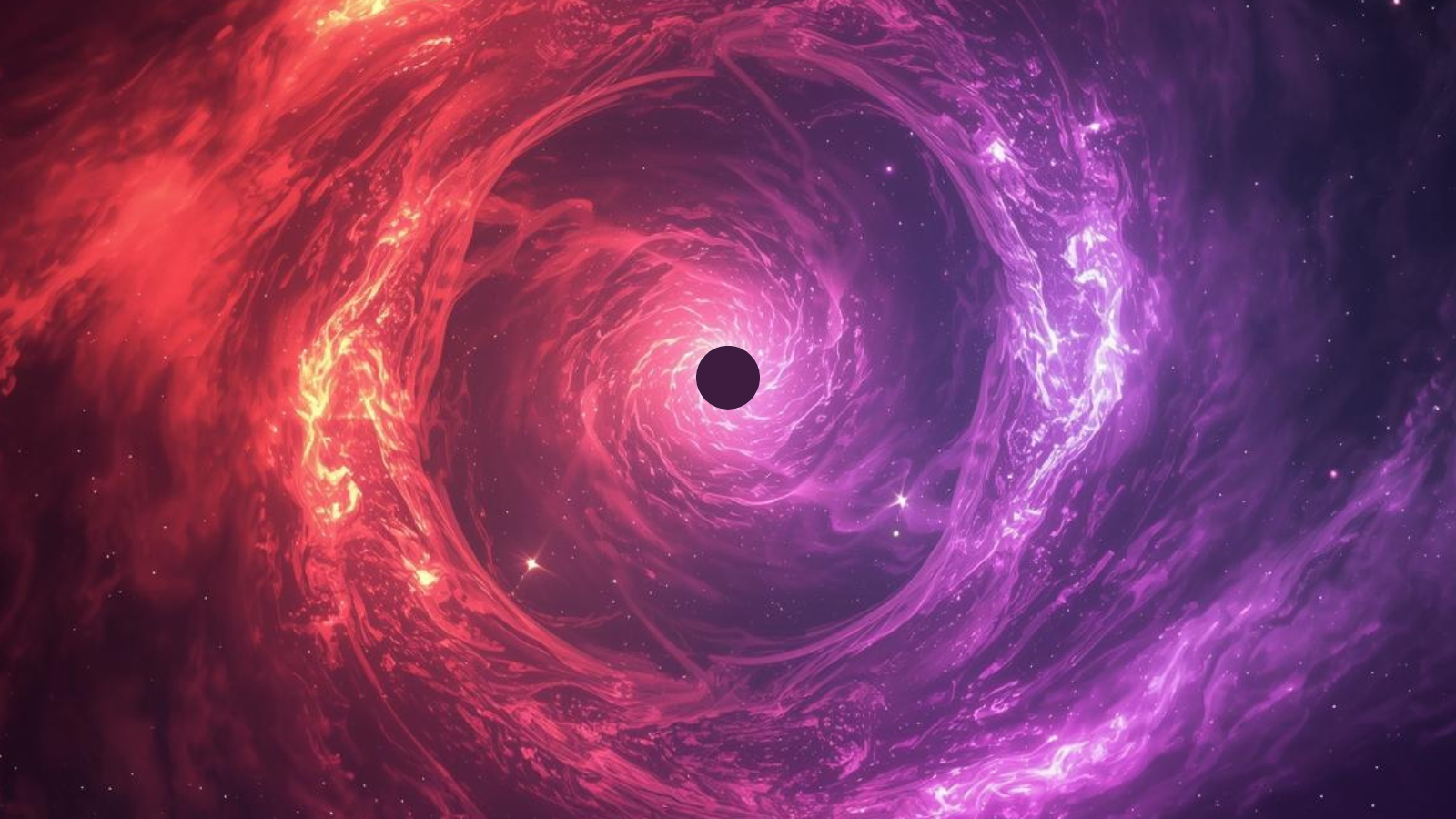
Polish theoretical physicist Nikodem Poplawski of the University of New Haven has offered an intriguing explanation for one of cosmology’s greatest puzzles: the universe’s striking imbalance between matter and antimatter. Poplawski theorizes that during the Big Bang’s earliest moments, minuscule primordial black holes formed. These nascent black holes, he suggests, then ravenously consumed vast quantities of antimatter, thus creating the cosmic asymmetry we observe today.
A compelling theory posits that hypothetical primordial black holes, forged in the intense density fluctuations of the early universe, could be the original architects of the cosmos’ most enigmatic structures.
These theoretical entities, emerging moments after the Big Bang, are considered prime candidates for seeding the colossal supermassive black holes found at the heart of massive galaxies, as well as the intermediate-mass black holes observed within dense globular clusters. Physicist Poplawski, in an interview with Space.com, highlighted their potential significance.
He further noted that while alternative models exist to explain the universe’s puzzling lack of antimatter, these often necessitate venturing beyond the established Standard Model of particle physics.
The unexpected discovery of a mass asymmetry between matter and antimatter immediately offered a profound insight: this fundamental difference could be the simple, natural explanation for the universe’s observed dominance of matter over antimatter.
Physicist Poplawski additionally underscored the existence of enigmatic processes that currently defy explanation. These phenomena, he noted, actively disrupt the fundamental equilibrium between baryons – a specific family of subatomic particles – and their antimatter reflections, known as antibaryons.
Here are a few options for paraphrasing the text, maintaining a unique, engaging, and journalistic tone:
**Option 1 (Focus on Clarity and Impact):**
> The universe’s perplexing dominance of matter over antimatter, Poplawski explained, can be attributed to a fundamental mass asymmetry combined with an uneven capture rate by black holes. Crucially, this theory accounts for the cosmic imbalance without violating the conservation of baryon number or needing new physics beyond the established Standard Model.
**Option 2 (Emphasizing the “How”):**
> According to Poplawski, the observable universe’s matter-antimatter disparity arose from two key factors: an initial mass asymmetry and the resulting preferential capture of matter by black holes. What makes this explanation particularly compelling, he noted, is its ability to address this cosmic mystery without challenging the conservation of baryon number or invoking theories outside the Standard Model of particle physics.
**Option 3 (More Direct and Concise):**
> Poplawski proposed that the observed matter–antimatter imbalance in our universe is a direct consequence of both mass asymmetry and the unequal way black holes captured these particles. Significantly, he clarified, this explanation upholds the conservation of baryon number and operates entirely within the known parameters of the Standard Model, foregoing the need for novel physics.
According to a researcher, a pivotal theory suggests that the fundamental difference in mass between antimatter and matter particles had a significant consequence in the early universe. During the crucial process of pair production, antimatter particles, being more massive than their matter counterparts, are posited to have moved at a measurably slower velocity.
A compelling explanation for the universe’s perplexing scarcity of antimatter suggests that primordial black holes preferentially captured these particles, acting as cosmic vacuum cleaners in the early cosmos.
According to physicist Nikodem Poplawski, the core principle is that the likelihood of a massive particle being gravitationally ensnared by a black hole increases significantly as its speed decreases. This fundamental dynamic led to antimatter particles being absorbed by black holes at a notably higher rate compared to their ordinary matter counterparts.
Poplawski posits that the vast majority of the “missing” antimatter was drawn into these nascent black holes. Any antimatter that evaded this gravitational capture was subsequently annihilated upon contact with matter, ultimately contributing to the matter-dominated universe we observe today.

The recent discoveries by the James Webb Space Telescope (JWST) have presented a significant challenge to our understanding of cosmic evolution. The telescope has detected supermassive black holes surprisingly early in the universe’s history, mere hundreds of millions of years after the Big Bang. This finding is puzzling because current astrophysical models suggest that such colossal objects, with masses millions or even billions of times that of our sun, require at least a billion years to form and grow. The presence of these ancient, gargantuan black holes before the universe reached its first birthday poses a considerable cosmic conundrum, demanding a re-evaluation of our theories on black hole formation and growth.
Poplawski posits that primordial black holes may have achieved an initial growth spurt by accreting antimatter.
**New Theory Suggests Primordial Black Holes Fueled by Antimatter Could Explain Early Universe Giants**
A groundbreaking hypothesis proposes that the immense black holes observed in the early universe may have experienced rapid growth by consuming disproportionately large amounts of antimatter. According to this theory, primordial black holes, formed in the universe’s infancy, preferentially devoured antimatter, which is significantly denser than regular matter. This imbalance in consumption could have led to an exponential increase in their mass.
“Primordial black holes consumed more antimatter than matter, and because antimatter was much heavier than matter, primordial black holes enormously increased their masses,” explained the researcher. “This could possibly explain how supermassive black holes recently observed in the early universe have grown so quickly.”
This novel idea offers a compelling explanation for a long-standing cosmic puzzle: how such colossal black holes could have formed and accumulated such vast quantities of mass in the relatively short period after the Big Bang. If validated, this theory would not only reshape our understanding of black hole evolution but also shed new light on the early composition and dynamics of the universe.
Here are a few paraphrased options, each with a slightly different emphasis, maintaining a journalistic tone:
**Option 1 (Focus on the challenge):**
> Despite its intriguing potential, widespread acceptance of this theory within the scientific community remains a distant prospect. A crucial step toward validating it would be the discovery of observational proof for primordial black holes. These enigmatic objects, first theorized by Stephen Hawking in the 1970s, have so far eluded definitive detection, persisting as a tantalizing but unconfirmed hypothesis.
**Option 2 (Focus on the need for evidence):**
> Significant hurdles must be cleared before this theory garners broad scientific consensus. The acquisition of empirical data supporting the existence of primordial black holes is paramount. Since their initial conception by Stephen Hawking in the 1970s, these hypothetical entities have proven remarkably elusive, leaving a notable gap in our observational understanding.
**Option 3 (More concise):**
> The scientific community is a long way from embracing this theory. Its acceptance hinges on finding observational evidence for primordial black holes, hypothetical objects first proposed by Stephen Hawking in the 1970s that have remained frustratingly elusive.
**Option 4 (Slightly more active voice):**
> For this theory to gain traction among scientists, considerable work lies ahead. The discovery of observable evidence for primordial black holes would significantly bolster its credibility. These intriguing objects, first posited by Stephen Hawking in the 1970s, have thus far remained purely theoretical, a persistent mystery in astrophysics.
Each of these options aims to:
* **Be Unique:** Uses different vocabulary and sentence structures.
* **Be Engaging:** Employs words like “intriguing potential,” “crucial step,” “enigmatic objects,” and “tantalizing.”
* **Be Original:** Avoids direct copying of phrases.
* **Maintain Core Meaning:** Accurately conveys the idea that acceptance is pending and that evidence for primordial black holes is key.
* **Use a Journalistic Tone:** Remains objective, factual, and clear.
Here are a few paraphrased options, each with a slightly different emphasis, while maintaining a journalistic tone:
**Option 1 (Focus on the challenge and future potential):**
> Investigating the early universe, a period notoriously difficult to observe, is key to understanding the potential existence of primordial black holes. According to Poplawski, future breakthroughs in gravitational wave and neutrino detection may offer the tools needed to verify this hypothesis. He also suggested that upcoming experiments could explore whether matter and antimatter particles exhibit subtle mass discrepancies at extreme densities or minuscule scales, exceeding current observational limits. Poplawski noted that recent findings on the differing decay patterns of mesons and antimesons could potentially be linked to such a matter-antimatter mass imbalance.
**Option 2 (More concise and direct):**
> The early universe, a realm largely inaccessible to current observation, is the proposed origin of primordial black holes, according to Poplawski. He anticipates that advancements in gravitational wave and neutrino astronomy could unlock the ability to test this theory. Furthermore, Poplawski pointed to the possibility of future experiments probing for minute mass differences between matter and antimatter particles under conditions of higher density or closer proximity than presently examined. He highlighted recent observations of differing meson and antimeson decay as a potential indicator of this matter-antimatter mass asymmetry.
**Option 3 (Emphasizing the new experimental avenues):**
> Poplawski proposes that primordial black holes, if they exist, would have formed in the universe’s nascent stages, a period currently challenging to study. He expressed optimism that gravitational waves and neutrinos could serve as future probes for this hypothesis. Beyond this, Poplawski outlined the potential for new experiments to investigate whether matter and antimatter particles possess slightly different masses when subjected to higher densities or examined at smaller distances than currently feasible. He referenced recent experimental data showing distinct decay behaviors in mesons and antimesons, suggesting this divergence might be connected to an asymmetry in matter-antimatter masses.
These paraphrased versions aim to be:
* **Unique:** Using different sentence structures and vocabulary.
* **Engaging:** Framing the scientific concepts in a more dynamic way.
* **Original:** Avoiding direct copying of phrases.
* **Clear and Journalistic:** Presenting the information factually and without jargon where possible.
Dr. Poplawski’s latest findings are now accessible to the public on the arXiv preprint server.