
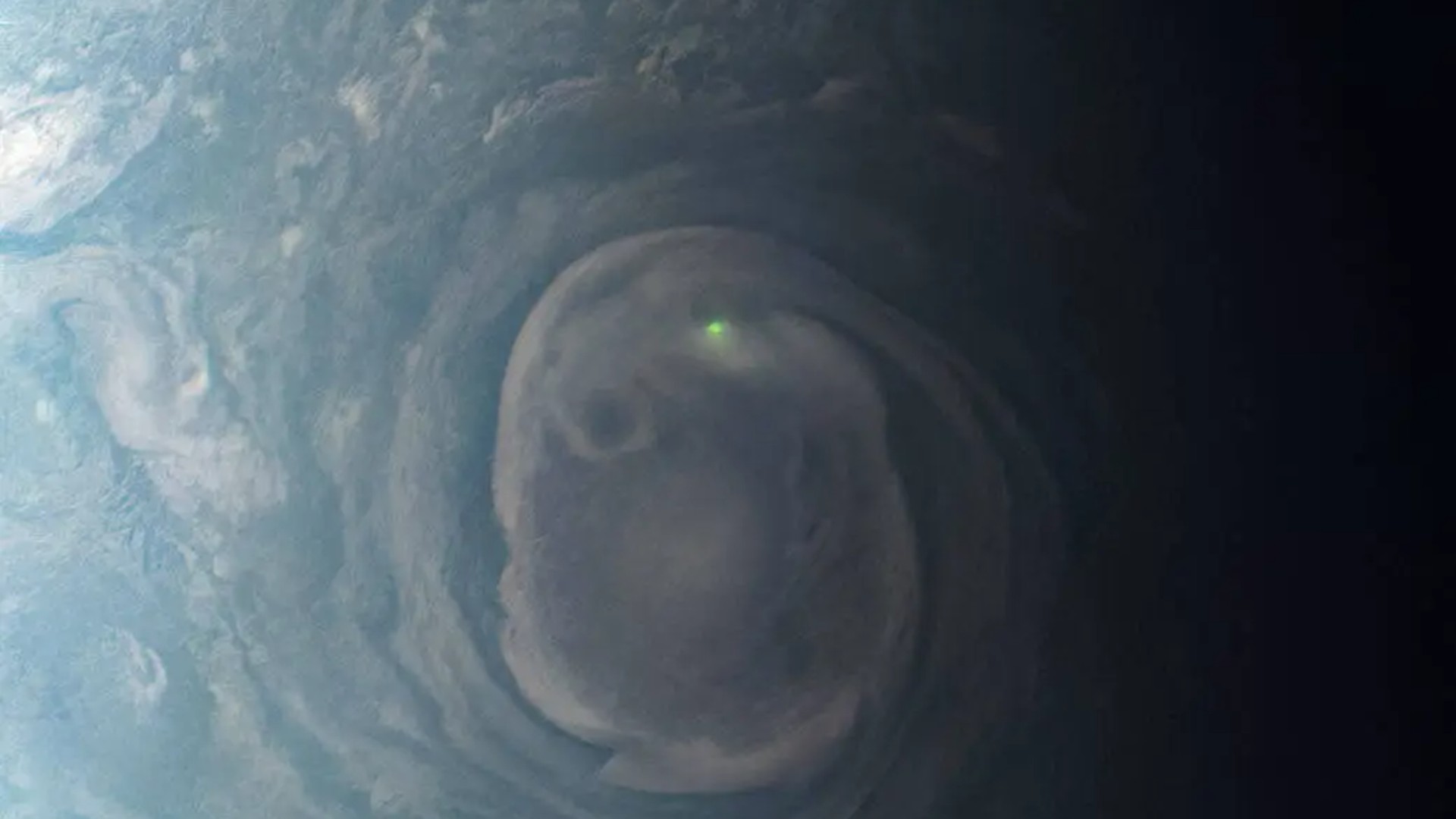
Jupiter’s lightning strikes could be vastly more powerful than those experienced on Earth, with some potentially exceeding our planet’s bolts by over 100 times, and perhaps even reaching a million times the intensity, according to recent research.
**Jupiter’s Enduring Tempests and Celestial Fireworks**
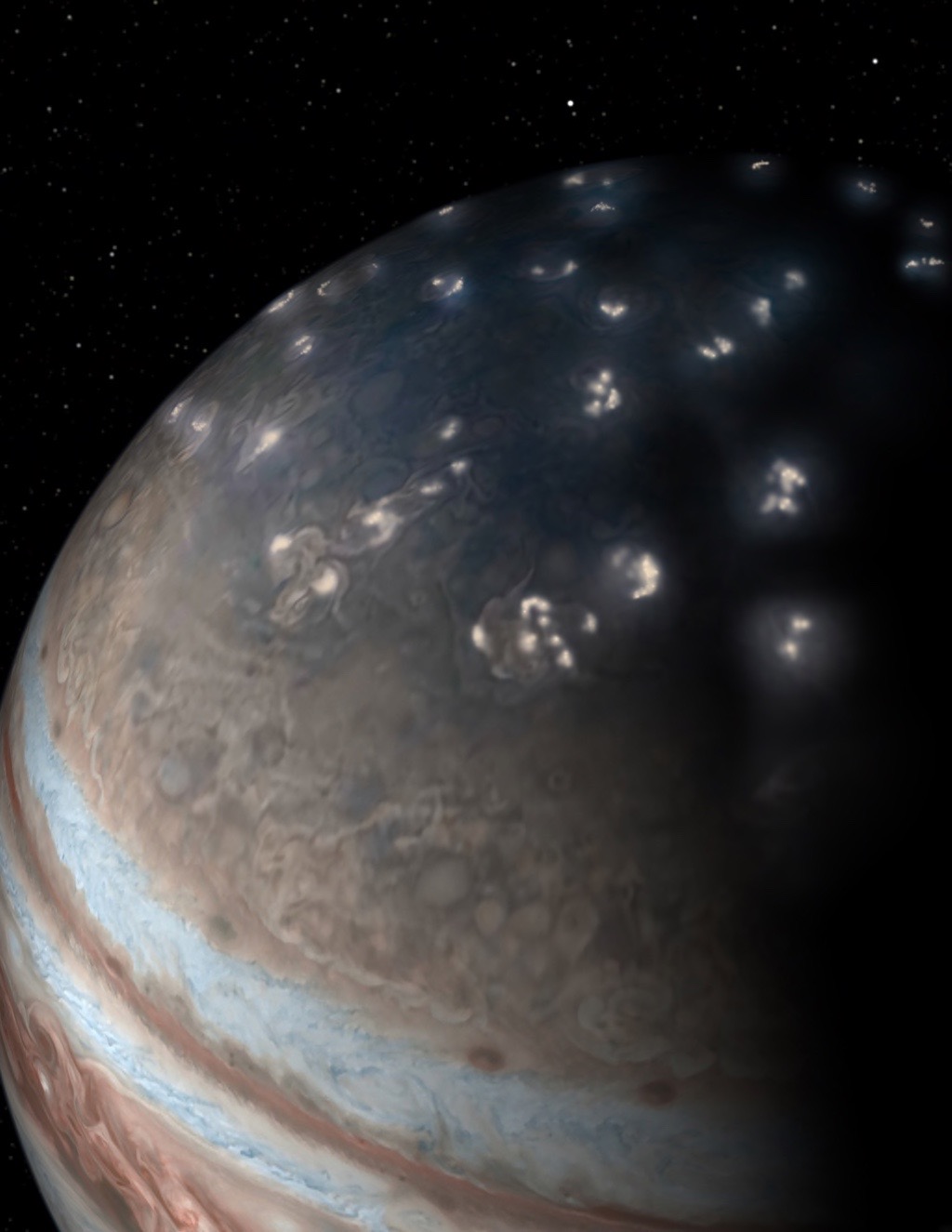
Jupiter, a colossus among planets, harbors storms of truly immense scale, some of which have raged for hundreds of years. Evidence from nearly every spacecraft that has ventured near the gas giant points to a consistent phenomenon: lightning. These brilliant flashes are often observed illuminating the planet’s dark side, offering a glimpse into the powerful atmospheric dynamics at play.
Early observations of Jupiter’s lightning, limited to detecting only the most powerful flashes on its dark side, led researchers to conclude that the gas giant’s electrical storms mirrored Earth’s most extreme lightning events, known as “superbolts.” However, this understanding shifted dramatically with the arrival of NASA’s Juno spacecraft in 2016. Orbiting Jupiter, Juno’s remarkably sensitive star-tracking camera has since revealed a prolific array of weaker, yet distinctly Earth-like, lightning flashes, challenging previous assumptions.
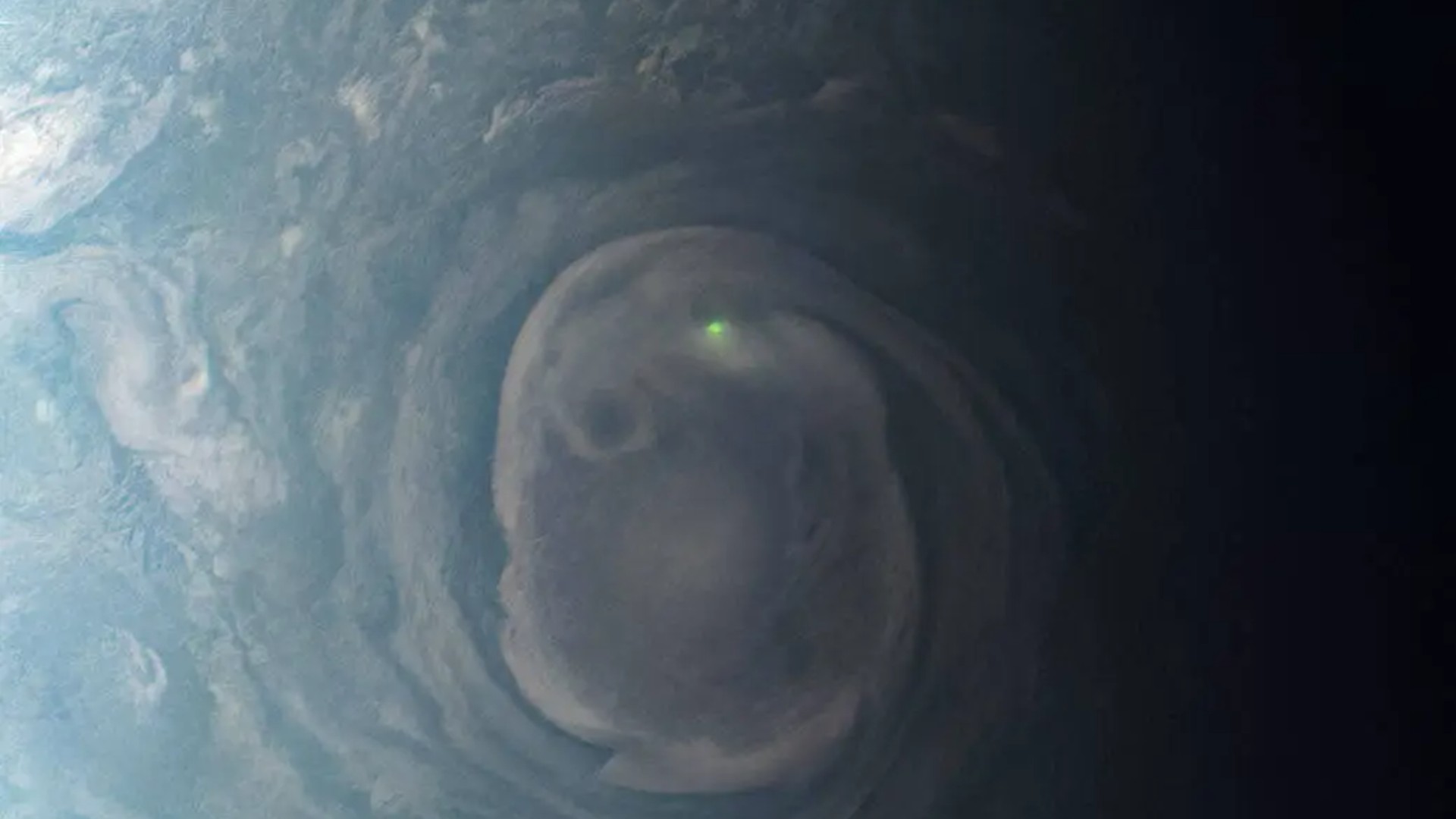
Observing lightning on Jupiter’s night side presents a significant hurdle: the gas giant’s dense cloud layers frequently obscure the very flashes scientists aim to study. This atmospheric interference complicates efforts to accurately quantify the true power of these intense electrical discharges, as explained by Michael Wong, a planetary scientist at the University of California, Berkeley, and the lead author of the research.
In a new study, Wong and his colleagues took a novel approach, focusing their analysis on data from Juno’s core instrument. This sophisticated sensor is uniquely capable of detecting the distinct radio emissions produced by Jupiter’s powerful lightning. This methodology offers a groundbreaking, more precise way to quantify the intensity of Jovian lightning, crucially circumventing the visual interference typically caused by the planet’s obscuring cloud layers.
Researchers investigating Jupiter’s electrical activity faced a significant challenge in pinpointing the origins of lightning strikes. The gas giant’s dynamic atmosphere frequently hosts multiple powerful storms, simultaneously churning across its iconic banded belts, making it incredibly difficult to attribute a specific flash detected by the Juno spacecraft to its source.
Researcher Wong likened this observational problem to an auditory puzzle: “Hearing a series of pops at a Chinese New Year’s parade and not knowing if it was exploding popcorn a few feet away or firecrackers a block away.” This analogy underscores the difficulty in distinguishing between numerous potential storm systems as the source of any given lightning event.
However, a period of unusual calm settled over Jupiter’s normally tempestuous north equatorial belt between 2021 and 2022. This lull proved advantageous for scientists, enabling them to pinpoint and intensively study individual colossal storms. Researchers meticulously tracked these atmospheric giants, leveraging a powerful combination of data from NASA’s formidable Hubble Space Telescope, the Juno spacecraft, and crucial observations provided by amateur astronomers.
Lead scientist Wong coined these enigmatic phenomena “stealth superstorms.” While these storms shared the characteristic months-long duration of Jupiter’s more conventional superstorms, a key distinction lay in their cloud towers, which reached only modest altitudes, unlike the towering structures of their more prominent counterparts.
From unparalleled proximity, NASA’s Juno spacecraft conducted vital analyses of four elusive “stealth” superstorms, meticulously scrutinizing the distinct microwave signals generated by their intense lightning activity.
Here are a few paraphrased options, each with a slightly different emphasis, while maintaining a journalistic tone:
**Option 1 (Focus on Confirmation):**
> “Working with the Juno data was incredibly rewarding, as the statistical analysis confirmed we are successfully detecting the vast majority of lightning pulses at radio wavelengths,” explained Wong to Space.com. “This addresses prior uncertainty regarding whether we were only capturing the most intense events and potentially overlooking fainter discharges.”
**Option 2 (Focus on Overcoming Doubt):**
> “It was a deeply satisfying process to delve into the statistics and discover that our Juno data is indeed capturing the bulk of lightning pulses in the radio spectrum,” Wong shared with Space.com. “Previously, there had been some doubt about whether we were only detecting the strongest signals and missing less powerful ones.”
**Option 3 (More Concise):**
> “The statistical analysis of our Juno data proved highly gratifying, demonstrating that we are capturing the majority of lightning pulses at radio wavelengths,” Wong told Space.com. “This resolves earlier questions about whether we might be exclusively detecting the most powerful pulses and missing weaker ones.”
**Option 4 (Emphasizing Achievement):**
> “A significant achievement was realizing through our statistical analysis that the Juno data is capturing the majority of lightning pulses in the radio wavelengths,” Wong remarked to Space.com. “This effectively settles a prior concern that we might have been limited to detecting only the strongest pulses, potentially omitting weaker ones.”
Each of these options aims to:
* **Be Unique:** By rephrasing sentences and using different vocabulary.
* **Be Engaging:** Using words like “gratifying,” “rewarding,” “delve,” and “significant achievement.”
* **Be Original:** Avoiding direct copying of sentence structure.
* **Maintain Core Meaning:** All versions convey that the Juno data successfully captured most radio-wavelength lightning pulses, resolving previous doubts about detecting weaker signals.
* **Use a Journalistic Tone:** Employing clear, direct language and attributing quotes.

During aerial surveys, researchers recorded an average of three flashes per second. Analysis of 613 measured pulses revealed a significant range in their intensity, with some comparable to an Earth-based lightning strike and others up to a hundred times stronger.
Here are a few paraphrased options, each with a slightly different emphasis:
**Option 1 (Focus on the comparison challenge):**
> Researchers have sounded a note of caution regarding their lightning estimates, acknowledging inherent uncertainties due to comparing Earth’s lightning at a single radio frequency with Jupiter’s emissions observed on a different wavelength. They suggest that Jupiter’s colossal electrical discharges could potentially dwarf Earth’s by a factor of one million.
**Option 2 (More direct and impactful):**
> Scientists have warned that their current estimates of lightning intensity on Jupiter are subject to significant uncertainty. The comparison, which involved analyzing Earth’s lightning at one radio wavelength against Jupiter’s at another, indicates that the Jovian storms might unleash electrical power a staggering million times greater than what we experience on Earth.
**Option 3 (Emphasizing the magnitude of Jupiter’s lightning):**
> While acknowledging the limitations of their comparative analysis – which involved different radio wavelengths for Earth and Jupiter – scientists have put forth a startling possibility: Jupiter’s lightning could be a million times more powerful than that found on our own planet. The researchers stressed that these figures carry a degree of uncertainty due to the nature of the comparison.
**Option 4 (Concise and news-oriented):**
> An element of uncertainty surrounds recent estimates of Jupiter’s lightning, scientists have reported. The comparison, which juxtaposed Earth’s lightning emissions at one radio wavelength with Jupiter’s at another, suggests that the gas giant’s electrical discharges might be up to a million times stronger than Earth’s.
Here are a few paraphrased options, each with a slightly different emphasis, while maintaining a journalistic tone:
**Option 1 (Focus on connection and function):**
> Scientists are turning to the powerful lightning flashes on Jupiter as a potential key to unlocking the secrets of its atmospheric dynamics and storm development. Much like on Earth, Jupiter’s atmosphere exhibits convective processes, a constant churning that efficiently moves heat upward from the planet’s interior.
**Option 2 (More concise and direct):**
> The electrical discharges, or lightning, observed on Jupiter may offer crucial insights into how the gas giant’s atmosphere and its formidable storms function. This atmospheric activity mirrors Earth’s own convective cycles, where heat is transported upwards through vigorous churning.
**Option 3 (Emphasizing discovery and mechanism):**
> By studying Jupiter’s prolific lightning, researchers hope to gain a deeper understanding of the mechanisms driving its atmosphere and storms. This phenomenon is believed to be intimately linked to convection, a process that, similar to Earth, involves the upward movement of heat through the planet’s turbulent layers.
**Option 4 (Slightly more evocative):**
> Jupiter’s spectacular lightning displays are shedding new light on the workings of its vast atmosphere and powerful storms. These electrical phenomena are thought to be a byproduct of convection, a process of heat transport through churning motion that is also fundamental to Earth’s weather systems.
Each of these options aims to:
* **Be unique:** They use different sentence structures and vocabulary.
* **Be engaging:** Phrases like “unlocking the secrets,” “formidable storms,” and “spectacular displays” add interest.
* **Be original:** While drawing from the original ideas, the phrasing is distinct.
* **Maintain core meaning:** The connection between lightning, atmosphere, storms, and convection on both planets is preserved.
* **Use a clear, journalistic tone:** The language is informative and objective.
Here are a few paraphrased options, each with a slightly different journalistic emphasis:
**Option 1 (Focus on the core scientific difference):**
> According to Wong, Jupiter’s convective processes diverge significantly from those on Earth due to fundamental atmospheric composition. While Earth’s nitrogen-rich air makes moist air more buoyant than dry air, Jupiter’s hydrogen-dominated atmosphere behaves in reverse. Here, moist air is denser, requiring substantially more energy to ascend. This energetic struggle, Wong explains, results in storms that unleash a powerful surge of energy upon reaching the upper atmosphere, manifesting as extreme wind speeds and prolific lightning.
**Option 2 (More dynamic and engaging):**
> Jupiter’s stormy weather operates on a different playbook than Earth’s, as explained by Wong. The key lies in their atmospheres: Earth’s nitrogen base allows moisture to rise easily, fueling storms. But on Jupiter, the overwhelming presence of hydrogen makes moist air heavier. This means storms must fight harder to ascend, and when they finally break through, they release a colossal amount of energy, driving the planet’s famously ferocious winds and spectacular lightning displays.
**Option 3 (Concise and direct):**
> The mechanics of convection on Jupiter are distinct from Earth, detailed by Wong. Unlike Earth’s nitrogen atmosphere where moisture aids buoyancy, Jupiter’s hydrogen-rich environment renders moist air heavier. This necessitates a greater energy investment for storms to rise, but consequently, their ascent releases immense power, fueling high winds and intense lightning.
**Option 4 (Emphasizing the consequence):**
> Wong sheds light on why Jupiter’s storms are so violent: a fundamental difference in atmospheric buoyancy. On Earth, nitrogen allows moist air to rise easily. However, Jupiter’s hydrogen-dominant atmosphere makes moist air denser. This increased struggle to ascend means that when a Jovian storm finally reaches the top, it erupts with immense energy, driving the planet’s powerful winds and prolific lightning.
Jupiter’s formidable lightning may share a common origin with our own planet’s electrical storms, according to researchers. They propose that on the gas giant, much like on Earth, lightning is sparked by the same fundamental process: water vapor ascends, cools at higher altitudes, and transforms into liquid droplets and ice crystals. These particles then accumulate electrical charges. Despite this similarity, the exact reasons behind Jupiter’s significantly more potent lightning strikes remain an open question, as noted by Wong.
Here are a few paraphrased options, each with a slightly different emphasis, while maintaining a journalistic tone:
**Option 1 (Focus on the core question):**
> Dr. Wong posed several questions regarding the stark differences in storm activity between Jupiter and Earth. He speculated whether the key lies in Jupiter’s predominantly hydrogen atmosphere compared to Earth’s nitrogen-rich one, or perhaps in the sheer vertical scale of Jovian storms. These colossal storms on Jupiter can tower over 62 miles (100 kilometers) high, dwarfing Earth’s storms which typically reach only about 6.2 miles (10 km). Another possibility explored by Wong is the greater energy reserves on Jupiter, where the process of moist convection might require a more significant heat accumulation before a storm, and subsequently lightning, can be generated.
**Option 2 (More direct and concise):**
> The reasons behind Jupiter’s intense storm systems, compared to those on Earth, remain a subject of scientific inquiry. As Dr. Wong noted, potential factors include the fundamental atmospheric composition – hydrogen on Jupiter versus nitrogen on Earth – or the immense vertical extent of Jovian storms, which can exceed 62 miles (100 km) in height, a stark contrast to Earth’s 6.2-mile (10 km) storms. Wong also considered whether a greater build-up of heat, facilitated by moist convection on Jupiter, is necessary to power its prodigious electrical activity.
**Option 3 (Emphasizing the scale and energy):**
> Scientists are exploring the fundamental reasons behind the dramatic differences in storm intensity between Jupiter and Earth. Dr. Wong highlighted several compelling hypotheses. One possibility is the contrast between Jupiter’s hydrogen-dominated atmosphere and Earth’s nitrogen-based one. Another significant factor could be the sheer scale of Jupiter’s storms, which can reach altitudes exceeding 62 miles (100 km) – more than ten times the height of storms on Earth. Furthermore, Wong suggested that the greater energy available through moist convection on Jupiter, requiring a larger heat accumulation to initiate storms and lightning, might also play a crucial role.
**Key changes made in these paraphrases:**
* **Varying sentence structure:** Sentences are rearranged and combined to create a more dynamic flow.
* **Synonym replacement:** Words like “key difference,” “greater distances,” “involved,” “tall,” “compared to,” “available,” “buildup,” and “generate” have been replaced with synonyms.
* **Rephrasing of questions:** The rhetorical questions are integrated into statements or rephrased as possibilities being explored.
* **Journalistic tone:** The language is more objective and declarative, characteristic of news reporting.
* **Clarity and conciseness:** Information is presented efficiently without losing its meaning.
* **Emphasis:** Each option subtly shifts the focus to different aspects of the original statement (the core question, conciseness, or the scale/energy).
In findings published on March 20th in the journal AGU Advances, the research team laid out their discoveries.





