**Comet’s Cosmic Pirouette Captured by Hubble: Astronomers Witness Unprecedented Spin Shift**
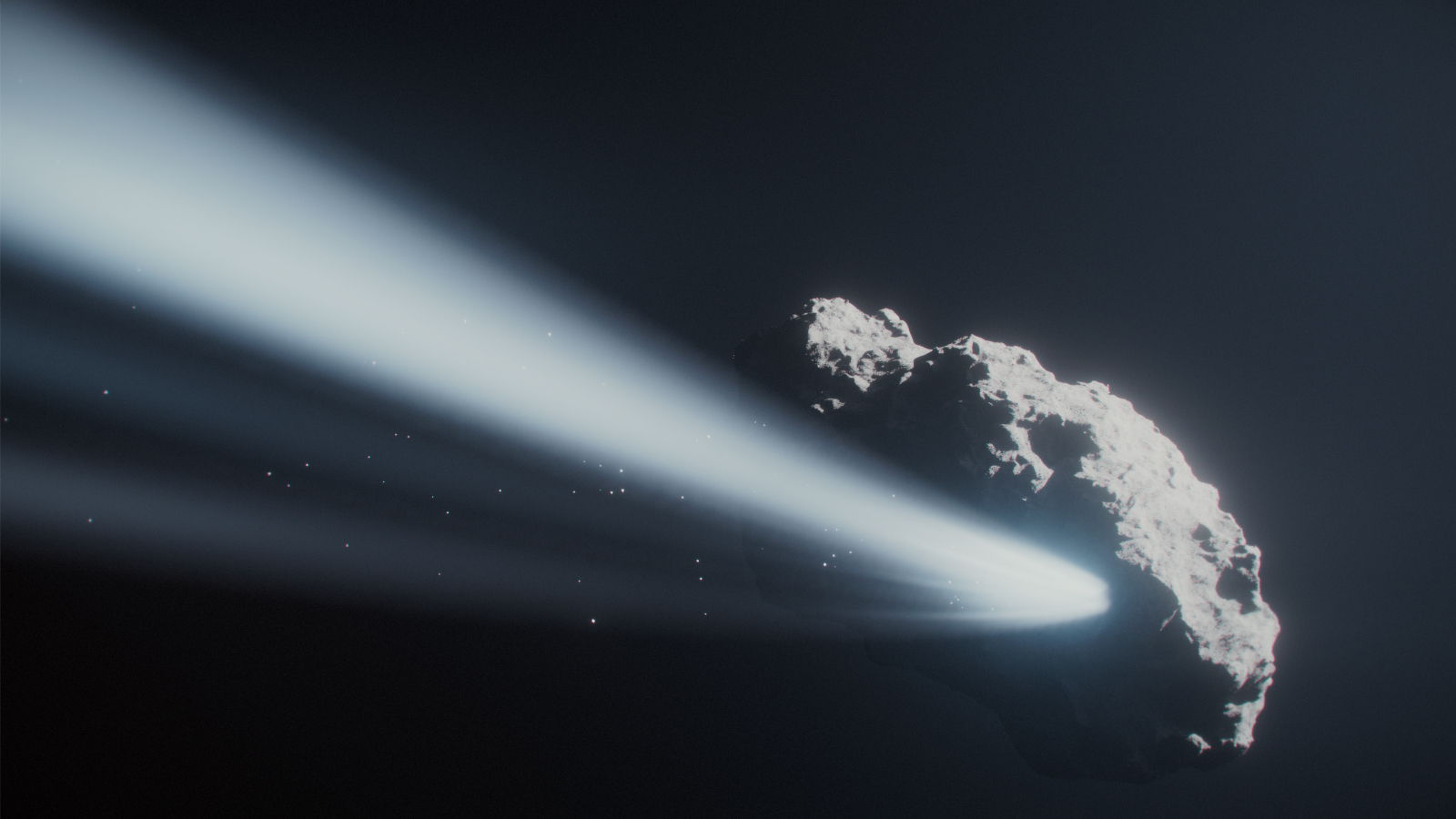
In a groundbreaking astronomical discovery, the Hubble Space Telescope has provided the first-ever visual evidence of a comet altering its own spin rate and trajectory. Newly analyzed images reveal a celestial body performing an astonishing mid-flight maneuver, a phenomenon attributed to the explosive expulsion of icy gas and dust.
This remarkable event, detailed in a recent study, was initiated by powerful “outgassing” jets. These jets, erupting from the comet’s surface, acted as miniature thrusters, forcefully propelling material into the vastness of space and, in doing so, initiated a dramatic shift in the comet’s rotational motion. Scientists are abuzz with this unprecedented observation, offering new insights into the dynamic and often surprising behavior of these ancient cosmic visitors.
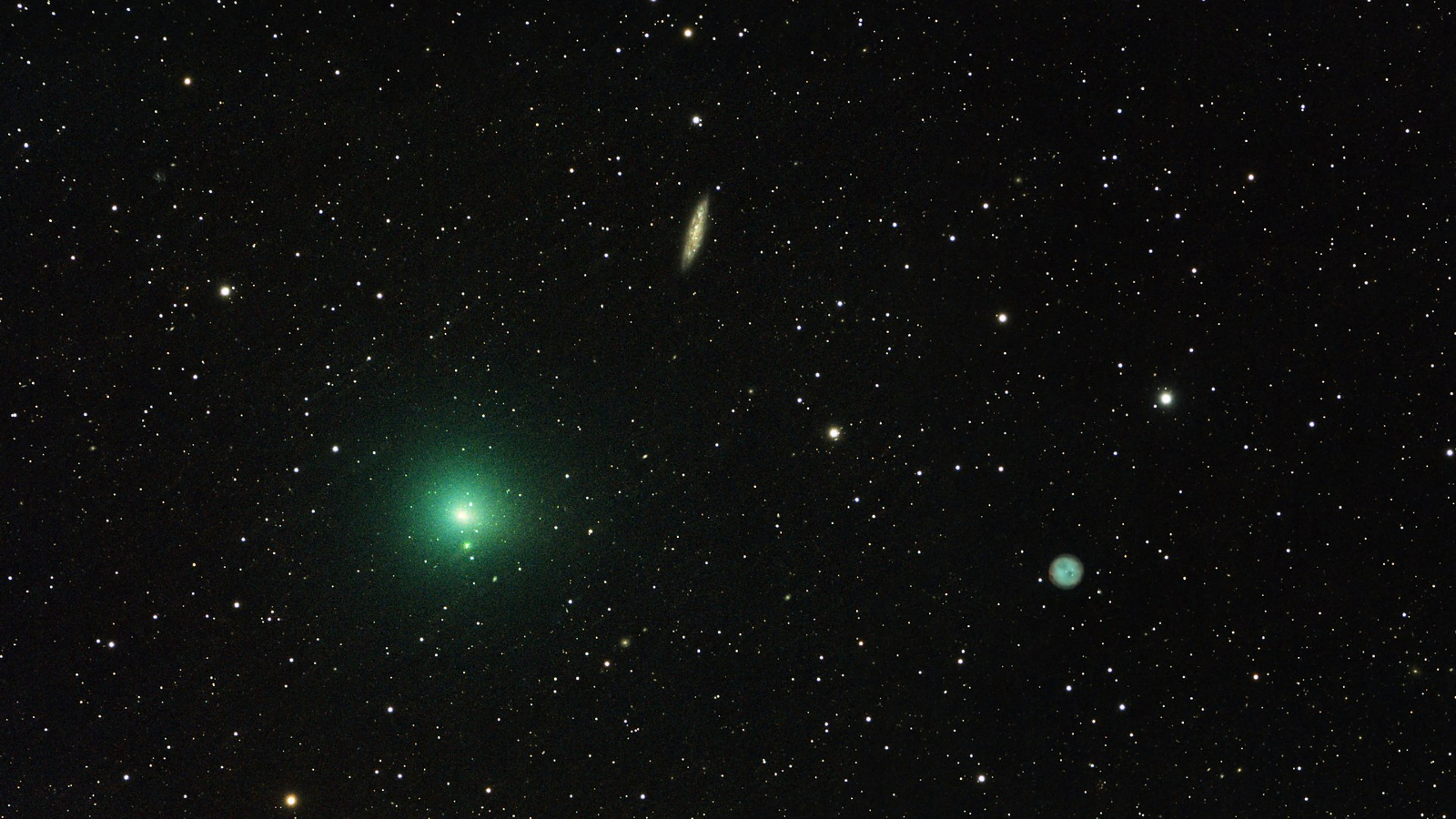
Comet 41P Tuttle-Giacobini-Kresák, often abbreviated as 41P, boasts a fascinating multi-generational discovery narrative. This celestial traveler was first identified by American astronomer Horace Parnell Tuttle in 1858. Its subsequent re-detections by French astronomer Michel Giacobini in 1907 and Slovak scientist L’ubor Kresák in 1951 cemented its lengthy, eponymous designation.
Astronomers believe 41P likely originated in the distant Kuiper Belt – a vast, icy expanse of asteroids, comets, and dwarf planets situated beyond Neptune’s orbit. For the majority of its extensive lifespan, it is thought to have charted its course around the sun on orbital cycles typically lasting anywhere from decades to centuries.
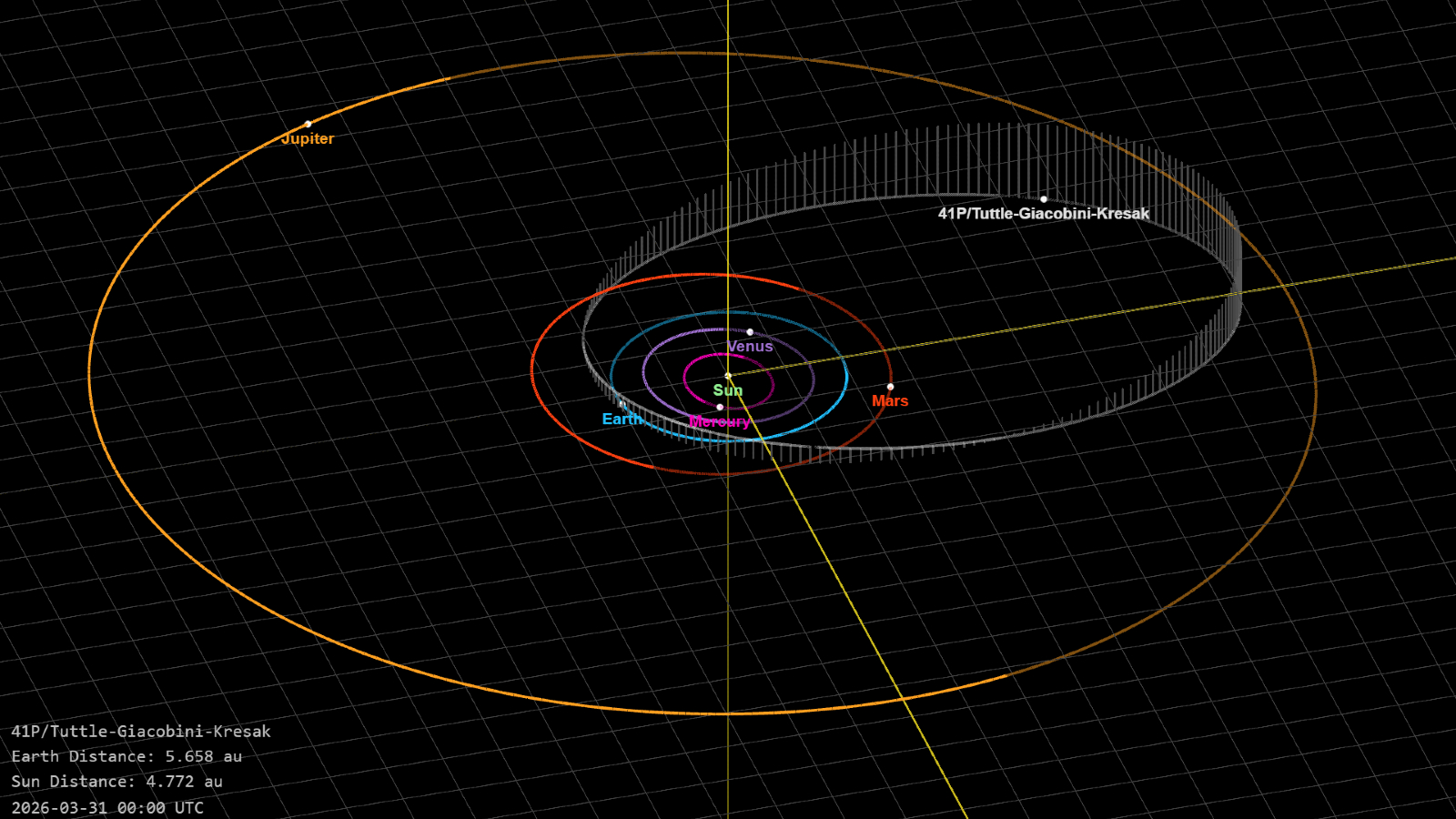
Approximately 1,500 years ago, Comet 41P’s orbital path underwent a significant transformation. A close gravitational interaction with Jupiter’s immense mass pulled the comet into a considerably tighter elliptical orbit, now completing a circuit around the Sun every 5.4 years.
Its closest approach to the Sun, a point known as perihelion, typically coincides with a near-Earth passage, rendering it distinctly visible to observers equipped with telescopes. The comet’s most recent perihelion occurred in 2022, building upon extensive observations conducted during previous close approaches in 2001, 2006, 2011, and 2017.
During its 2017 close encounter with Earth, comet 41P exhibited a puzzling phenomenon: a significant deceleration in its rate of rotation. While astronomers initially attributed this slowdown to a standard outgassing event, a wealth of critical data from the Hubble Space Telescope remained unexamined. Extensive photographic records of the flyby, captured by Hubble, were filed away and, for years, went without proper scientific scrutiny.
A new study, detailed in the March 26 edition of *The Astronomical Journal*, reveals a surprising turn of events. An astronomer, meticulously analyzing images captured by the Hubble Space Telescope in 2017, has discovered that a previously observed sudden deceleration was, in fact, followed by a hitherto unrecognized acceleration event.
UCLA astronomer David Jewitt, lead author of the study, leveraged a comparative analysis of Hubble Space Telescope images and data from ground-based observatories to meticulously track the erratic rotational behavior of Comet 41P throughout 2017.
His findings revealed dramatic fluctuations in the comet’s spin. By May of that year, 41P’s rotation had significantly decelerated, its spin period stretching to an estimated 46 to 60 hours per revolution. This represented a striking threefold reduction in speed compared to its rotational pace in March 2017.
However, a surprising reversal occurred by December 2017. The comet displayed a remarkable re-acceleration, completing a full rotation in just 14 hours. This swift recovery to a faster spin cycle was far quicker than previously understood, a detail highlighted by Space.com.
A perplexing question arose: if the comet’s rotation had been slowed by the expulsion of gases, how could it so quickly regain speed? The only logical conclusion, according to astronomer David Jewitt, is a complete reversal of the comet’s spin direction.
**Journalistic Paraphrase:**
“Imagine trying to halt a spinning merry-go-round,” he explained in a released statement. “By applying force against its current momentum, you can achieve a deceleration and ultimately, a reversal of its direction.”
Utilizing data from the Hubble Space Telescope, astronomer Jewitt has determined that the nucleus of comet 41P measures approximately 0.6 miles (1 kilometer) in diameter. This makes it roughly three times the height of the Eiffel Tower. While this might seem substantial, it is considered quite small for a comet, and this modest size could be crucial in understanding the celestial body’s peculiar actions.
**Comets are far from the inert celestial bodies they might appear to be. Nearly every comet we’ve studied exhibits a dramatic phenomenon known as “outgassing.” This is essentially the comet venting material from its core through tiny fissures in its icy shell. The trigger for this outburst is typically the comet’s journey closer to the sun. As solar radiation intensifies, it heats the comet’s interior, causing its frozen components to vaporize and escape, ultimately leading to the formation of these cracks.**
Here are a few paraphrased options, each with a slightly different journalistic emphasis:
**Option 1 (Focus on visual spectacle and scientific intrigue):**
> The solar system has recently showcased dramatic displays of cometary outgassing, with celestial bodies offering truly remarkable sights. Notably, the explosive “devil comet,” 12P/Pons-Brooks, captivated observers in 2024 with its distinctive, demonic horn-like protrusions as it swung past the sun. Last year, the interstellar visitor 3I/ATLAS also presented a fascinating spectacle, exhibiting multiple jets and an unusual “anti-tail” as it journeyed through our cosmic neighborhood.
**Option 2 (More direct and concise):**
> Recent astronomical observations have provided striking examples of cometary outgassing. The explosive “devil comet,” 12P/Pons-Brooks, made headlines in 2024 with its prominent “demonic horns” as it passed the sun. Similarly, the interstellar object 3I/ATLAS, observed last year, demonstrated impressive outgassing with multiple jets and a peculiar “anti-tail” during its transit through the solar system.
**Option 3 (Emphasizing the dynamic nature of comets):**
> The dynamic processes of cometary outgassing have been vividly illustrated in recent years. The explosive comet 12P/Pons-Brooks, nicknamed the “devil comet,” produced stunning “demonic horns” during its solar flyby in 2024. Furthermore, the interstellar interloper 3I/ATLAS, detected last year, revealed itself through multiple jets and a unique “anti-tail,” underscoring the volatile nature of these celestial travelers.
**Key changes made in these paraphrases:**
* **Synonym substitution:** “Stunning examples” became “dramatic displays,” “remarkable sights,” “striking examples,” or “vividly illustrated.” “Outgassing in action” became “displays of cometary outgassing” or “the dynamic processes of cometary outgassing.”
* **Sentence restructuring:** The original sentence was broken down or rephrased to improve flow and impact.
* **Varied phrasing:** Instead of “slingshotted around the sun,” we used “swung past the sun,” “passed the sun,” or “solar flyby.” Instead of “spotted shooting through the solar system,” we used “journeyed through our cosmic neighborhood” or “transit through the solar system.”
* **Engaging vocabulary:** Words like “captivated,” “fascinating spectacle,” “impressive,” and “interloper” add interest.
* **Journalistic tone:** The language is objective, informative, and aims to present the facts clearly.
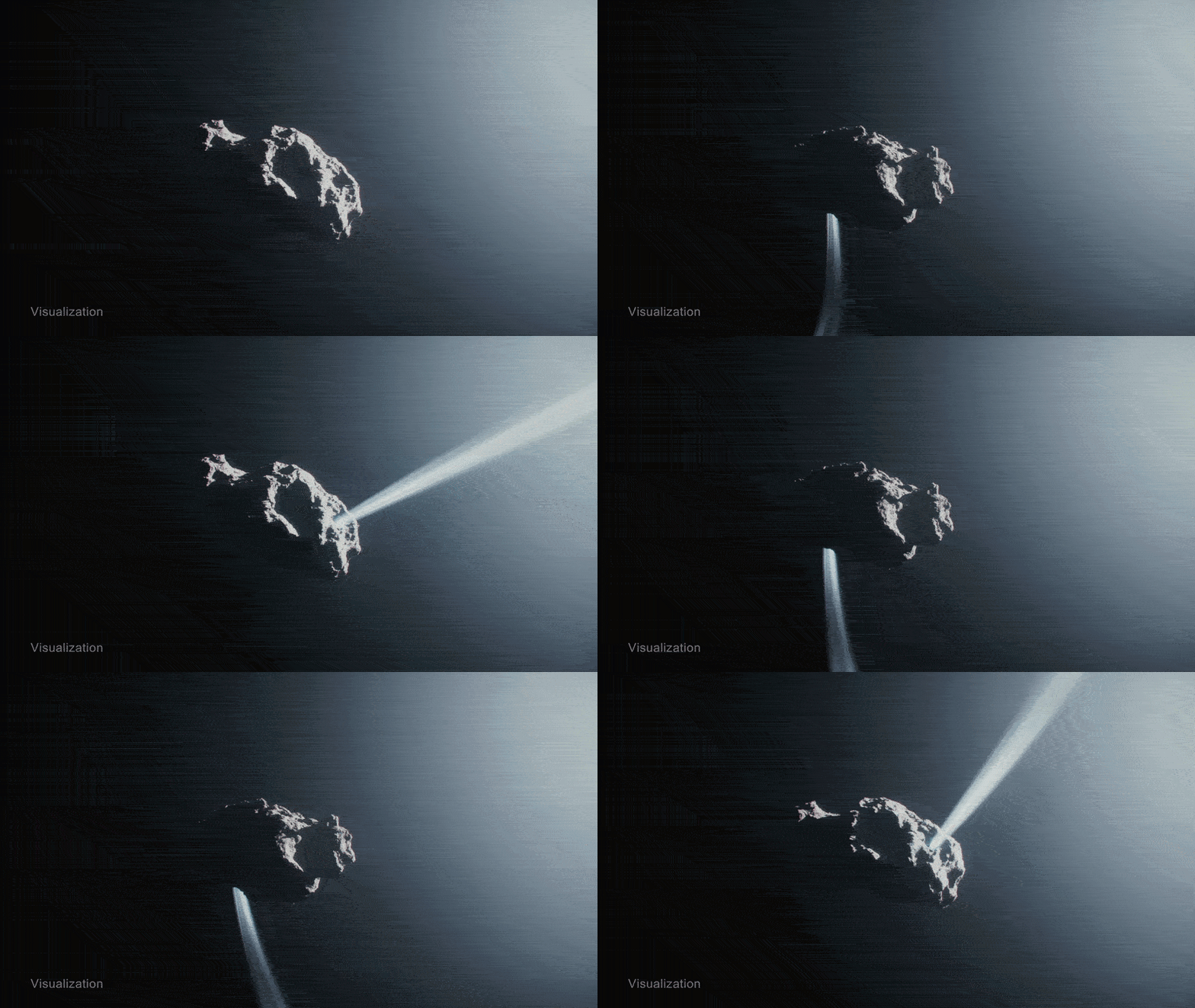
**Original Text:** Scientists previously knew that outgassing could alter the spin of a comet, but most of these objects are too large for an outflowing jet to make much of a difference before it fades away. However, 41P’s relatively small size likely enabled the comet’s jets to make a greater impact.
**Paraphrased Text:**
While the scientific community has long understood that outgassing can influence a comet’s rotation, the sheer scale of most comets typically renders their jets too insignificant to cause a noticeable change before dissipating. In the case of comet 41P, however, its comparatively diminutive size appears to have allowed its outgassing plumes to exert a more substantial influence on its spin.
According to planetary scientist David Jewitt, gas expulsions from a comet’s surface can function akin to miniature rocket engines. He explained that any unevenness in the distribution of these gas jets can significantly alter a comet’s spin, particularly impacting smaller celestial bodies.
Scientists are currently investigating a significant outgassing event observed on comet 41P, struggling to determine whether the phenomenon was driven by numerous smaller vents or a singular, colossal expulsion of material. There is a concern that if similar powerful events recur during the comet’s subsequent passes near the sun, the icy celestial body could fragment and disintegrate. This potential scenario mirrors the fate of Comet C/2025 K1 (ATLAS), which dramatically broke apart in late 2025.
“This nucleus, designated 41P, is expected to disintegrate rapidly,” stated Jewitt.