A groundbreaking new study suggests that galaxies in the early universe were tumultuous and unformed, much like restless youngsters, struggling to settle into stable structures.
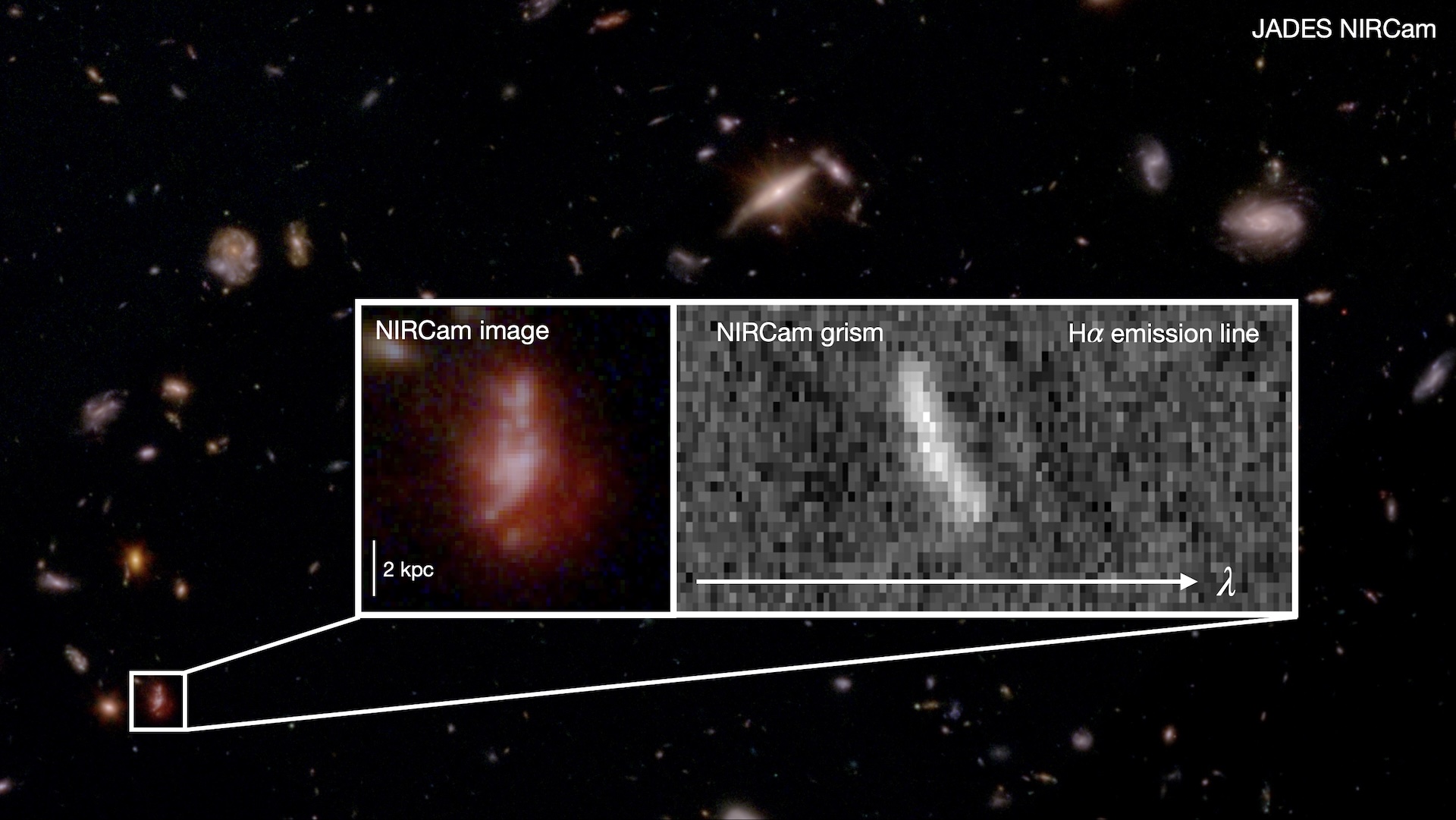
Harnessing the extraordinary power of the James Webb Space Telescope (JWST), scientists have undertaken a significant investigation, observing more than 250 nascent galaxies from the early universe. This detailed research meticulously mapped the movement of gas during a pivotal phase of cosmic development, specifically between 800 million and 1.5 billion years after the Big Bang. To put this into perspective, the universe is estimated to be approximately 13.8 billion years old.
A recent study, published Tuesday (Oct. 21) in the journal *Monthly Notices of the Royal Astronomical Society*, reveals that galaxies experienced a remarkably turbulent and dynamic youth.
A significant portion of the galaxy population is presently experiencing a tumultuous phase in its cosmic evolution, explained Lola Danhaive, a doctoral candidate at the University of Cambridge’s Kavli Institute for Cosmology.
In a notable departure from earlier investigations, Danhaive explained that his team strategically focused on less-massive galaxies. This shift in approach led to the discovery of what they termed “messy kinematics,” a phenomenon indicating that these celestial bodies possess chaotic, unstable internal motions, rather than the well-ordered, rotating disk structures typical of galaxies like the Milky Way and its galactic companions.
Scientists now believe the early universe experienced significantly greater turbulence than previously understood, a revelation attributed by Danhaive to a crucial shift in research focus. Earlier studies, he explained, inadvertently skewed their findings by primarily observing larger, more ordered galaxies, which are more readily detectable by telescopes. The latest research, however, specifically targeted smaller, less conspicuous galaxies, unveiling a far more chaotic cosmic infancy.
Astronomer Danhaive explained that the turbulent dynamics within a galaxy’s disk are directly attributed to an abundance of gas. This copious gas, he noted, not only fuels bursts of intense star formation but also triggers significant gravitational instabilities.
The research meticulously charted the evolution of galaxies, tracing their transformation from chaotic, nascent structures into the organized patterns characteristic of mature stellar systems. This groundbreaking work offers an unparalleled window into the cosmic journey of galactic development, from its earliest stages to full maturity.
According to Danhaive, early in their cosmic evolution, galaxies undergo a turbulent phase of assembly. This period is marked by vigorous star formation and high concentrations of gas, which actively disrupt the smooth, ordered motions typically found within their gas disks. Over time, however, these galaxies accumulate mass and progressively transition into a more stable state.
In cosmic terms, galaxies resembling our own Milky Way are relatively recent formations, having taken shape primarily over the past few billion years. This emergence coincided with a significant decline in available interstellar gas, much of which was progressively assimilated into new stars. Consequently, this reduced supply of free-floating gas now facilitates a more stable and less turbulent evolutionary path for mature galaxies, marking a distinct departure from the more dynamic and chaotic growth phases of their youthful past.
This pivotal research would not have been feasible without the capabilities of the James Webb Space Telescope (JWST). Strategically positioned at a distant, gravitationally stable cosmic perch, the observatory benefits from a vantage point far removed from the obscuring stray light of Earth and the Moon—a critical asset for its observations.
With its advanced infrared instruments, the JWST possesses an unparalleled ability to gaze deeper into the cosmos than any preceding telescope. This allows it to routinely discover galaxies that formed in the earliest epochs of the known universe. As Danhaive noted, the insights gleaned from this observatory, when paired with sophisticated simulations, are significantly enhancing researchers’ understanding of “bursty” star formation and the intricate influence of gas on a galaxy’s disk.
The groundbreaking research offers unprecedented insight into the intricate dynamics of early galaxy formation, a lead scientist revealed. The team’s next endeavor will delve into the complex movement of gas within individual galaxies, meticulously tracking its inflows and outflows and monitoring its chemical enrichment.
Researchers anticipate a clear distinction in the chemical composition of gas interacting with galaxies: inflowing gas is expected to be less chemically complex, often described as “pristine,” while outflowing gas will exhibit a richer array of chemical components, thanks to contributions from the galaxy’s individual stars. This detailed examination of how gas flows throughout a galaxy could provide crucial insights, potentially explaining phenomena such as why certain galaxies rotate at faster speeds than others.
Here are a few options, maintaining a clear, journalistic tone:
**Option 1 (Emphasizing potential):**
Danhaive underscored the immense, untapped potential of the James Webb Space Telescope (JWST), asserting that a wealth of discoveries still await regarding early galaxy formation. He expressed the team’s eagerness to delve deeper into these crucial cosmic origins.
**Option 2 (Focusing on future exploration):**
“There is so much more to uncover with JWST’s amazing capabilities,” Danhaive remarked, conveying the team’s strong anticipation for continued exploration into the multifaceted processes of early galaxy formation.
**Option 3 (Concise and impactful):**
The James Webb Space Telescope’s remarkable capabilities promise many further revelations, Danhaive stated, adding that researchers are keen to explore additional dimensions of early galaxy formation.